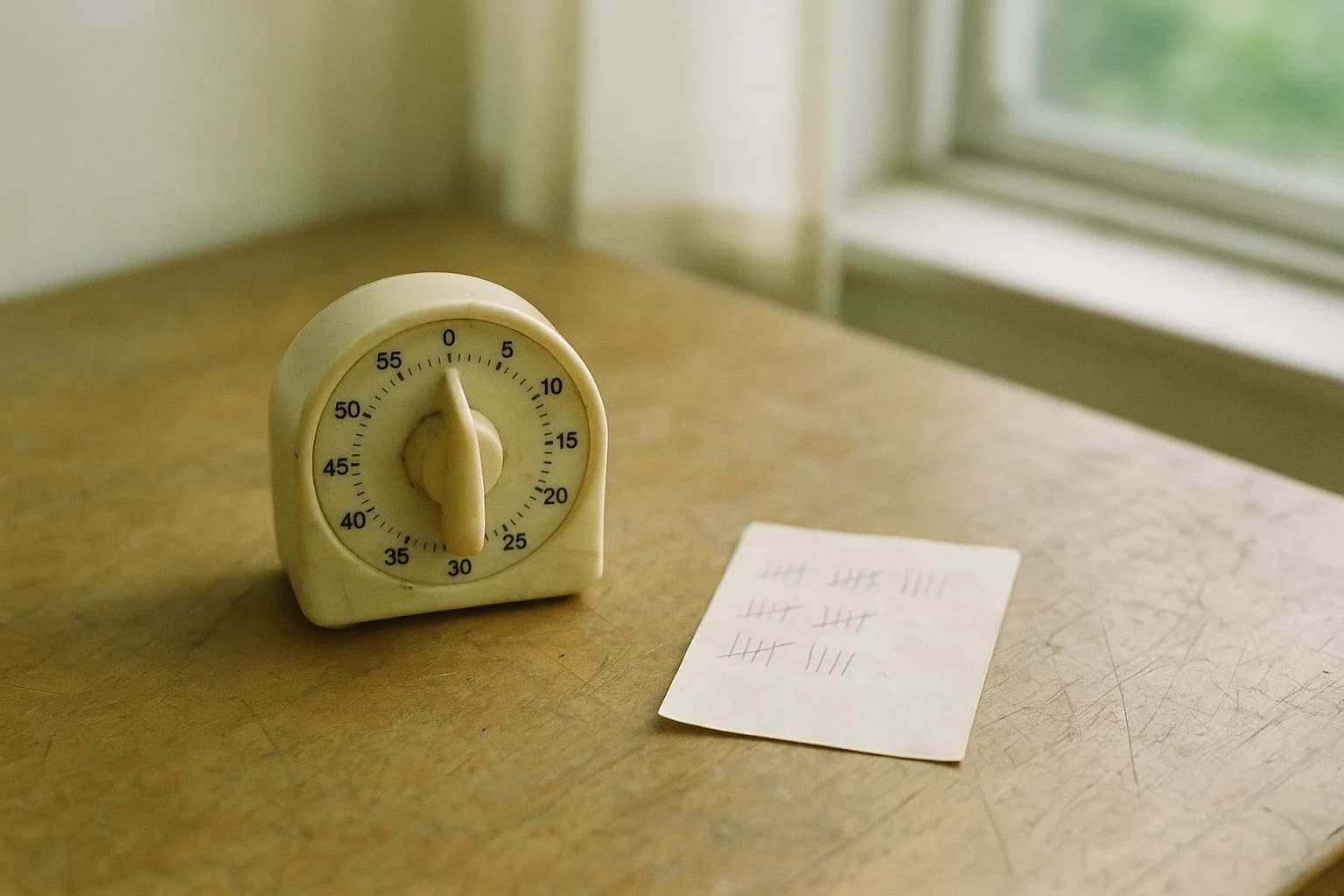
Gratitude when everything is going wrong: a harder look
Does gratitude work when everything is going wrong?
Yes, provided you change what is being asked. After a bad week, « write down three positive things » lands like a tasteless joke, and most people give up before the fourth evening. The gap between what the trials measure and what people experience in front of a notebook does not come from the data. It comes from the instruction.
One plain hypothesis accounts for the direction of the finding. In someone whose attention already loops on what is wrong, there is a lot of attentional room to win back; in someone who notices what is going well without trying, there is almost none left. The practice does not make you happier: it hands back a share of attention to the person who had committed all of it elsewhere. That is mechanical, and not remotely consoling.
Two misunderstandings sit on top of each other. The first mistakes gratitude for an emotion produced on demand, when the tested protocols ask for an operation of attention. The second credits it with a superiority no meta-analysis grants: it works, it does not work better than another practice done properly. Both come apart, and what follows takes them in turn.
This article is not a defence of the evening list. If you want the step-by-step version, it exists elsewhere, in the guide to keeping a gratitude journal (in French). What follows is for the stretches when that notebook stays shut.
Why can’t I feel grateful?
Because you are being asked for an emotion, and emotions do not take orders.
The usual wording puts the weight in the wrong place. « Feeling grateful » names an affective state, and an affective state is not an available action: you no more decide to be thankful than you decide to be hungry. Attention, on the other hand, can be pointed. That is the only thing the clinical protocols really ask for, even when their authors use the vocabulary of feeling in their titles.
An ordinary example. In February 2025, after a month in which a contract and a relationship gave way a fortnight apart, someone opens a notebook in the evening because an article promised it would help. Line one: nothing. Line two: nothing. After four minutes he writes « the coffee » and shuts the notebook feeling like a cheat. The next day he does not open it.
Nothing in that scene points to a failure of the practice. It points to a badly worded instruction: he was hunting for a sense of thankfulness, and all he had available was a verifiable fact, namely that there had been hot coffee. The fact was the right answer; it was the pass mark that was wrong.
There is also a question of timing, almost always left unsaid. In a six-week trial analysed by Bohlmeijer and colleagues, the effect on mental well-being did travel through a rise in gratitude as mood, but that mediation was measurable at four weeks and absent at two. Which means the first fortnight, during which nothing happens, is not a sign that it is not taking. It is the first half of the curve. People who stop on the fourth evening stop before the beginning.
On what the practice does once it is established, the documented benefits of gratitude meditation (in French) give the detail of the measures.
When the instruction to be positive backfires on the person following it
There is a literature on the flattering phrases people repeat to themselves, and it is not reassuring. Wood, Perunovic and Lee asked participants to repeat « I am a lovable person », then measured their mood. Among those with low self-esteem, mood got worse compared with those who repeated nothing. Among those with high self-esteem it improved, weakly. The authors conclude that such phrases can backfire on precisely the people who would need them most.
Contrary to what tends to be drawn from it, this result does not say that positive thinking is useless across the board. It says something narrower, and more useful: a statement about yourself is checkable, and when it is contradicted by what you believe about yourself, repeating it merely reactivates the contradiction. The phrase summons its own counter-argument. That is a mechanism, not a moral verdict.
What separates gratitude from affirmation lies in the nature of what you state. « There was hot coffee this morning » claims nothing about who you are. The sentence cannot be contradicted, so it summons no counter-argument, so it costs nothing to say on a day when everything else is going wrong. The content is modest. That is what makes it workable.
Then there is the social layer, and it does real damage. Hearing « look on the bright side » while absorbing a loss adds a fault to an injury, and plenty of people end up addressing themselves with the instruction they received from outside. The subject runs wider than gratitude; it is taken head-on in this piece on constant guilt (in French). Keep only this: a practice that produces shame has stopped being a practice.
What the meta-analyses actually say about gratitude
The honest picture is duller than the one on personal development pages, and steadier.
The reference meta-analysis is by Davis and colleagues, published in 2016 in the Journal of Counseling Psychology. It separates the comparisons, which changes everything. Against a group that only fills in questionnaires, gratitude protocols do better on psychological well-being (d = 0.31). Against some replacement activity, they do better on measured gratitude (d = 0.46) and on well-being (d = 0.17). On anxiety, the confidence interval crosses zero: the effect is not established.
And on that same psychological well-being, against a psychologically active comparison, meaning another serious practice, the result is d = -0.03 across nine studies. Nothing whatsoever.
That last line deserves to be read without makeup. On that outcome, gratitude is not superior to other self-help exercises: it belongs to the same family, with the same order of magnitude. The reason to pick it is therefore not that it is best, but that it asks for little, needs no equipment, and can be done in two minutes without anyone knowing. An average tool you practise beats a superior one you abandon.
The same protocol had already been tested six years earlier by a neighbouring team, in internet and mobile form, with results of the same order on repetitive negative thinking (Heckendorf and colleagues, 2019): this is not an isolated finding. The 2025 trial does deserve the same care, though. Its effects are real and recent, but the control condition was a waiting list, which mechanically inflates the gaps compared with an active comparator. What holds is not the size of the effect, it is its distribution: within the same trial, with the same protocol and the same control, the subgroup doing badly moved more than the one doing well. A difference internal to the protocol does not depend on the choice of control. That is the point that matters for the question asked here.
The blank page you are allowed to leave empty
Here is the version that holds on days when the list will not come. It runs two to three minutes, needs no notebook and no pen, and rests on an inversion of the instruction: the aim is not to find three things, it is to stay in front of the empty space without filling it.

Sit down, let your eyes close, and picture a blank inner page. Not a notebook to fill: a page simply lying there, with nothing that needs writing just now. That is the whole opening instruction, and it is deliberately underwhelming.
Then let attention sweep the last twenty-four hours, without hunting. Not the broad strokes, not the summary. Things the size of a minute: the temperature of the water, a drive where nobody sounded a horn, having been hungry and having eaten, a door held by someone whose face you never saw. If something turns up, let it settle onto the page and stay with it for two breaths. If nothing comes, stay in front of the page.
That last point is what separates this from the notebook. A page you are allowed to leave empty cannot be failed, so it produces neither cheating nor shame, so you open it again tomorrow. Regularity is the parameter the trials bring out most clearly, and anything that threatens it threatens the result.
Two implementation details, drawn from what makes people quit. First: never aim for a number. A count makes the exercise a performance, and an evening at zero then becomes a failure where it is only an evening. Second: keep the wording factual. « There was » rather than « I am grateful for ». The first form states a fact, the second asks you for a state, and you have already read above what becomes of states you order yourself to have.
For a variant that goes through the body rather than the page, the three concrete gratitudes (in French) approach the same gesture from another angle.
When this approach is not enough
It needs saying, because pages about gratitude almost always leave it out.
This practice does not belong in the weeks following a loss. None of the trials cited covers recent bereavement, and attention to what is going well, at that point, mostly produces guilt in people who needed no further supply of it. Nor does it belong when mood has been low for months, sleep is broken and nothing tastes of anything: the reported effects sit in the self-help range, and that range is the wrong scale.
Another limit, less serious and far more common. A two-minute exercise acts on attention, not on the situation. If what is wrong is an unmanageable job, unfit housing or a relationship that is damaging you, no blank page will correct it, and it would be dishonest to make the practice carry work that belongs to a decision. Gratitude is not there to make bearable what should not be borne. On that line between what can be changed and what has to be lived through, the case told here speaks better than any general rule.
Otherwise the exercise carries no known risk and needs no equipment. It does not ask you to believe that everything happens for a reason, nor to find meaning in what has landed on you, nor to consider the period acceptable. It asks you to look at the last twenty-four hours without demanding anything of them. That is a low enough bar for a month in which everything else is already demanding a great deal.
Frequently asked questions
- Should you practise gratitude while grieving?
- Not as a list, and not in the first weeks. None of the trials cited covers recent bereavement, and asking someone to name what is going well while they absorb a loss usually just hands them one more reason to feel guilty. Attention to what remains can come later, without a target number and without any obligation to write.
- How long before you feel anything?
- Two to four weeks of short practice. In the six-week trial by Bohlmeijer and colleagues, the effect on well-being travelled through a rise in gratitude as mood that was measurable at four weeks but not yet at two. A fortnight of feeling nothing is therefore not a sign of failure.
- Can forced gratitude do harm?
- As a statement about yourself, yes, for some people. The experiment by Wood and colleagues showed that repeating a flattering phrase worsened the mood of participants with low self-esteem. Noting an external fact, by contrast, asks you to endorse no self-description you believe to be false, and did not produce that backfire.
- Is a journal better than meditating on it?
- Both have been tested with comparable results, and nothing settles it for everyone. The useful criterion is which one you will still be doing in three weeks. If the notebook stays shut, the silent two-minute version has the advantage of requiring nothing written.
- Why do I only come up with ordinary things, like coffee or a hot shower?
- Because those are the right answers. The protocols tested in clinical trials almost all rest on ordinary parts of the day, not on memorable events. Reaching for something bigger is exactly what stops most people after three days.
- Can gratitude replace seeing a professional?
- No. The reported effects sit in the range of self-help tools, and the meta-analyses show no superiority over another psychologically active activity. Against low mood settled in for several months, an anxiety disorder or dark thoughts, the practice can sit alongside proper care, never in place of it.
Sources
- Effectiveness of a gratitude app at reducing repetitive negative thinking as a transdiagnostic risk factor in the general population: Results from a pragmatic randomized controlled trial — Kalon, Freund, Rinn, Watkins, Zarski & Lehr, 2025
- Thankful for the little things: A meta-analysis of gratitude interventions — Davis, Choe, Meyers, Wade et al., 2016
- Positive self-statements: power for some, peril for others — Wood, Perunovic & Lee, 2009
- Gratitude as Mood Mediates the Effects of a 6-Weeks Gratitude Intervention on Mental Well-Being: Post hoc Analysis of a Randomized Controlled Trial — Bohlmeijer, Kraiss, Schotanus-Dijkstra & ten Klooster, 2021
- Efficacy of an internet and app-based gratitude intervention in reducing repetitive negative thinking and mechanisms of change in the intervention’s effect on anxiety and depression — Heckendorf, Lehr, Ebert & Freund, 2019