Why do I always imagine the worst: what the scenario is doing there
Why do I always imagine the worst: the scenario has a job
If you always imagine the worst, the scenario is doing something for you: it hands back a feeling of control over something that does not depend on you. Faced with uncertainty, mentally drafting the worst version replaces passive waiting with an activity, and that activity looks a lot like preparation.
The trap is in what comes next. The disaster almost never arrives, and the brain has no way of telling “it did not happen” apart from “it did not happen because I thought about it”. It records the second version. The habit is therefore reinforced by false predictions, which is why it survives every argument: you already know your scenarios do not come true, and knowing changes nothing.
It is the mechanics of a superstition. The gesture does nothing, and the absence of misfortune confirms it anyway.
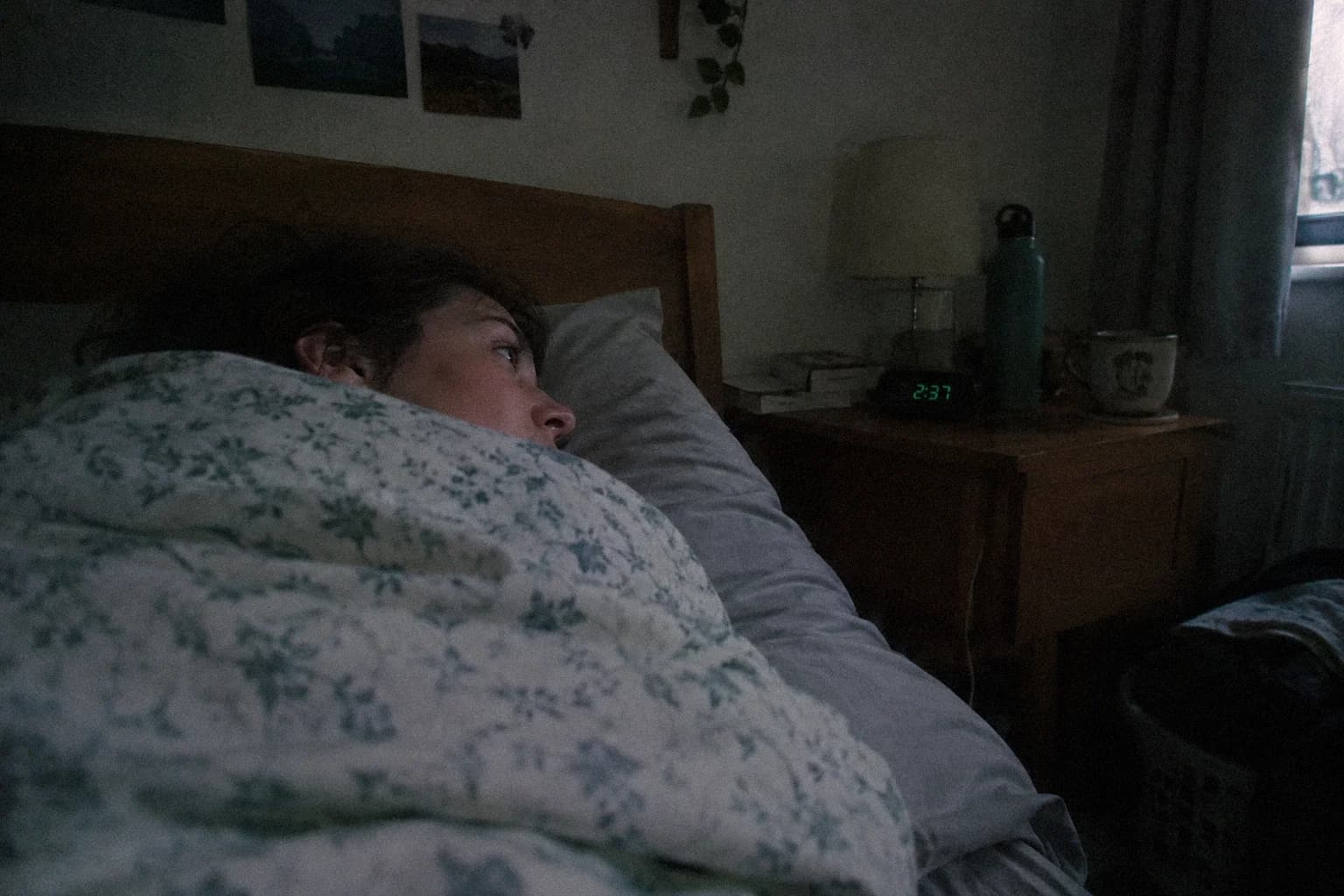
A second driver shows up at night. The foundational work on worry, carried out by Thomas Borkovec and colleagues in the early 1980s, describes an activity that is largely verbal, made of sentences and chains of reasoning rather than images, and triggered by the moments when attention has nothing else to hold. Hence the timetable: the commute, the queue, and above all the 3am waking, when nothing and nobody interrupts the next sentence.
What follows will not try to convince you that everything will be fine. The four steps are there to tell you when the scenario is actually preparing something, and to make the waiting bearable the rest of the time.
Do worst case scenarios actually happen?
Rarely, and the gap with intuition is wide. In 2020, Lucas LaFreniere and Michelle Newman asked people being treated for generalised anxiety disorder to log their worries over several days, then to check afterwards what had actually occurred. 91.4% of the logged worries did not come true.
Two cautions before using that as an argument. The sample was small and clinical, and both the worries and their outcomes were reported by participants themselves. The figure gives an order of magnitude, not a probability that applies to your situation.
It stays useful for an unexpected reason. Participants who tracked this day to day saw their worry drop, which does not come from the number but from the act: write it down, then come back and look. That is step 1.
Preparing or looping: the exit test
Half the articles on this subject explain that expecting the worst is a survival reflex to be calmed; the other half say it is a strength. Both are right, and neither tells you how to work out which one you are doing.
The version that works has a name. In 1986, Julie Norem and Nancy Cantor described defensive pessimism: high-performing people who deliberately set low expectations before a deadline, then work through everything that could go wrong so they can prepare for each item. Their anxiety does not drop, it becomes fuel, and pushing them to think positively degrades their results rather than improving them.
What separates this from ordinary worry is neither the content of the scenario nor its intensity. It is what happens at the end.
A scenario that prepares you ends in a dated action: “so I will draft a reply on Tuesday”, “so I will put that document aside”. A scenario that occupies you ends where it began. It runs again, sometimes with variations, and nothing gets decided. The same subject can produce both inside ten minutes.
Ask the question out loud, it is sharper that way: what did I decide. If the answer is “nothing, but I feel ready”, you are looping.
Step 1: Log the scenario, with a date to check it
Take three lines in a notebook or a note on your phone. First line: what you are afraid of, one sentence, in the future tense. Second: the probability you would give it, as a percentage, with no more than two seconds of thought. Third: the date by which you will know.
Then close it, and come back on that date to write down what happened.
This is not a positive thinking exercise, which is what makes it bearable: you are not being asked to believe things will be fine, you are logging a prediction. After three or four weeks you have your own rate, and yours is the one that counts, not a study’s.
A useful side effect: what is written down stops being monitored. A good share of night-time replays exist only so the subject is not forgotten.
Step 2: Play the film to the end instead of freezing it
A worst case scenario has a feature people rarely notice: it always stops on the darkest frame. The interview goes badly. The result comes in. The conversation turns. Then, credits.
The sequel is missing, and that is exactly where the charge lives. Play it properly, out loud or on paper: and then, concretely. Who do you tell. What do you do the next morning. What do you need within three days. What would still be standing in a month.
Most scenarios deflate right there, not because the sequel is pleasant but because it is unpleasant and manageable rather than vague and enormous. A precise outline can be looked at; a blurred one grows.
Two honest limits. The exercise is wrong for a rising wave of anxiety, where spelling out the worst adds fuel: do it cold, when the situation is not live. And it does not apply to a real, imminent crisis, which calls for decisions rather than an exercise.
Scenarios that survive a full play-through are not failures of the method. They are the ones that deserve real preparation, in the sense of the previous step.
Step 3: Make the waiting bearable when there is nothing to decide
That leaves the commonest case: you are waiting on a result, a call, a reply, and no action exists before it arrives. Nothing to prepare, nothing to decide, only time to get through.
Two minutes of anchoring often breaks the loop, provided the task you give attention is simple enough to ask for nothing. The most available support is a short word, placed silently on each out-breath, always the same one: here, now, calm. The in-breath stays free, and you do not alter your breathing.
The out-breath rather than the in-breath, for three reasons: it is the passive half of the cycle, it comes back twelve to sixteen times a minute without you arranging it, and a 2018 systematic review of slow breathing reports a convergence across studies towards a lengthened expiratory phase alongside markers of calm. The authors stress how heterogeneous the protocols are, so this gives a direction rather than a dosage.
Count the returns, not the thoughts. You will drift after three breaths, which is expected, and every time you come back to the word the exercise has worked once more. If the inside is too noisy for that, an outside anchor holds better: naming five visible things around you asks less than closing your eyes, and we cover that in the 5-4-3-2-1 method (in French).
Step 4: Give worries a slot, not the whole day
This fourth step is the oldest of the four and the most counter-intuitive. Rather than pushing worries away as they arrive, you give them an appointment.
The protocol, set out by Borkovec’s team in 1983, comes down to four rules. Notice your worries as they turn up. Postpone them to the slot you have set, always the same, thirty minutes in the same place. Return in the meantime to whatever you were doing. And during the slot, worry properly, looking for solutions.
The slot never goes in the evening, and never in the bedroom. Late afternoon, somewhere other than where you sleep.
What works here is not suppression but relocation: worry stops being tied to every place and every moment. Many people find that a share of the postponed subjects no longer interest them once the slot arrives. The same sorting between what can be decided and what has to be handed back runs through our guide on the need to control everything, and the backward-facing version works differently: that is the ground of rumination (in French).
When this is no longer a habit
These four steps act on a mental habit. They do not treat an anxiety disorder, and presenting them otherwise would be dishonest.
The markers that matter are neither the intensity nor the absurdity of the scenarios, but their grip on the day. Anticipation that fills most days and has done for months, that makes you avoid situations, or that comes with lasting physical tension, broken sleep and trouble following a conversation, is past the reach of an exercise. Generalised anxiety disorder is common and responds well to cognitive behavioural therapy, of which the protocols above are only isolated fragments. A GP is enough as a starting point.
There is also the case where the scenario is right. When a situation really is deteriorating, anticipation is information, and soothing it repeatedly amounts to muting a working alarm. The question then is step 3 turned inside out: what am I refusing to decide. Putting a situation back to scale afterwards is covered in this guide on regaining perspective, and living mostly in your head rather than in what is happening is the subject of this one on mental overload.
For the rest: three lines, a date, and a slot in the late afternoon.
Frequently asked questions
- Why do I always imagine the worst when it never happens?
- Precisely because it never happens. Every time the worst fails to arrive, the brain links the absence of disaster to having thought about it, although the two are unrelated. The habit is therefore reinforced by its own failed predictions, in the same way a superstition survives on the occasions when nothing went wrong. That is why reasoning does not touch it: you already know your scenarios do not come true, and it changes nothing.
- Do worst case scenarios actually happen?
- Rarely, and that is exactly why knowing it changes nothing. Almost everyone has already watched their fears fail to materialise without the habit giving way: it feeds on those non-events instead of learning from them. What moves the line is a record of your own rather than a percentage read somewhere. Allow about a month between the first logged prediction and the point where your own history outweighs the impression of the day.
- Can imagining the worst ever be useful?
- Yes, in one specific setup. Defensive pessimism, described in 1986 by Julie Norem and Nancy Cantor, means setting low expectations before a high-stakes event and then working through the ways it could go wrong in order to prepare for each one. Among people who operate this way, performance does not suffer, and stopping them tends to make it worse. The difference from ordinary worry is the exit: defensive pessimism ends in concrete measures.
- How do I stop running films in my head?
- Finishing the film works better than trying to switch it off. A worst case scenario almost always stops on the darkest frame, with no sequel. Play it out: and then what, concretely, who do you tell, what do you do the next morning. Most scenarios lose their charge there, because what follows is unpleasant but manageable. The ones that survive the exercise are the ones that deserve real preparation.
- What is the difference between ruminating and imagining the worst?
- The direction in time. Rumination goes back over what already happened and hunts for a cause or a fault; worry runs ahead to what might happen and hunts for a countermeasure. Both loop, and they often travel together, but they are not handled identically: the first mainly needs the investigation called off, the second needs the scenario given an ending and the worries given a slot.
- When should I talk to a professional?
- When the anticipation spills past the point where it would be useful: if it fills most days and has done for months, if it makes you avoid situations, or if it comes with disturbed sleep, lasting physical tension or trouble concentrating. Generalised anxiety disorder is common and responds well to cognitive behavioural therapy. A GP is enough of an entry point to start.
Sources
- Exposing Worry’s Deceit: Percentage of Untrue Worries in Generalized Anxiety Disorder Treatment — LaFreniere LS, Newman MG, 2020
- Defensive pessimism: Harnessing anxiety as motivation — Norem JK, Cantor N, 1986
- Stimulus control applications to the treatment of worry — Borkovec TD, Wilkinson L, Folensbee R, Lerman C, 1983
- Preliminary exploration of worry: Some characteristics and processes — Borkovec TD, Robinson E, Pruzinsky T, DePree JA, 1983
- How Breath-Control Can Change Your Life: A Systematic Review on Psycho-Physiological Correlates of Slow Breathing — Zaccaro A, Piarulli A, Laurino M, et al., 2018