6 exercises to relax your jaw when you catch yourself clenching
How do you relax a clenched jaw?
Start with the mouth itself: teeth apart, lips resting together, tongue settled lightly against the palate. From there, work through the muscle: a deliberate five-second clench followed by a full release, slow circles over the cheek muscle, a yawn coaxed out on purpose, and a jaw that loosens a touch each time the breath leaves. A few minutes are usually enough to bring the tension down.
The whole thing rests on one fact: at rest, your teeth do not touch. There is normally a small free gap between the arches, which dentists call the freeway space. Clench all day and that gap disappears, leaving the masseter working non stop, for nothing.
The six exercises below can be done sitting down, with no equipment, between two emails. They sit alongside broader work on releasing the small tensions of the face (in French), because a clenched jaw is almost never alone: the temples, the forehead and the neck follow.
Why do I clench my jaw when I am stressed?
Because it is a muscle you can contract without anyone seeing it. Under strain, the body raises the tone of several muscle groups at once: shoulders rise, fists close, the jaw shuts. The difference is that shoulders start hurting fairly fast, while a jaw can clench for hours before it says anything.
Researchers call this daytime clenching awake bruxism, distinct from night time grinding. Studies that ping people several times a day on their phone reach the same conclusion: in healthy adults, prolonged tooth contact takes up a meaningful share of the day, and most people are unaware of it in the moment (Colonna et al., 2023).
That is the hard part. You cannot release a muscle you do not know is working. Electromyography has also shown that awake bruxism is not one single behaviour: depending on the person, it shows up as short repeated contractions or as a long, quiet hold (Monteiro et al., 2021). Hence the sixth exercise, which is not an exercise but a reminder.
Step 1: Find the resting position again (30 seconds)
This is the reference move, the one all the others lead back to. Lips closed without pressing, teeth slightly apart, tip of the tongue against the palate just behind the upper front teeth, no pressure.
Take thirty seconds to settle into it and feel what changes. Most people notice at that exact moment that their teeth were touching, without having decided anything. The jaw relaxation advice handed out in dental practices revolves almost entirely around this position (Orthlieb, L’Information Dentaire).
Do not hold it by force. The point is not to add one contraction to correct another, but to recognise a resting point and come back to it.
Step 2: Tense, then let go, three times over (1 minute)
A muscle that has been contracted for hours will not release because you asked it to. It releases better if you take it to the opposite extreme first.
Clench your teeth on purpose for five seconds, at roughly half your maximum force, never more. Then let go all at once, letting your mouth fall slightly open. Wait ten seconds before starting again. Three cycles are enough, and you can add two variations by easing the jaw gently to the left, then to the right. The release comes after the letting go, not during the clench: that contrast is the whole point.
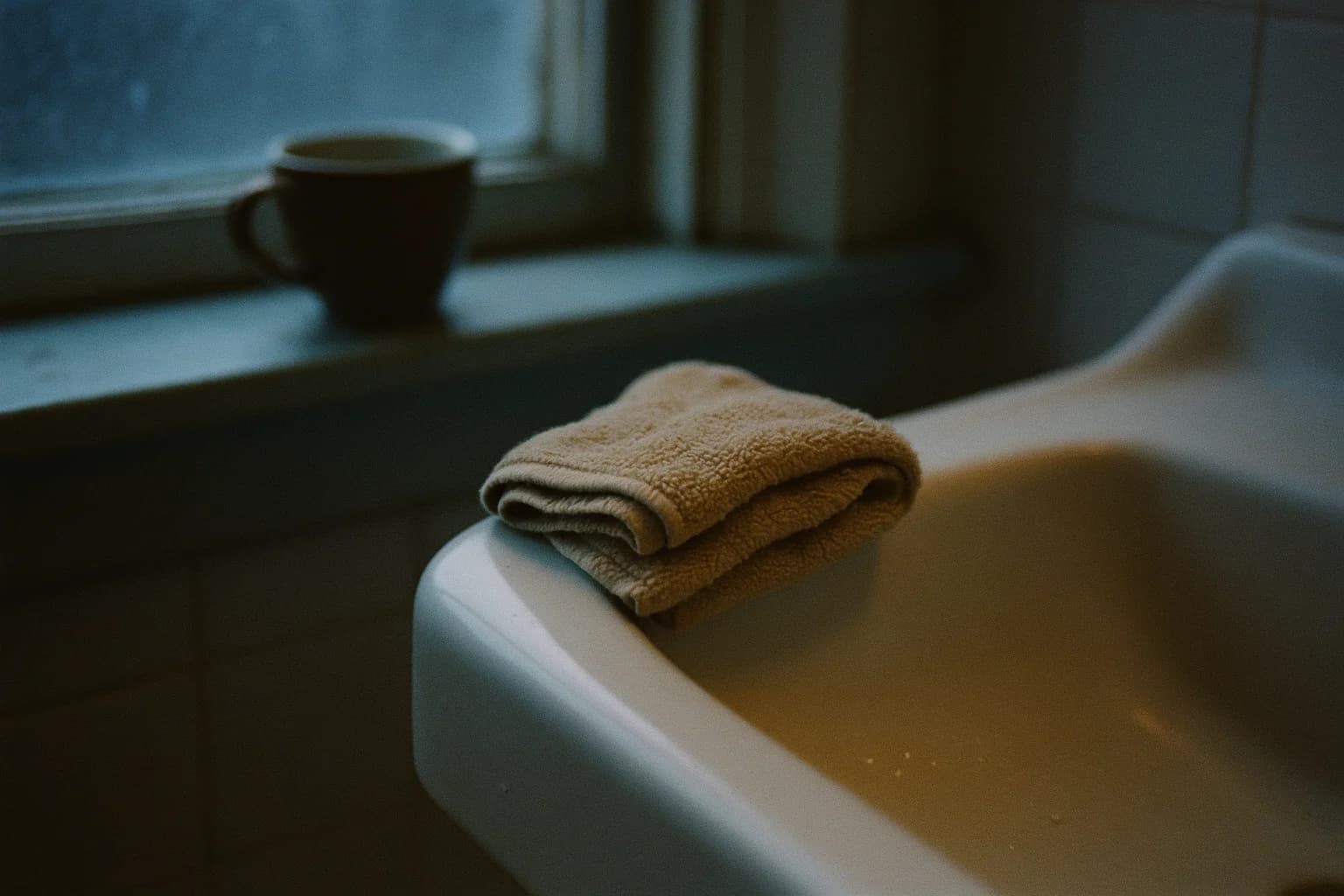
A warm washcloth held against the cheeks for two minutes beforehand makes the muscle noticeably more available. If clenching wakes up pain, stop immediately and move on.
Step 3: Trigger a yawn (30 seconds)
Yawning is the only complete jaw release the body organises on its own. You may as well use it.
Let your mouth fall slightly open, breathe in slowly through the nose, and let the jaw drop without forcing the opening. A real yawn often shows up after two or three tries. It takes the throat, the tongue, the soft palate and the diaphragm along with it, which no targeted exercise does as well. Repeat five to ten times, morning and evening.
Two caveats. Never open to your maximum if your jaw has locked before, and stop if you hear a sharp click in the joint.
Step 4: Massage the masseter in front of your ear (2 minutes)
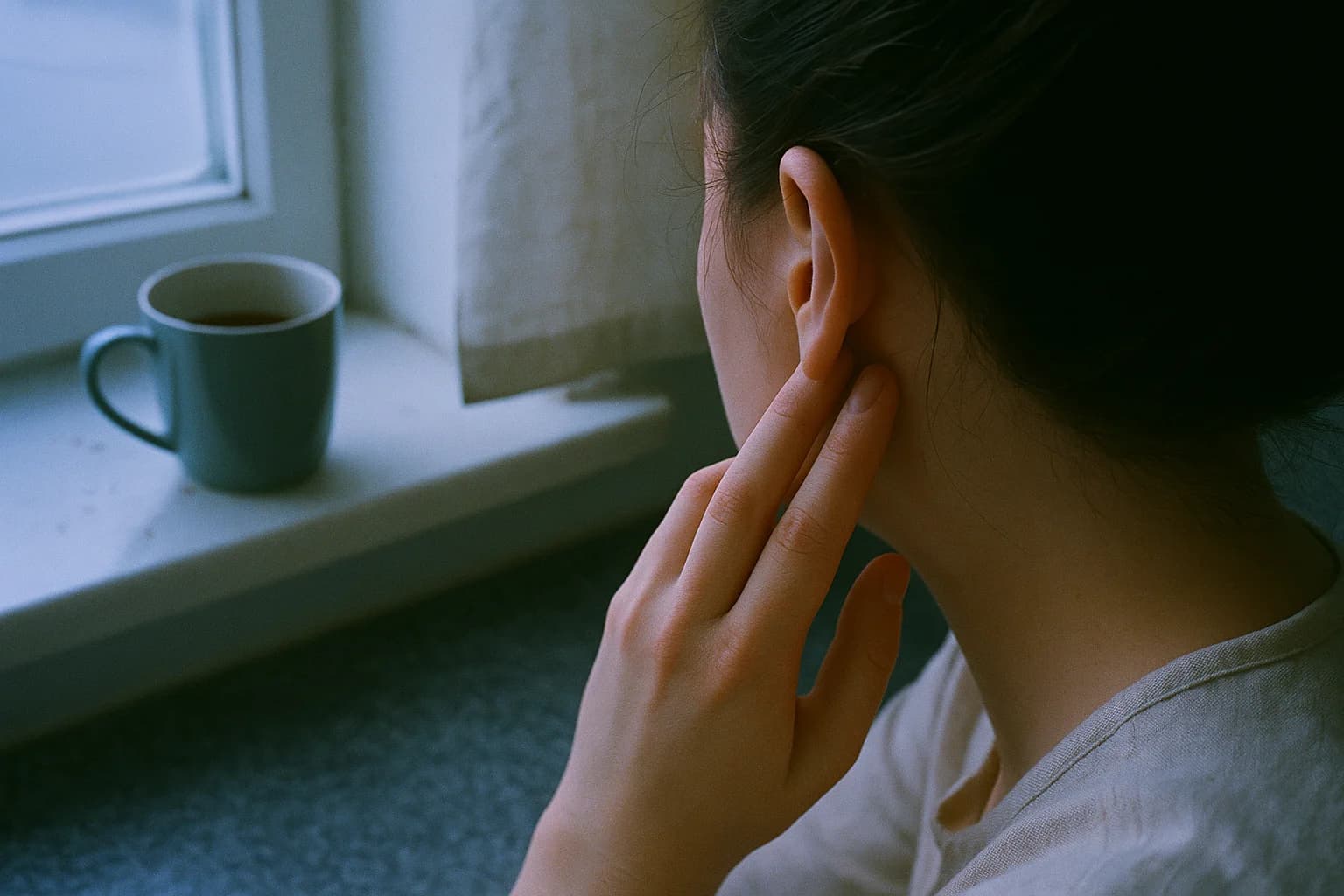
Put two fingers just in front of your earlobe, then clench once: the muscle bulging under your fingers is the masseter. One of the strongest in the body for its size, and one of the few nobody ever thinks to massage.
Let go, and make slow small circles with moderate pressure, working down towards the angle of the jaw and back up to the temple. Two minutes, breathing normally. The most tender spots are not necessarily where it usually hurts: plenty of people find their most reactive point in the temporalis muscle, above the ear.
Physiotherapists sometimes ask patients to keep those two fingers in place while the conversation moves on to something else entirely. Over a few minutes of ordinary talk, most people clench several times without noticing once.
Step 5: Let the jaw drop on the exhale (2 minutes)
This one ties the release to something you already do constantly, so it needs no effort of memory.
Breathe in through the nose over three or four counts, changing nothing. On the exhale, lengthen the breath slightly and let the jaw drop a millimetre, as if it were suspended and you were loosening the thread. Do not try to open your mouth. Ten cycles or so are plenty. The release happens on the exhale, never on the inhale, and that holds for the jaw as much as for the shoulders.
If you already practise, this is the same mechanism described in our piece on the physiological sigh (in French), applied to one precise area rather than the whole body.
Step 6: Scan your jaw several times a day (the one that sticks)
Here is the least impressive exercise, and by far the most useful. It consists of asking yourself, several times a day: are my teeth touching right now?
The question takes two seconds. If the answer is yes, you go back to the resting position from exercise 1, and that is it. The lever here is not intensity but how often the reminder fires, because clenching is unconscious and returns the moment attention moves elsewhere.
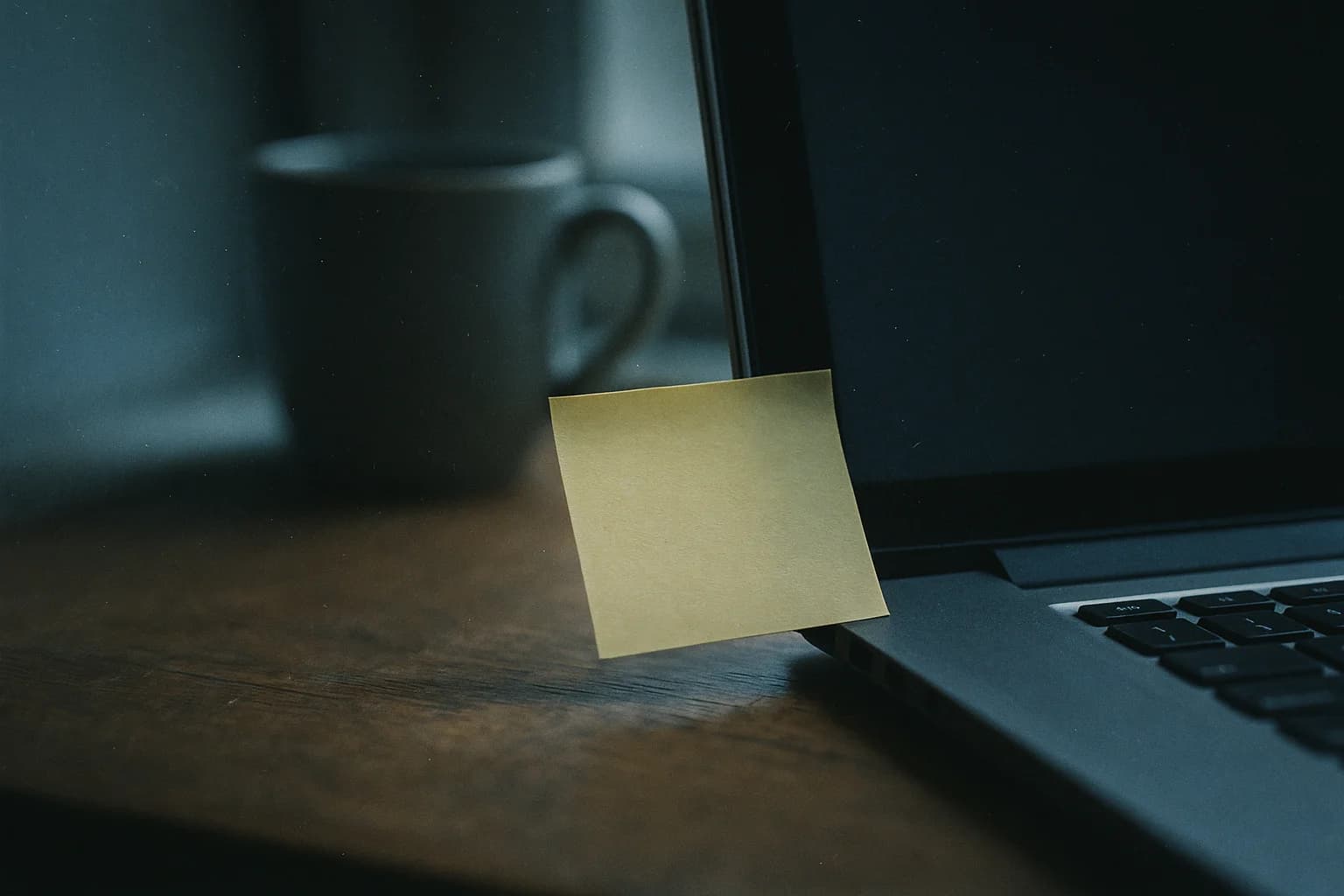
This is exactly the principle behind the biofeedback devices tested in clinical settings: an external signal that warns you at the moment of clenching. A systematic review on awake bruxism concludes that such devices do reduce excessive muscle activity, while noting that protocols remain heterogeneous and samples small (Vieira et al., 2023). A sticky note on the corner of your screen, or a quiet hourly alarm, is the same idea in homemade form.
Where to put the cues, concretely. Clenching episodes are not spread at random: they cluster on tasks that demand concentration or restraint, a difficult meeting, a tense file, a queue. So place your cues where you are most often holding something back, not in the calm moments when you are not clenching anyway. A note on the work screen, another on the steering wheel, a phone reminder in the early afternoon.
And when the reminder fires, do nothing more than the minimal move: teeth apart, tongue to the palate, one slightly longer exhale. Two seconds. The temptation is to run a full sequence, which makes the reminder expensive and quickly abandoned. A move you will do thirty times a day beats a perfect routine you will do twice a week.
This kind of scanning gets easier once you are used to listening to other areas of the body, the way a full body scan (in French) trains you to. And if you want the mechanism rather than the moves, our piece on what the jaw and tongue tell the brain (in French) covers the link between mental chatter and mouth tension.
Jaw exercises for bruxism (teeth grinding at night)
Jaw exercises help with bruxism in one specific way: they lower the resting tone of muscles that have worked all night, and they ease the morning soreness that comes with it. What they do not do is stop the grinding itself. Nobody controls their masseter while asleep, and the research to date has not shown that exercises reduce night time episodes.
A word on vocabulary first. The international consensus on bruxism distinguishes two behaviours: sleep bruxism, a rhythmic or non-rhythmic activity of the chewing muscles during sleep, and awake bruxism, the sustained tooth contact or bracing of the jaw that the rest of this article is about. In otherwise healthy people, the consensus treats bruxism as a behaviour that can become a risk factor for the teeth and the joint, not as a disease in itself (Lobbezoo et al., 2018). Grinding at night and clenching by day are related, but they are not the same problem, and they do not answer to the same tools.
What the evidence says about exercises for night grinding is modest. A systematic review of physical therapy for bruxism found only very low quality evidence that methods such as therapeutic exercise, massage and muscle relaxation improve muscle pain and activity, mostly because the studies were small and poorly designed (Amorim et al., 2018). A separate review went looking for trials of muscle stretching in bruxism and found none (Gouw et al., 2017). The management review by Manfredini and colleagues reached a similar conclusion: the only approach with enough evidence behind it for sleep bruxism is the oral appliance fitted by a dentist, while biofeedback and cognitive-behavioural approaches are not fully supported (Manfredini et al., 2015).
So here is an honest use of the six exercises when you grind at night. In the morning, exercises 2 and 4 (tense-and-release, then the masseter massage) on a jaw that woke up tight, ideally after two minutes of warmth. In the evening, exercises 1 and 5 (resting position, jaw dropping on the exhale) so that you go to bed with a lower muscle tone. And by day, exercise 6, because grinding at night does not exempt anyone from clenching when awake. Treat the exercises as care for the muscle and the night guard as protection for the teeth: the two are complementary, and neither replaces the other.
How to relax your jaw when sleeping
You cannot relax your jaw while you sleep, in the strict sense: once asleep, the decision is no longer yours. What you can do is arrive in bed with a jaw that is already at rest, and remove what tends to tighten it during the night. Three levers, in order of how well they are supported.
A five-minute wind-down before lights out. Warm washcloth on both cheeks for two minutes, then the masseter massage from exercise 4, then ten slow exhales letting the jaw drop, as in exercise 5. Finish lying down in the resting position: lips together, teeth apart, tongue resting behind the upper front teeth. If you are asleep before the tenth exhale, so much the better. This routine does not stop grinding, but it means the muscle starts the night from a lower baseline instead of from the tension of the day.
Watch what you drink and smoke in the evening. A systematic review in the Journal of the American Dental Association found sleep bruxism associated with alcohol use (odds roughly doubled), current smoking (more than doubled) and very heavy coffee drinking, on the basis of limited evidence (Bertazzo-Silveira et al., 2016). An association is not a cause, but a late drink or a last cigarette is the kind of lever you can test on yourself over a fortnight.
Do not count on stress management alone. The link between sleep bruxism and anxiety is less clear than people assume: a systematic review of eight studies found the literature controversial, with an association for some specific anxiety symptoms only (Polmann et al., 2019). Winding down in the evening is good for sleep in general, and our body scan for sleep is a fine way to do it, but it should not be sold as a cure for grinding.
If you wake up with a sore jaw, a headache at the temples or teeth that feel sensitive, the useful next step is a dental appointment rather than a longer routine. A well-fitted night guard does not stop the muscle from working, but it protects the teeth from wear and is the reference approach in the reviews above. Devices that deliver a small stimulus to the masseter during sleep have also been shown to cut grinding episodes over a few nights, though long-term data are lacking (Jokubauskas & Baltrušaitytė, 2018); they are prescribed and supervised, not bought off the shelf.
What these exercises will not fix
They act on muscular tension and on the habit of clenching. They treat neither a damaged joint, nor a faulty bite, nor the sources of the stress feeding the clench.
If the tension shows up as a lid that keeps jumping rather than a tight jaw, that is a different mechanism, covered in how to stop eye twitching from stress. Some signs call for a dental opinion rather than another round of exercises: pain lasting several weeks, a limited or locking mouth opening, a painful click, visibly worn teeth, or waking up with a sore jaw. These exercises do not replace an examination, and doing them harder compensates for nothing.
One last thing, less obvious: aim to feel the resting position, not to control it. Plenty of people leave their first sessions monitoring their jaw non stop, which adds tension exactly where we were trying to remove some. Two minutes in the morning, two in the evening, and a handful of reminders across the day do more than constant vigilance.
Frequently asked questions
- How often should you do jaw relaxation exercises?
- Two minutes in the morning, two in the evening, plus a handful of two-second reminders spread across the day. Frequency matters more than intensity: a minimal move you repeat thirty times a day beats a perfect routine you do twice a week, because daytime clenching returns the moment attention moves elsewhere.
- What is the correct resting position for the jaw?
- Lips closed without pressing, teeth slightly apart, and the tip of the tongue resting against the palate just behind the upper front teeth, with no pressure. At rest the teeth do not touch: there is normally a small free gap between the arches, which dentists call the freeway space. The position is something to find again, not to hold by force.
- Is clenching your jaw during the day the same as bruxism?
- Daytime clenching is called awake bruxism, and it is distinct from night time grinding. It is almost always unconscious: studies that ping people on their phones several times a day find that most healthy adults are unaware of prolonged tooth contact in the moment. That is why a regular reminder works better than any single intense exercise.
- Does heat help relax a tight jaw?
- Yes, as a preparation. A warm washcloth held against the cheeks for two minutes before the exercises makes the masseter noticeably more available, so the tense-and-release cycles work more easily. Warmth on its own does not address the clenching habit, which is why it pairs with the reminders.
- Can these exercises fix teeth grinding at night?
- No. They lower the tone of muscles that have worked all night and ease the morning soreness, but nobody controls their jaw while asleep, and the available evidence does not show that exercises reduce night time grinding episodes. The reference approach for sleep bruxism is an oral appliance fitted by a dentist; the exercises care for the muscle, the appliance protects the teeth.
- When should you see a dentist about jaw tension?
- When pain lasts several weeks, when mouth opening is limited or the jaw locks, when a click in the joint is painful, when teeth are visibly worn, or when you wake up with a sore jaw. The exercises do not replace an examination, and doing them harder compensates for nothing.
Sources
- Ecological Momentary Assessment of Awake Bruxism Behaviors: A Scoping Review of Findings from Smartphone-Based Studies in Healthy Young Adults — Colonna et al., 2023
- Electromyographic Patterns and the Identification of Subtypes of Awake Bruxism — Monteiro et al., 2021
- Effectiveness of Biofeedback in Individuals with Awake Bruxism Compared to Other Types of Treatment: A Systematic Review — Vieira et al., 2023
- International consensus on the assessment of bruxism: Report of a work in progress — Lobbezoo et al., Journal of Oral Rehabilitation, 2018
- Management of sleep bruxism in adults: a qualitative systematic literature review — Manfredini et al., Journal of Oral Rehabilitation, 2015
- Effect of Physical Therapy in Bruxism Treatment: A Systematic Review — Amorim et al., Journal of Manipulative and Physiological Therapeutics, 2018
- Bruxism: Is There an Indication for Muscle-Stretching Exercises? — Gouw et al., International Journal of Prosthodontics, 2017
- Association between sleep bruxism and alcohol, caffeine, tobacco, and drug abuse: A systematic review — Bertazzo-Silveira et al., Journal of the American Dental Association, 2016
- Association between sleep bruxism and anxiety symptoms in adults: A systematic review — Polmann et al., Journal of Oral Rehabilitation, 2019
- Efficacy of biofeedback therapy on sleep bruxism: A systematic review and meta-analysis — Jokubauskas & Baltrušaitytė, Journal of Oral Rehabilitation, 2018
- Relâcher les muscles de la mâchoire : 12 conseils — Orthlieb, L’Information Dentaire, 2019