Head feels heavy from stress: it is not your skull that weighs
Why your head feels heavy when you are stressed
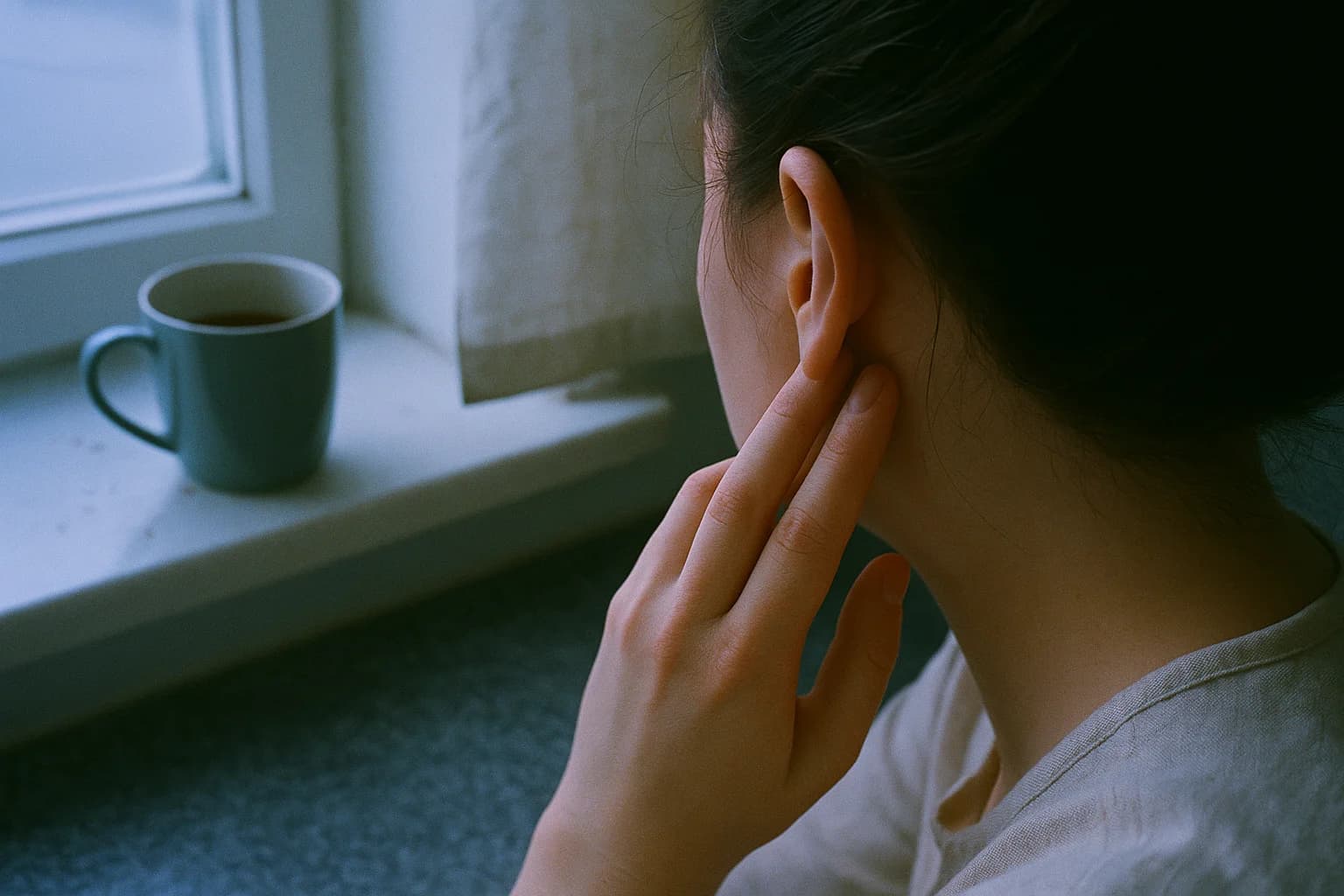
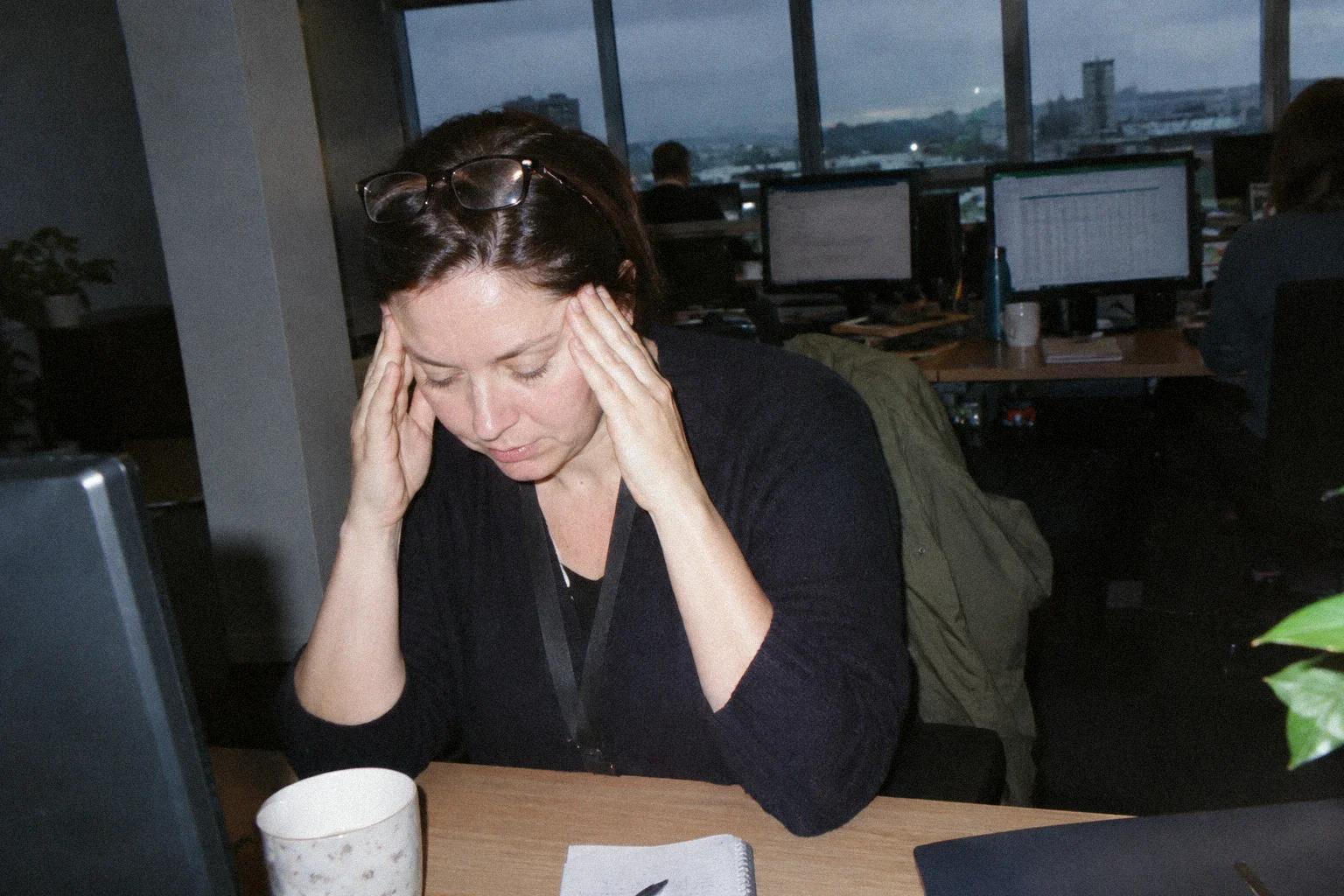
What weighs sits on the outside of the skull, not inside it. The muscles covering the temples, the top of the neck and the area around the eyes work continuously as soon as tension rises, and they stop returning to their resting length between contractions. What reads as the weight of your head is the state of a muscular envelope that no longer lets go.
The NHS files the sensation on the same side. Its page on tension headaches describes pain on both sides of the head, face or neck, with the feeling of something pressing on the head or tightening around it, and notes that the area can be tender to the touch. Stress, poor sleep and caffeine sit at the top of its list of causes.
That still leaves the odd part: why it feels like weight rather than cramp. A muscle holding a weak effort for hours gives no obvious signal. It does not burn, it does not shake. It produces a dull, badly located discomfort that the brain happily attributes to the contents of the skull rather than to its wall. It is the same confusion as in a chest that tightens under stress, where the discomfort seems to come from inside the ribcage when it comes from the muscles holding it.
There is a second contributor, and the end of the working day makes it obvious. Eight hours spent fifty centimetres from a screen ask the muscles of the eye for a sustained focusing effort, and the area that carries the trace of it is exactly the one the MSD Manual describes for tension headaches: it starts at the front of the head or around the eyes, then spreads across the whole skull.
A heavy head with no pain: is that even a headache?
Technically, no. The definitions of tension-type headache all speak of pain: steady, moderate, spread across both sides, often described as a band tightening around the head. A heavy head with no pain does not meet that description. It sits next to it.
The distinction is not academic, because it changes the tool. A painkiller acts on pain, so a sensation of weight gives it little to work on. That is the simplest explanation for something very widely reported: the tablet taken at five does nothing, another one goes down at seven, and the head stays exactly as heavy.
That loop has a known cost. The NHS warns that taking painkillers too often or for too long can cause overuse headaches, the kind that arrive because of the treatment rather than despite it. Pushing a medicine at a symptom it does not target burns through the margin kept for the days it will genuinely help.
One caveat, because the two states often coexist. Plenty of people describe a mix: a permanent heaviness in the background, with episodes of real squeezing pain on top. In that case the painkiller has its place on the episode, and the muscular reading keeps its place on the background. And when headaches come several times a week, or no longer respond to painkillers, the NHS says to see a GP. That is a different conversation from this article.
The three areas that pull, and why you never feel them work
The first is the jaw. The masseter and the temporalis are among the strongest muscles in the body for their size, and the temporalis fans out exactly where the head seems to weigh, above the ear. Clenching your teeth without noticing, through a meeting or an inbox, is enough to hold it under tension for hours. The moves that unclench the jaw therefore act on a heavy head by ricochet, which always comes as a surprise.
The second is the top of the neck. The small muscles sitting under the back of the skull hold the head against gravity, and the usual working position, chin forward and gaze tipped slightly down at a screen, asks them for a constant effort. When the shoulders ride up, that whole chain rides up with them.
The third is the area around the eyes, and it is the quietest of the three. The orbicularis and the frontalis work to squint, to lift the eyebrows when the eyelid starts to droop at six in the evening, to compensate for a badly placed lamp. Their fatigue never presents itself as tired eyes. It presents itself as a heavy forehead. The same overload sometimes produces that small eyelid twitch that worries people far more than it should.

One guardrail, and it matters. The tenderness of these muscles is not an anomaly to hunt down. Castien and colleagues pooled seventeen studies in 2021, fifteen of which compared patients with healthy controls in the meta-analysis, and did find higher pericranial tenderness in people with tension-type headache. They also concluded that it is common in healthy people, and the quality of evidence they report is only low for the episodic form. In other words: prodding your own skull in search of the guilty spot is a poor use of that finding. What is useful is knowing where to look in order to release.
What screens add, and what a blue light filter will not fix
Digital eye strain is the factor the usual advice skips, even though it touches almost everyone at a desk. The review by Sheppard and Wolffsohn, published in 2018 in BMJ Open Ophthalmology, puts its prevalence at 50 % or more among computer users and counts headache among its symptoms, alongside dry eye and blurred vision.
Two mechanisms stack up on a screen, and neither has anything to do with the colour of the light. The eye holds focus and convergence at a fixed, close distance, without the variation a normal environment imposes on it. And blinking becomes rarer and less complete, which dries the surface of the eye and adds a discomfort the eyelid then compensates for by working harder.
Hence a conclusion that pleases no one selling eyewear. The same authors note that blue light filtering lenses, much studied, give mixed results on this fatigue. What they keep is considerably more mundane: correct a refractive error, treat dry eye, take regular breaks, and check for vergence and accommodation problems.
In practice the variable that counts is distance. Looking beyond five or six metres for twenty seconds releases accommodation, which no eyes-closed pause achieves if the face stays fifty centimetres from the screen. A window will do. An open door onto a corridor will do too.
And if your head has felt heavy every evening for months, the first thing to check is not a relaxation technique. It is the date of your last eye test.
What to do in the moment: locate before releasing
The principle fits in one sentence: you cannot release a muscle you have not located.
This is not a methodological preference. The meta-analysis by Nestoriuc and colleagues, published in 2008, retained 53 studies on biofeedback for tension-type headache and found a medium to large effect, stronger than headache monitoring, stronger than placebo and stronger than relaxation therapies, holding over an average of fifteen months of follow-up. What biofeedback adds to relaxation is precisely that: a readout of the muscle’s actual tension, which is the missing information. Those studies used measuring devices rather than self-perception, so the transfer is plausible rather than demonstrated, but it points at where to look.
The sequence takes three minutes, sitting, with nothing closed.
One: take inventory, without correcting anything yet. Are your teeth touching? Is your tongue pressed to the roof of your mouth? Are your eyebrows drawn slightly together? Does your scalp feel tight above the ears? Most people answer yes to two or three of those, and the surprise is part of the exercise.
Two: release in order, from the bottom up. Leave a gap the thickness of a fingernail between your teeth. Let the tongue drop. Let the eyebrows come down and the forehead spread towards the temples. Each area takes a few seconds, and it creeps back when you forget it. That is normal. You put it down again.
Three: give time to the exhale. Not a big inhale, which lifts the shoulders and puts the neck straight back under tension, but a long exhale carried to the end through barely parted lips, for about ten cycles. It is the only moment when the neck muscles have nothing to carry.
A fourth move earns its place when the heaviness sits at the front: rest the back of your hand, or your forehead itself, against a surface cooler than your skin. A window in November, a wall, the air from an open sash. The coolness on the forehead gives attention a precise place to settle, which beats the vague instruction to relax, and it turns the gaze towards the distance at the same time. Nothing says it acts on the muscle itself: it is a foothold for attention, and that is what was missing.
If nothing has shifted after ten minutes, stop. Pushing turns an exercise into a test, and the test brings back the tension you had just removed. A ten minute walk outside, where the gaze carries far by construction, often does better than a second attempt in the chair.
Heavy head: when to see a doctor
This section does not negotiate with a breathing exercise. The NHS sorts headaches into three levels of urgency, and they are easy to keep in mind.
Call 999 or go to A&E after a head injury from a fall or an accident, or for a sudden-onset, extremely painful headache. The NHS adds a second group, where each sign counts because it comes with an extremely painful headache: sudden trouble speaking or remembering things, loss of vision, drowsiness or confusion, a very high temperature with symptoms of meningitis, redness in the white of the eye. In the United States that call is 911, and 112 works across the European Union.
Ask for an urgent GP appointment, or call 111, for a severe headache that comes with jaw pain when eating, blurred or double vision, a sore scalp, or numbness or weakness in the arms or legs.
And book an ordinary appointment when headaches come several times a week, when they are severe, when painkillers and relaxation no longer help, or when the pain throbs at the front or on one side of the head with nausea, vomiting, or discomfort in light and noise.
Outside those cases, a heaviness that has been there for weeks still deserves a consultation, for a simple reason: it has possible causes other than muscular tension, and several of them cannot be guessed at. Uncorrected vision is one, and the review on digital eye strain puts its correction among the first useful measures. A doctor rules out the rest, which no article can do in their place.
What releasing does not fix
Knowing how to bring a heavy head down in three minutes takes a lot out of the end of the day. It says nothing about what brings it back tomorrow at the same hour.
A forehead that contracts every afternoon around five is not a forehead problem. It is an indicator, and it points elsewhere: at a load that never comes down, at a day that never properly ends, at sleep that does not return what it should. Closing the working day rather than chasing it away deals with that side of it.
The muscular move keeps its worth for what it is. It makes the evening workable, and it teaches something along the way: tension does not live in your head as an idea, it lives in three precise areas you can feel and release. That is not information you forget.
Frequently asked questions
- Can stress really make your head feel heavy?
- Yes, and the mechanism is muscular first. The NHS lists stress among the causes of tension headaches and describes the feeling of something pressing on the head or tightening around it. The muscles wrapped around the skull stay contracted at a low level, and a contraction held that way registers as a weight rather than as an effort.
- Why do painkillers do nothing for a heavy head?
- Because a painkiller works on pain, and a sensation of weight without pain gives it nothing to act on. That does not make it useless when the heaviness comes with a genuine headache. The NHS also warns that taking painkillers too often or for too long can itself cause overuse headaches, which is the trap of reaching for another tablet two hours later.
- How long does a heavy head from stress last?
- Reported durations run from under an hour to a dullness that holds all day, and the spread makes sense: a peak of tension during an argument, a residual heaviness after a day of screens, and a contracture built over weeks have no reason to ease at the same pace. The NHS suggests seeing a GP when headaches come several times a week or are severe.
- Can screens make your head feel heavy?
- They contribute through visual fatigue. The review by Sheppard and Wolffsohn (2018) estimates that at least half of computer users report digital eye strain symptoms, headache among them, and keeps regular breaks and the correction of a refractive error among the measures that help. Uncorrected vision can therefore sustain an end-of-day heaviness on its own.
- How do you release the muscles around the skull and jaw?
- By locating the area before trying to release it, because a general instruction to relax misses a muscle you cannot feel working. Unclench the teeth until there is a small gap between them, let the tongue drop off the palate, let the eyebrows come down, then lengthen the exhale for two or three minutes. The meta-analysis by Nestoriuc and colleagues (2008) puts biofeedback, which gives a readout of actual muscle tension, above relaxation therapies.
- When should you see a doctor about a heavy head?
- Straight away, by calling 999 or going to A&E in the UK, after a head injury from a fall or an accident, or for a sudden-onset and extremely painful headache. The NHS also sends you there when an extremely painful headache comes with sudden trouble speaking or remembering things, loss of vision, drowsiness or confusion, a very high temperature with meningitis symptoms, or redness in the white of the eye. Urgently, through a GP or 111, for a severe headache with jaw pain when eating, blurred or double vision, a sore scalp, or numbness or weakness in the limbs. And through a routine GP appointment when headaches come several times a week or painkillers no longer help.
Sources
- Tension-Type Headaches — MSD Manual (Consumer Version), 2026
- Tension headaches — NHS, 2026
- Pericranial Total Tenderness Score in Patients with Tension-type Headache and Migraine. A Systematic Review and Meta-analysis — Castien et al., 2021
- Digital eye strain: prevalence, measurement and amelioration — Sheppard & Wolffsohn, 2018
- Meta-analysis of biofeedback for tension-type headache: efficacy, specificity, and treatment moderators — Nestoriuc et al., 2008