Replaying conversations in my head: it is not the missing line
Why we replay conversations for days
We replay conversations because, for the mind, the stake was never what was said but what it says about us. An exchange ends when the other person walks away. The file marked “how did I come across” does not end: it stays open, consultable, and replaying is the only procedure available for trying to close it.
Hence something everyone recognises without having put words to it. A throwaway chat with a stranger is forgotten in ten minutes. One clumsy sentence in front of three colleagues can take up an entire commute, then the shower, then the night. The difference is not the objective seriousness of the exchange. It is what there was to lose in the image.
Rumination arrives with a very convincing costume: the costume of work. It feels like analysing, understanding, preparing for next time. The review Susan Nolen-Hoeksema co-authored in 2008 says roughly the opposite of that feeling. Pulling together thirty years of research, it describes a mental activity that worsens low mood, sharpens negative thinking and degrades the ability to solve problems, on top of eroding the social support around the person who ruminates.
That last point is worth reading twice. Not only does replaying fail to settle the awkward exchange, it gradually damages the one resource that could have settled it: the people you might have told about it.
One honest caveat. Not all self-reflection is rumination, and the same review spends part of its conclusions separating the two. Thinking back on an exchange in order to reach a decision is analysis, and it stops once the decision is made. Rumination is recognisable by this: it produces no decision, and it does not stop on its own.
Each pass adds something that was never there
Here is what most articles on the subject leave out, and it changes everything that follows: replaying a conversation is not rereading it. It is rewriting it.
The first pass is roughly faithful. On the second, you add the line you did not have at the time, and you slot it into the gap. On the third, the other person's silence, which may have meant nothing at all, has become a disapproving silence, because that is the version that best explains your discomfort. By the fifth, you have a coherent, sharp, well-lit scene, and it no longer has much to do with what happened.
One Friday in March, in a meeting, someone answers a director's question with a sentence that stops halfway. Nobody picks it up. The meeting carries on, the minutes do not mention it, and a week later two attendees have no memory of it. The person involved spent the weekend with a version in which the unfinished sentence had frozen the room.
By day three, you are not replaying a conversation: you are replaying your own worst version of it. And since every pass produces something slightly more damning than the last, the loop has a slope. It is not stable. It descends.
That is also why the reassurance other people offer slides off so easily. “Nobody noticed anything” is a statement about the real exchange. The loop is working on a scene that has been retouched five times since, and for which that objection no longer applies.
“I should have said…”: why the right line closes nothing
Replaying almost always takes the shape of a search for a comeback. You look for what you should have answered, and you often do find it, sometimes hours later, with a brief satisfaction.
Then the loop starts again. Which should be enough to show that the line was not what it was after.
In French the experience even has a name that sounds like a personal defect: not having any repartie, no quickness of tongue. The phrasing misleads, because it labels as a vocabulary gap what is really a mismatch of timing. In the moment, attention is busy elsewhere: holding the situation, reading faces, managing the feeling. A few hours later all of that budget is free again, and it goes naturally to the only task still open.
The right line closes nothing because the loop is not asking for an argument, it is asking for a verdict to be overturned. And a verdict about yourself is not overturned by a clever phrase addressed to someone who is no longer there. That is precisely the difference with rumination that could be useful: if the exchange calls for a real action, a clarifying message, an apology, a word at the next opportunity, then the thought has an exit. It stops once the action is decided.
So here is a quick test. Ask what this replay is asking you to do. If a concrete answer arrives in under a minute, do it or write it down, and the loop loses its pretext. If no answer arrives, this is not analysis, and no extra quantity of thinking will make it conclusive (in French).
Is it normal to replay a conversation for several days?
Yes for a day or two, and there is one research finding that explains rather well why beyond that it is something else.
Philippe Verduyn and Saskia Lavrijsen asked 233 secondary school students to recall recent emotional episodes, estimate how long they had lasted, and answer questions about how they had appraised and handled them. Out of 27 emotions, sadness lasted the longest. And among the shortest were surprise, fear, disgust, boredom, irritation, relief, and shame.
Shame among the briefest emotions. That is counterintuitive when you have spent three nights with one clumsy sentence, and it is exactly the useful information: the awkwardness that follows a conversation has no intrinsic reason to last for days. What does last, in their analysis, depends on two things that between them account for almost half of the duration differences across emotions: how important the event was taken to be, and the level of rumination.
Put differently, duration is not a property of the awkward moment. It is a property of what is done with it afterwards.
Two reading caveats, because they matter. The sample is adolescents, asked retrospectively about durations they estimated themselves: this is a long way from real-time measurement in adults. And a correlation between rumination and duration does not, on its own, settle which way the arrow points. What these results establish is more modest, and enough here: the length of social discomfort sits on the replay side, not on the event side.
In practice, then, the criterion is not the clock. It is frequency and cost: loops several times a week, falling asleep an hour later than you meant to, meetings you dread or people you start avoiding.
What loosens it: changing vantage point, not chasing the thought
The advice people most often receive is to stop thinking about it. It fails for a mechanical reason: checking that a thought has not come back requires holding it in mind.
The lever that holds up in the literature is elsewhere. It keeps the scene but changes the place you watch it from. Özlem Ayduk and Ethan Kross examined this across three studies: the more participants spontaneously stepped back while thinking about a negative memory, the less emotional and cardiovascular reactivity they showed, and the fewer intrusive thoughts they reported over time. The important part is what carried the effect: not avoidance, but a shift in how they construed the experience, more reconstruing of meaning and less blow-by-blow retelling.
This is not the same as taking your mind off it. You stay with the exchange. You simply stop running it from the inside.
A second finding gives a very concrete handle on that, and it lands exactly on our subject. Kross and colleagues ran seven studies, 585 participants in total, on the language used in one's own inner monologue. Using your own name or the second person, rather than “I”, increases distancing. In the study on public speaking, the group not addressing themselves in the first person showed less distress and less post-event processing, and were rated better by independent observers. A meta-analysis across the set further indicated that trait social anxiety did not moderate these results, which makes the tool usable by the people who need it most.
The broader mechanism is documented beyond these two teams: a review with a supporting neuroimaging meta-analysis places distancing among the more consistent emotion-regulation strategies. What remains debated is the detail of the processes involved, not whether the effect exists.
And this shift has a useful cousin: watching a thought go by without stepping into it is the same move, applied to a thought rather than to a memory.
Three minutes in the evening, when the loop starts
What follows is not a technique for silencing the replay. It is a way of taking away its ground, which is the present tense.
Name the loop, and not in the first person. Quietly, in the kitchen or in the car: “you are replaying the two o'clock meeting, for the sixth time”. Two things happen at once. The sentence states instead of arguing, and the “you” puts the observer a metre away from the scene, which is exactly the gap the studies above measure.
Then write for ten minutes, by hand, without rereading and without trying to write well. Describe the exchange, what bothered you, what you fear it says about you. Park, Ayduk and Kross showed across two longitudinal studies that expressive writing produces precisely this distancing: participants who wrote about a distressing experience took more of a step back when they thought about it the next day, and reported lower emotional reactivity a month later in both studies, and six months later in the second.
One clarification, so as not to make them say more than they measured: their protocol was fifteen minutes a day, three days running. Ten minutes on one evening borrows the move, not the dose. If the loop comes back the next day, that is a reason to do it again rather than to conclude that it does not work.
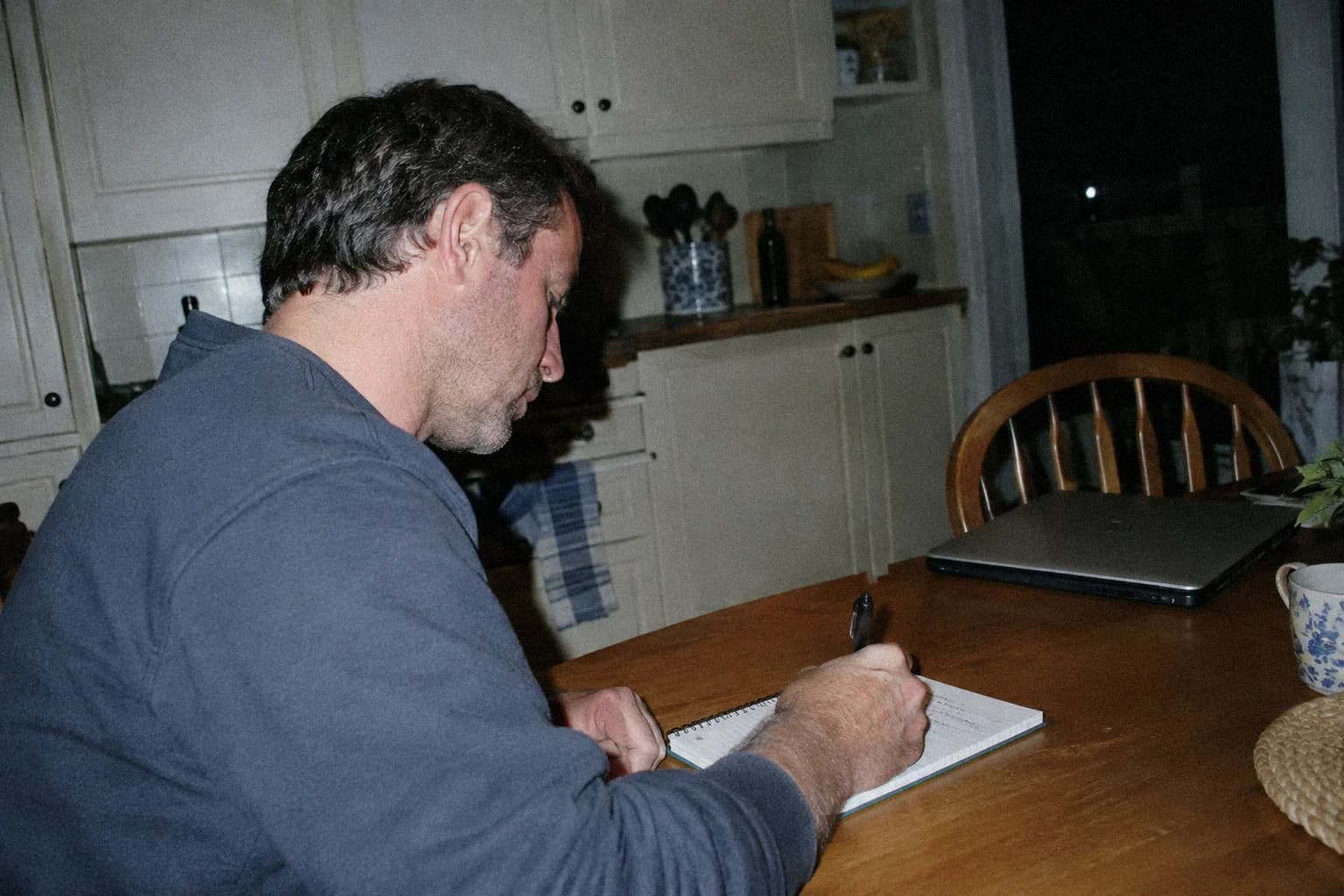
One detail from their linguistic analysis is worth more than an instruction: the texts that increased distancing over time used more causal words and fewer first-person singular pronouns. No need to think about it while writing. It is enough to know that explaining why something happened works better than describing over and over what it did to you.
Third move, the one people skip: water something else. A loop does not retreat from empty ground, it comes back into whatever space it is left. A ten-minute walk, a call to someone about a completely different subject, a task that occupies the hands. The point is not to distract yourself from the problem, it is to give attention back to something that deserves as much of it.
And a fourth move, if the verdict returns anyway: change what you tell yourself at the end, not what you remember. This is where the tone of your inner voice genuinely counts, and a systematic review with meta-analysis of self-compassion interventions reports a reduction in self-criticism, which is the real fuel of the replay.
Two situations where this sequence does not fit. If writing pulls you back into the exchange with more intensity rather than more distance, stop after five minutes: for some people expressive writing stirs before it settles, and that is not the moment to insist. And if the loop is about an ongoing conflict, none of this replaces the conversation you will have to have.
When it is no longer ordinary replaying
There is a threshold beyond which the moves above are a dressing, and it helps to recognise it.
Nolen-Hoeksema set the frame in 1991, proposing that the way people respond to their own symptoms influences how long those symptoms last, and that ruminative responses lengthen depressive episodes. What came next is more interesting than the formula. Seventeen years later, the review she co-authored corrects that point on the accumulated evidence: rumination more consistently predicts the onset of an episode than its duration, and affects duration only in interaction with negative cognitive styles. The same review notes that rumination is tied not only to depression but also to anxiety and other behaviours.
What to take from that turn, if you are someone who replays conversations: rumination is not a symptom to file in a box, it is a processing habit that raises a risk. So it is something you can act on early, without waiting for a diagnosis.
A few signs that call for a consultation rather than an article. Replaying that comes back almost daily for weeks. Exchanges from several years ago that return with the same charge. Situations you begin to avoid, or words you hold back in a meeting so as not to have to replay them later. Replaying experienced as an intrusion that you try to neutralise with a mental ritual, which belongs to a different category. A GP or a psychologist is the person to sort this out, and there are approaches aimed squarely at it.
One last thing, which is neither advice nor technique. The person opposite you has their own conversation to replay tonight. The research on how much room our missteps really take up in other people's attention is fairly consistent: we routinely overestimate it, which is not the same as it being nothing, much as we do when shame turns a moment into a statement about who we are. That is not a reason to blame yourself for replaying. It is simply a piece of information the loop will never hand you.
Frequently asked questions
- Is it normal to replay a conversation for several days?
- Coming back to an exchange for a day or two is common, especially if the exchange mattered to you. What separates ordinary replaying from a problem is not raw duration but frequency and cost: loops that return several times a week, that push back the time you fall asleep, that make you avoid people or meetings, deserve attention even when each episode is short.
- Why do I replay conversations in my head when they are already over?
- Because what stays open is not the exchange, it is the question of how you came across. A real dialogue ends when the other person leaves; a self-assessment has no end point, so the replay can run indefinitely without ever reaching a conclusion. That is also why it feels like work while settling nothing.
- How do I stop replaying a conversation at night?
- Try not to fight it in thought, where it has the advantage. Name the loop out loud in the second person, then write for ten minutes about the exchange, by hand, without rereading. Writing moves the scene out of the present tense, which mental replay never does. If the loop returns afterwards, that is expected: the aim is for it to return less sharply, not to vanish on command.
- Does replaying conversations mean I lack confidence?
- Not directly. Everyone reruns exchanges, including people who seem very sure of themselves. What varies is how harsh the verdict is at the end of the replay. When every pass ends with a conclusion about your worth rather than about the situation, that judgement is the useful thing to work on, more than the replaying itself.
- Is replaying conversations social anxiety or intrusive thoughts?
- Both exist and they do not feel alike. Post-event processing is a well-described feature of social anxiety: you rerun the exchange looking for evidence that you got it wrong. Replaying experienced as an intrusion, which you then try to neutralise with a mental ritual or a check, belongs to a different category. Only a professional can sort this out, in consultation.
- Is the other person replaying it as much as I am?
- Probably far less than you think. Work on the spotlight effect shows that we routinely overestimate how much of other people's attention our own words and missteps occupy. It does not show that they give it no thought at all: it shows that the share they give it is smaller than the share you assume.
Sources
- Rethinking Rumination — Nolen-Hoeksema, Wisco & Lyubomirsky, 2008
- Which emotions last longest and why: The role of event importance and rumination — Verduyn & Lavrijsen, 2015
- From a distance: Implications of spontaneous self-distancing for adaptive self-reflection — Ayduk & Kross, 2010
- Self-talk as a regulatory mechanism: how you do it matters — Kross et al., 2014
- Stepping back to move forward: Expressive writing promotes self-distancing — Park, Ayduk & Kross, 2016
- Responses to depression and their effects on the duration of depressive episodes — Nolen-Hoeksema, 1991