How to find courage right before something you dread
How to find courage when the fear is already there
Courage does not mean no longer being afraid. It means keeping the use of yourself while you are afraid. Fear is not the obstacle; freezing is. And freezing comes undone through the body rather than through reasoning, because by the time it sets in, reasoning is precisely the function that has become least available.
That is why most advice on the subject falls flat. "Think positive", "remember your past wins": those instructions ask the mind to do a job at the exact moment it can no longer do it. You can tell yourself ten times that an interview is not that serious, and your throat stays tight.
Contrary to what people assume, those who act despite fear do not feel less fear than everyone else. What sets them apart is latency: the gap between the fear and the first move. That gap is what can be trained, and the exercise below aims at nothing else.
Four steps, eight minutes. You can run it sitting in a car, on a corridor chair, or standing in a lift.
1. Name what you dread, in one sentence (1 minute)
Not "I'm stressed". Not "this is going to go badly". One sentence containing a checkable fact and a precise consequence: "I'm afraid he'll ask why I left my job in March and I'll fumble the answer", "I'm afraid she'll say she's already thought about it and that it's over".
Say it under your breath, or write it on a corner of paper. A precisely worded fear takes up less room than a vague one, because it stops covering the whole field. A blurry fear applies to everything; a named fear has edges.
Give it one minute, no more. Past that, you are no longer naming, you are ruminating, and rumination is exactly what the rest of the exercise is built to interrupt.
2. Lengthen the out-breath until the rhythm gives way (2 minutes)
Breathe in through the nose for four counts, out through slightly parted lips for six to eight. The ratio matters more than the numbers: the out-breath should be clearly longer than the in-breath, and it should end without squeezing out the last drops of air.
This is the best documented physiological lever in the whole exercise. The systematic review by Zaccaro and colleagues, published in 2018, gathered the available work on slow breathing and reports a coherent set of effects: a shift of autonomic balance toward the parasympathetic side, increased heart rate variability, and a reported drop in agitation. The synthesis by Russo and colleagues places the useful zone around six breaths per minute, which roughly matches the rhythm above.
Two caveats, since articles on the topic almost always skip them. First: this work was done on people at rest, not on someone standing in a corridor five minutes before an interview. Second: several of these trials rest on small samples, and the review itself flags how heterogeneous the protocols are. The effect is real. It is not spectacular.
What you are watching for is not a feeling of calm. It is quieter than that: the moment the out-breath stops taking effort and starts happening on its own. Usually around the eighth or tenth breath.
If nothing gives way after two minutes, move on anyway. The exercise is not conditional.
3. Rest your attention behind the breastbone (2 minutes)
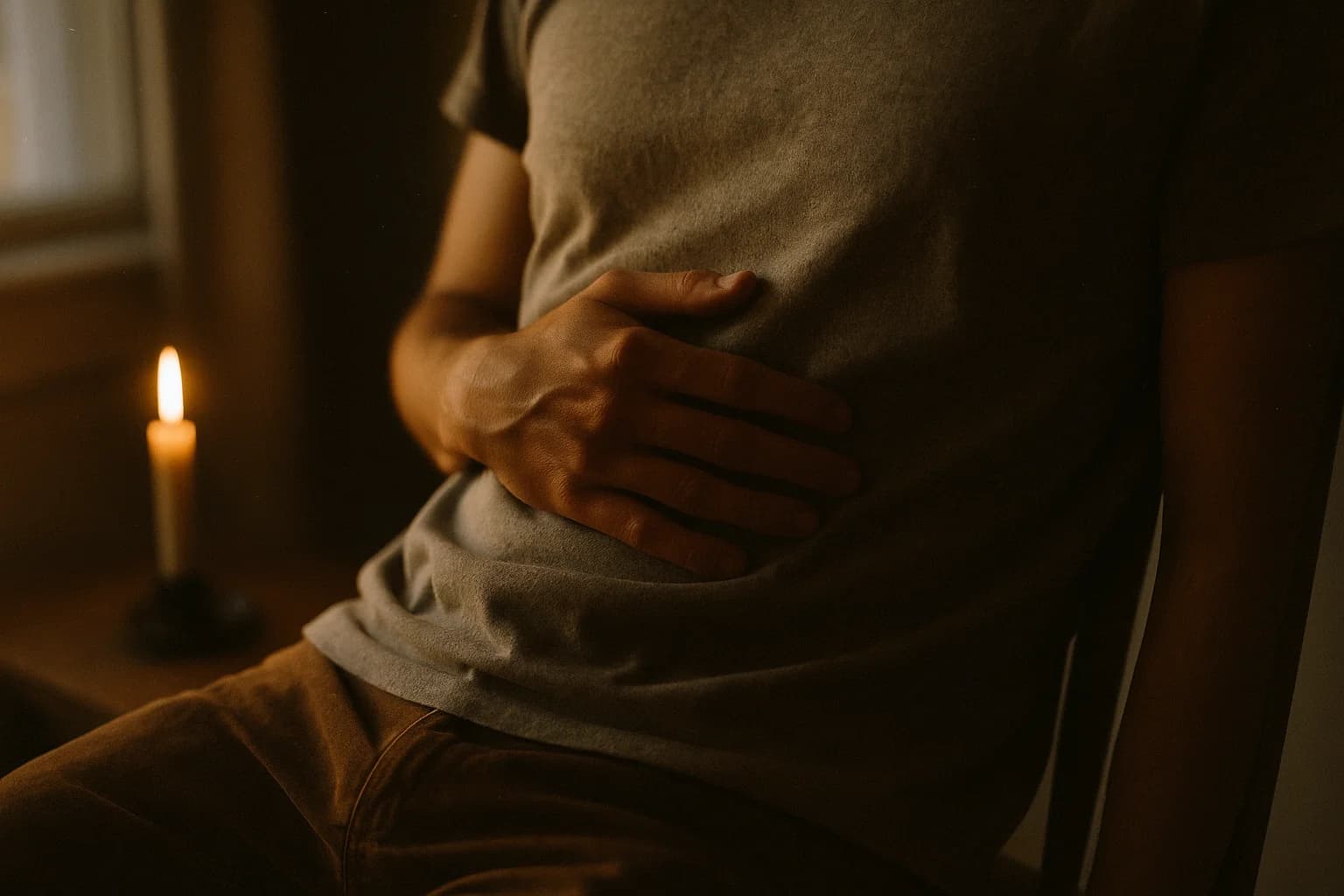
Without changing anything about the breath, bring your attention to the area behind the bone in the middle of the chest. Not the heart, not the belly: that vertical band a few centimetres wide, between the base of the throat and the pit of the stomach.
Look for whatever is there, as it is. Tightness, emptiness, pressure, warmth, nothing at all. You are not correcting, you are noting. The exact instruction is: stay there for ten breaths without trying to improve what you find.
The choice of area is not decorative. In the bodily maps of emotions established by Nummenmaa and colleagues with more than seven hundred participants, the chest stands out as the region where emotional states produce the strongest felt variation, and in both directions: fear and anger light it up, so do pride and joy. It is the area that speaks loudest, which makes it the easiest to hear when attention is poor.
Plenty of people find nothing the first few times. That is not an attention deficit, it is a lack of habit: we spend our days not looking there. If that is you, a hand flat on the chest gives a tactile landmark that helps locate the zone, as this piece on the hand-on-heart gesture (in French) describes.
4. Let the warmth rise, then take one step (3 minutes)
Now the image, and only one: a low light rising slowly behind the breastbone, like a sun just off the horizon. It does not snap on. It climbs, and as it climbs it warms the inside of the chest.
The slowness is the useful part. A light that flicks on like a switch produces nothing; warmth that gains ground over thirty seconds or so often ends up becoming a real sensation rather than a mental picture. The mechanism is the same one at work in this visualization exercise to relax, except the movement goes up instead of down: you are not trying to release, you are trying to mobilise.
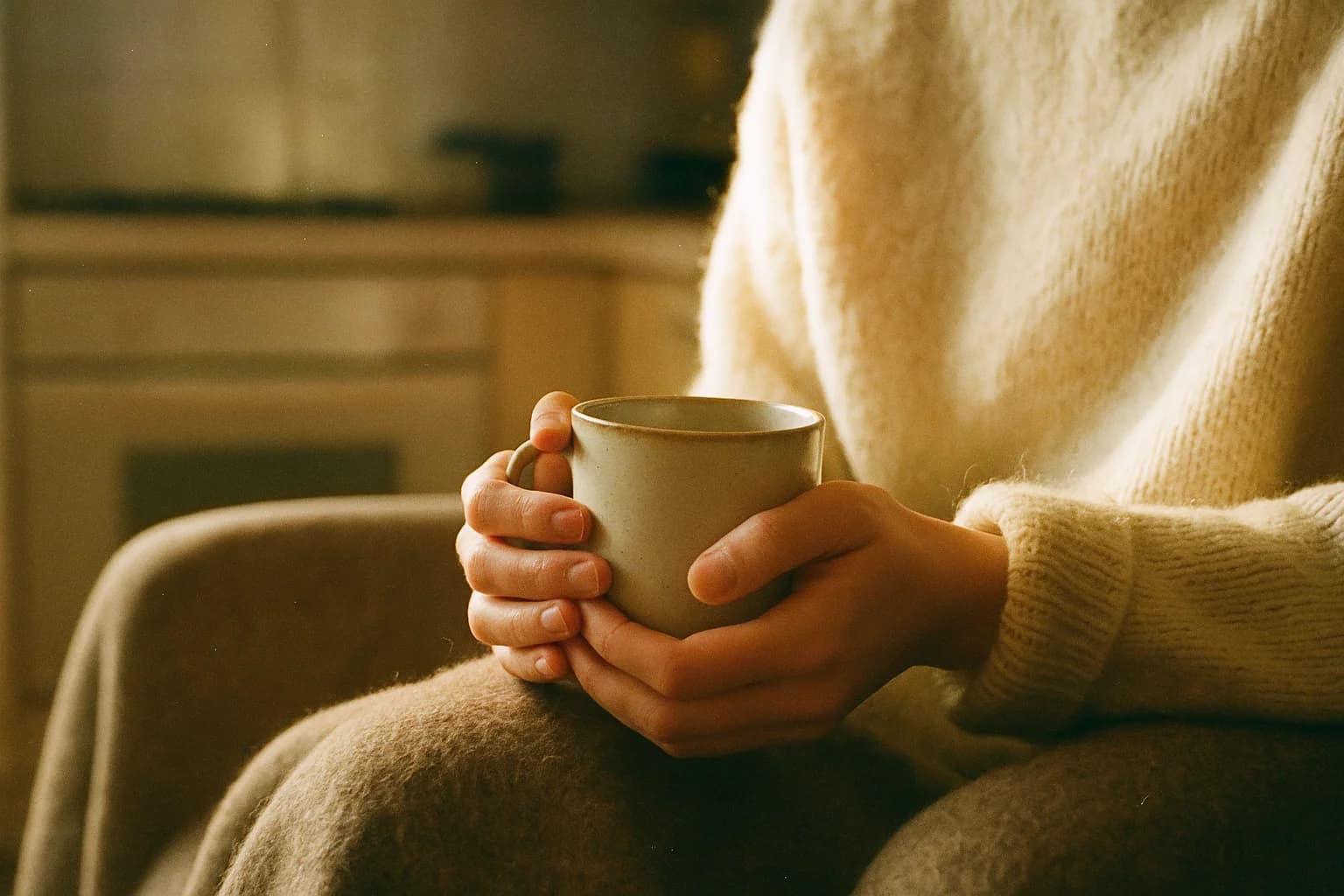
If no image comes, do not push. Look only for warmth in that spot, or recall a warmth you know: a mug held in both hands, late afternoon sun on the sternum. We have written elsewhere about what happens when no image arrives, and why it is not an obstacle. The same holds for warmth in the hands (in French), often the first area to answer.
Then the part nobody enjoys: open your eyes and take one concrete action within ten minutes. Dial the number. Stand up. Send the message. Knock on the door. Not the whole move, the first piece of it.
One example, this past January: someone who had been putting off a call to a radiology department for eleven days ran the four steps sitting in their kitchen, then dialled without rereading their notes. The call lasted four minutes. The exercise did not make the call easy, it was not. It made the following eleven days unnecessary.
Can you become brave, or is courage a personality trait?
The question comes up constantly, and it is badly framed. Nobody is brave in general. People are brave on certain terrain and not on others: someone who skydives without blinking may be unable to tell a business partner that things are not working.
So what moves is not a trait, it is a situated skill. And that skill looks less like bravery than like mechanics: catching the bodily signs early, having a protocol that requires no decision at the moment deciding is hard, and having already acted despite fear often enough to know it is doable.
Repetition does most of the work. Not dry repetition on a quiet Sunday afternoon: repetition in situation, on small deadlines, before the big one arrives. A postponed conversation. An email you keep not sending. That is where the short latency gets installed, and it follows the same logic as the calm courage of letting go (in French), where what counts is what you stop holding on to.
When this exercise is not the right tool
There are at least three cases where it does not apply.
When the fear concerns a real and present danger, the right response is getting to safety, not breathing. An attentional exercise should never be used to make a situation bearable when the situation should be left.
When attention turned inward amplifies the agitation instead of settling it, which happens for some people prone to panic attacks: drop the third step, keep only the lengthened out-breaths, eyes open on a fixed point.
And when the avoidance has run for months, spans several areas of life, or comes with degraded sleep and low mood. At that point it is no longer a question of courage, and eight minutes of breathing is not the right tool. A professional is.
That leaves the most common case, which is also the most ordinary: a regular deadline, a proportionate fear, and the urge to push it back a little further. For that one, four steps and eight minutes often make the difference between tomorrow and now.
Frequently asked questions
- How long before the dreaded moment should I do the exercise?
- Ideally between fifteen and five minutes before. Too early and the effect of the slowed breathing fades while you wait. Too late and you cannot get through the four steps. If you only have two minutes, keep the lengthened out-breaths alone: that step is what makes the others possible.
- Can I do this exercise with my eyes open, in a public place?
- Yes, and often you have to: moments that call for courage rarely happen in a quiet room. Rest your gaze on a fixed, neutral point instead of closing your eyes. The slowed breathing and the attention to the chest work identically, only the image in the fourth step comes through a little less clearly.
- What if the fear comes straight back once the exercise is over?
- That is the normal case, not a failure. The goal is not to erase the fear but to recover enough room to act despite it. If the agitation climbs again, that is the signal to move to the action immediately rather than running another round: acting is what cuts anticipatory rumination best.
- How do I find courage if I cannot visualize anything?
- Swap the image for the sensation. Instead of seeing light behind the breastbone, look for warmth, pressure or simple release in that spot. Seeing nothing blocks nothing: the available data do not suggest that people who produce few or no mental images benefit less from attentional exercises.
- Does this work for fear of public speaking?
- That is the easiest context to schedule it in, because the dreaded moment has a precise time. Run the four steps while the previous speaker is talking, and save the final action for walking on: plant both feet flat and let one full out-breath pass before your first sentence.
- Can courage be trained, or do you have to wait until you feel it?
- Waiting until you feel it means waiting for the fear to drop on its own, which it rarely does before the deadline. What can be trained is the delay between fear and action. Repeated over a few weeks, the exercise shortens that delay: the fear stays comparable, the latency before the first move shrinks.
Sources
- How Breath-Control Can Change Your Life: A Systematic Review on Psycho-Physiological Correlates of Slow Breathing — Zaccaro et al., 2018
- The physiological effects of slow breathing in the healthy human — Russo et al., 2017
- Bodily maps of emotions — Nummenmaa et al., 2014