Tonglen meditation: how to practice it in 6 steps
What is tonglen meditation?
Tonglen meditation is a breathing practice from Tibetan Buddhism. The Tibetan word, sometimes written “tong len”, means “giving and receiving”. The principle fits in one sentence: on the in-breath, you welcome what weighs; on the out-breath, you send out gentleness. The gesture reverses our usual reflex, which is to flee discomfort.
It was the meditation teacher Pema Chödrön who made this practice known in the West. She sums it up as a movement where you breathe in “heat, darkness and heaviness” and breathe out “coolness, brightness and lightness” (Pema Chödrön, Lion’s Roar). Nothing mystical about it. Just a breath you give a direction to.
The guide below describes an accessible version, designed for starting out without overloading yourself. It stays close to home: you are not trying to take the pain of the whole world onto your shoulders. Here we go straight to the practice, step by step, then to where the practice comes from and how it differs from metta.
Step 1: Sit down and settle the body (2 minutes)
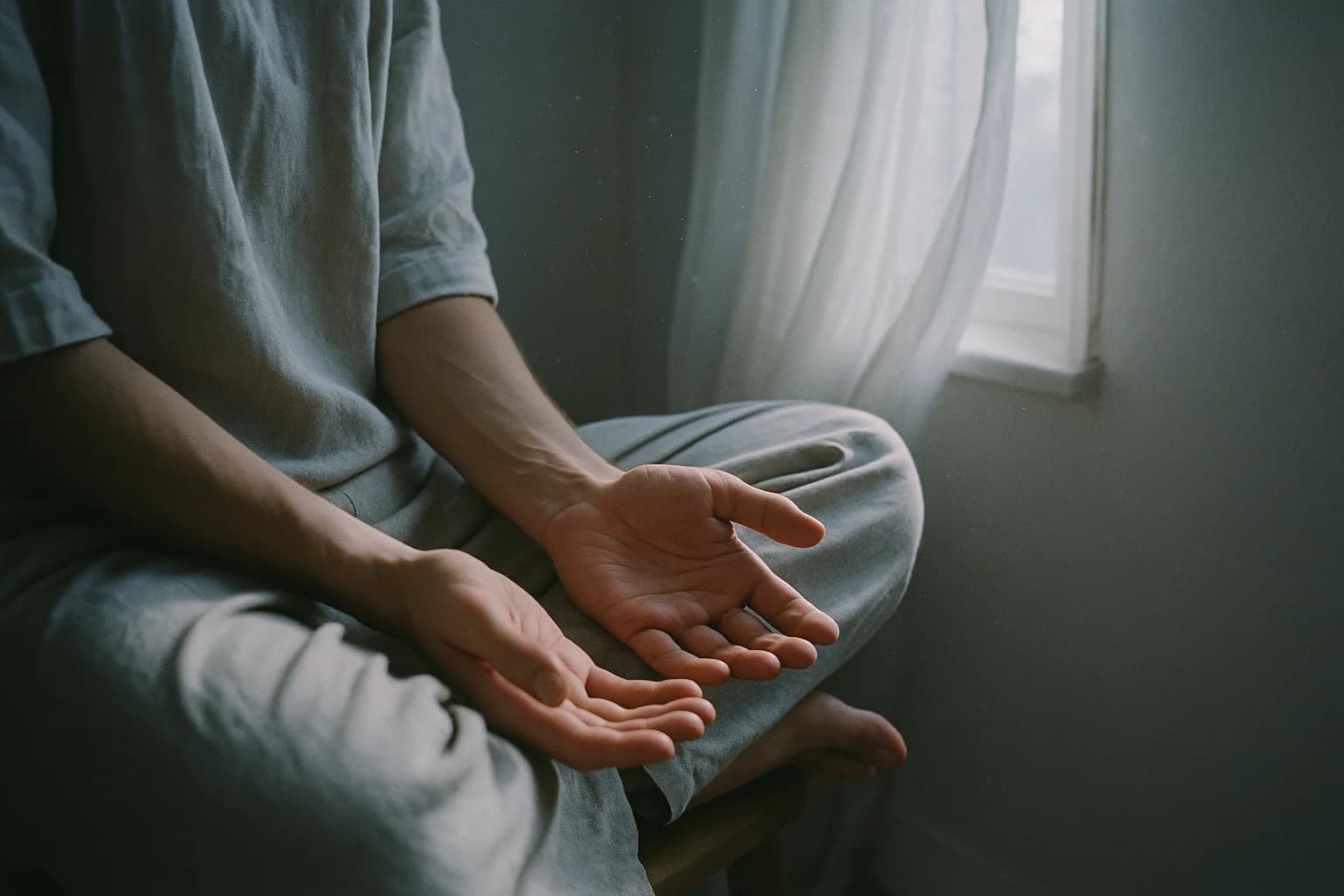
Sit somewhere you will not be disturbed. A chair, a cushion, the edge of a bed: it does not matter. Back fairly straight, without stiffness, feet or legs supported. Sitting beats lying down, because lying down you slide quickly towards sleep.
Close your eyes if that is comfortable, otherwise let your gaze drop to the floor. Take two or three breaths a little slower than usual, just to tell the body nothing is urgent. Feel the points of contact: thighs on the seat, feet on the ground. You can only lighten what is first set down.
No need to “empty your mind” or reach a special state. You are ready as soon as you are sitting and breathing. That is all.
Step 2: Notice what weighs, without analysing it (1 minute)
Briefly review your inner state. Where do you feel heaviness right now? A clenched jaw, a knot in the belly, a thought going round, a diffuse tiredness. You do not have to put a precise word on it, or understand where it comes from. Noticing it is enough.
Many people want to “sort out” what weighs before meditating. Tonglen works the other way round: it works with what is there, as it is. If nothing in particular comes up, that is fine too. You can take a very ordinary discomfort, an awkward position, the noise outside. The practice stays the same.
Step 3: Breathe in the difficulty (the heart of tonglen)
Here is the only truly specific gesture of this meditation. On the in-breath, imagine that you are welcoming the heaviness you noticed in step 2. Not by suffering it, not by drowning in it. By making room for it, the way you open a door to someone who was waiting outside.
Some people visualise dark smoke entering through the nose and dissolving in the centre of the chest. Others prefer to feel the sensation, without an image. Both work. What matters is to stop resisting what is already present, if only for the length of one in-breath.
This is the moment that worries beginners most: “what if I breathe in negativity?” Remember that you are not breathing in the suffering of the world. You are only acknowledging your own, the one that is already there. The in-breath adds nothing, it simply stops pushing away. The logic is close to an exercise for letting go (in French): you stop pushing against what is, and the body relaxes a little.
Step 4: Breathe out gentleness
On the out-breath, let something gentle go. A clear light, a cool breeze, or simply the word “gentle” spreading through the body. You do not have to manufacture a grand healing gesture. A release is enough: shoulders coming down, the jaw loosening.

The out-breath is where lightness is created, not because the problem disappears, but because the body receives a clear signal: you can let go one notch. If the word “gentle” leaves you cold, take “calm”, “rest” or “here”. The right word is the one that relaxes you, not the one that sounds good.
Now chain them: breathe in what weighs, breathe out gentleness, cycle after cycle, at your own pace. No imposed count, no tempo to hold. The breath leads, you follow. If placing a hand on your heart helps you feel the out-breath, add it: the warmth of the palm reinforces the release.
Step 5: Widen to someone close, if the heart is willing (optional)
After a few minutes centred on yourself, you can open the circle a little. Think of someone going through a difficult time. On the in-breath, welcome their pain; on the out-breath, send them gentleness, relief, room. This is the form closest to traditional tonglen.
Always start with someone you love and for whom it is easy, never with someone who hurts you. This step is entirely optional, and nothing obliges you to do it. If staying with yourself is already plenty for today, stay there. Tonglen never asks you to do more than you can carry.
Step 6: Return to free breathing and close (1 minute)
To finish, drop the technique. Nothing more to breathe in, nothing in particular to breathe out. Breathe freely, the way the body wants. Notice what has changed, without looking for it: often a little more space in the chest, a new slowness.
Last November, on a Sunday evening when the week ahead was already weighing, I did ten cycles on my sofa before bed. Monday’s problem was still there. But I went to sleep less tense, and that was exactly the point. Tonglen does not fix the situation, it changes how you carry it.
Open your eyes when you are ready. Five to ten minutes are more than enough. Done regularly, this little ritual slips in everywhere: before a tense meeting, on public transport, in the evening.
Tonglen in 6 steps: the protocol at a glance
Here is the complete protocol, as just detailed in the six steps above, to keep to hand for your next sessions. Allow five to ten minutes in all, seated, with no equipment.
| Step | The move | Duration |
|---|---|---|
| 1. Sit down | Back straight without stiffness, two or three slow breaths, feel the points of support | 2 min |
| 2. Notice | Register what weighs (jaw, belly, a looping thought), without analysing it | 1 min |
| 3. Breathe in the difficulty | Welcome that heaviness on the in-breath, like smoke dissolving in the chest | Across the cycles |
| 4. Breathe out gentleness | Let something clear go out: a light, a breeze, the word “gentle” | Across the cycles |
| 5. Widen (optional) | Make the same movement for someone close who is going through a hard time | 1 to 2 min |
| 6. Close | Drop the technique, breathe freely, notice what has changed | 1 min |
The safety rule fits in one sentence: never breathe in more difficulty than you can breathe out in gentleness. If the exercise tightens instead of lightening, you return to ordinary breathing and try again another day.
Where does tonglen come from?
Tonglen comes from Tibetan Buddhism, and more precisely from lojong, “mind training”. Tradition traces these teachings back to the Indian master Atisha, who arrived in Tibet in the 11th century, and their best-known formulation to Chekawa Yeshe Dorje, a century later, in the Seven Points of Mind Training. The text reads as a series of short slogans, and one of them describes our exercise exactly: train in giving and receiving alternately, and let the two ride the breath.
The word itself says it all: tong, to give, and len, to receive. Hence the spelling “tong len” you sometimes come across. For centuries, the practice remained a demanding compassion meditation, in which you take on the suffering of all beings. It reached the West in the 20th century, carried notably by Chögyam Trungpa and then by his student Pema Chödrön, whose books and teachings made it an accessible practice outside any monastic setting (Pema Chödrön, Lion’s Roar).
The version described in this guide inherits that modern lineage: you start with your own difficulty, and widen only if the heart is willing. This is not a watering down. Pema Chödrön herself insists that you can only give gentleness to others from what you have first accepted in yourself.
Tonglen or metta: what is the difference?
Both are kindness meditations, and they are often confused. The difference lies in the starting point. Metta starts from a wish: you formulate, for yourself and then for others, phrases like “may you be at peace, may you be safe”. Tonglen starts from the difficulty: you begin with what weighs, you welcome it, and gentleness comes in response, on the out-breath.
Metta radiates in one direction, from yourself outwards, in concentric circles: yourself, someone close, a neutral person, a difficult person, all beings. Tonglen makes a round trip on every cycle, and it rides on the breath rather than on words. In practice, metta is often more comfortable for beginners, because it does not ask you to turn towards discomfort; tonglen is more direct on days when something already weighs, because it works with what is there instead of going around it.
On the research side, the two practices are studied together, under the label of loving-kindness and compassion meditations: the review by Hofmann and colleagues (2011), cited below, treats them as one family, and the available data do not, as far as we know, show that one outperforms the other. Nothing stops you alternating: metta on calm days, tonglen on heavy ones. If metta appeals to you, our piece on metta anchored in the body (in French) describes a very concrete version.
Is tonglen for everyone?
Almost, but not in every situation. Tonglen asks you to move towards discomfort rather than flee it, which is not advisable when you are already overwhelmed. In the middle of a panic attack, or right after a shock, it is better to steady yourself another way before turning towards what weighs.
People living with a marked anxiety disorder or a history of trauma benefit from learning it with support, rather than alone. The safety rule is simple: you should never breathe in more difficulty than you can breathe out in gentleness. As soon as the exercise tightens instead of lightening, you stop and return to ordinary breathing.
For most people, on the other hand, a few minutes of gentle tonglen on an everyday annoyance remain safe and rather soothing.
What are the benefits of tonglen meditation?
Tonglen belongs to the family of compassion and self-compassion meditations, whose effects are better documented than those of tonglen taken on its own. A meta-analysis of 56 randomised controlled trials found that self-compassion interventions reduce depressive symptoms, anxiety and stress, with small to moderate effect sizes (Han & Kim, 2023).
A review published in Clinical Psychology Review adds that loving-kindness and compassion meditations increase positive daily emotions and reduce distress (Hofmann et al., 2011). The effect is not only “less heaviness”, but also a little more warmth towards yourself and others.
A word of honesty about the evidence. Tonglen as such has been studied very little, and most of the data come from neighbouring practices. What can be said without exaggerating: it is a useful regulation tool in the moment, not a treatment. For a neighbouring approach centred on the breath and the nervous system, see our ten-minute anti-stress meditation.
When tonglen is not the right tool
One reservation to close on. Moving towards what hurts is not always the right door. Some days, the body mostly needs safety and ground under its feet, not inner work on the difficulty.
In those moments, a more concrete support helps more: feet flat on the floor, a cool object in the hand, eyes naming a few objects around you. Tonglen will come later, once the wave has subsided a little. It is the same logic as facing an emotional overload (in French): you let it pass first, and structure afterwards.
And if the heaviness settles in and weighs on sleep, work or relationships, no breathing exercise replaces real support. Distress that lasts deserves a professional’s opinion, and leaning on one is nothing like a failure.
Frequently asked questions
- Is it dangerous to breathe in suffering during tonglen?
- No, because you are not sucking anything in: the in-breath adds no suffering, it simply stops pushing away what is already present in you. The safety rule fits in one sentence: never breathe in more difficulty than you can breathe out in gentleness. As soon as the exercise tightens instead of lightening, you stop and return to ordinary breathing.
- Is tonglen suitable for meditation beginners?
- Yes, provided you start with the gentle version, which stays close to yourself: you do not try to carry the pain of the whole world. If nothing in particular weighs on you, you can even practise on a very ordinary discomfort, like an awkward position or the noise outside. Five to ten minutes are enough, with no special state to reach.
- Can you practise tonglen meditation lying down?
- You can, but sitting works better: lying down, you slide quickly towards sleep. A chair, a cushion or the edge of a bed will do, back fairly straight without stiffness, feet supported. The essential thing is to feel the points of contact with the ground, because you can only lighten what is first set down.
- Who should you start with when widening tonglen to another person?
- Always someone you love and for whom it is easy, never someone who hurts you. This widening step is entirely optional anyway: staying with yourself is already a complete practice. Tonglen never asks you to do more than you can carry.
- Are the benefits of tonglen scientifically proven?
- Tonglen as such has been studied very little: most of the data come from neighbouring practices, compassion and self-compassion meditations. A meta-analysis of 56 randomised controlled trials (Han and Kim, 2023) finds that these interventions reduce depressive symptoms, anxiety and stress, and a review by Hofmann and colleagues (2011) reports more positive daily emotions. It is a useful regulation tool in the moment, not a treatment.
- What is the difference between tonglen and metta meditation?
- Metta starts from a wish (“may you be at peace”) and radiates from yourself to others in successive circles, carried by phrases. Tonglen starts from the difficulty: you breathe in what weighs, breathe out gentleness, and everything rides on the breath. Metta is often more comfortable for beginners; tonglen is more direct when something already weighs. Both belong to the same family of compassion meditations and can be alternated from one day to the next.
- What if tonglen increases anxiety instead of easing it?
- Stop, without judging yourself. Tonglen asks you to move towards discomfort, which is not advisable when you are already overwhelmed: in the middle of a panic attack or right after a shock, it is better to steady yourself another way first, feet flat, a cool object in the hand, eyes naming a few objects. People living with a marked anxiety disorder or a history of trauma benefit from learning it with support, and distress that lasts deserves a professional’s opinion.
Sources
- How to Practice Tonglen Meditation — Pema Chödrön, Lion’s Roar, 2025
- Effects of Self-Compassion Interventions on Reducing Depressive Symptoms, Anxiety, and Stress: A Meta-Analysis — Han & Kim, Mindfulness, 2023
- Loving-Kindness and Compassion Meditation: Potential for Psychological Interventions — Hofmann, Grossman & Hinton, Clinical Psychology Review, 2011