How to meditate while walking: ten paces, back and forth
How to meditate while walking, concretely
Meditating while walking comes down to a constraint of place: a path of ten to fifteen paces, walked back and forth, twice as slowly as usual. Attention rests on one single point of the step, the heel leaving the ground for instance, and returns there each time it has wandered.
The short path is not a practical detail. It is what strips walking of its usual purpose, which is to arrive somewhere. Over ten paces there is nothing to reach: at the end, you turn around. The mind takes two or three lengths to understand there is no destination, and that is the moment something loosens.
The four steps below take ten minutes. They work in a flat hallway, between two trees in a park, or along an office wall at lunchtime. If you would rather understand first why walking works differently from sitting, what the research shows about walking meditation (in French) goes through the trials one by one.
1. Choose a path of ten to fifteen paces (1 minute)
Find a straight line of roughly five to eight metres, clear, where you can go back and forth without passing anyone. A hallway will do. So will a hallway rug, and the worn strip down its middle even gives you the length ready-made.
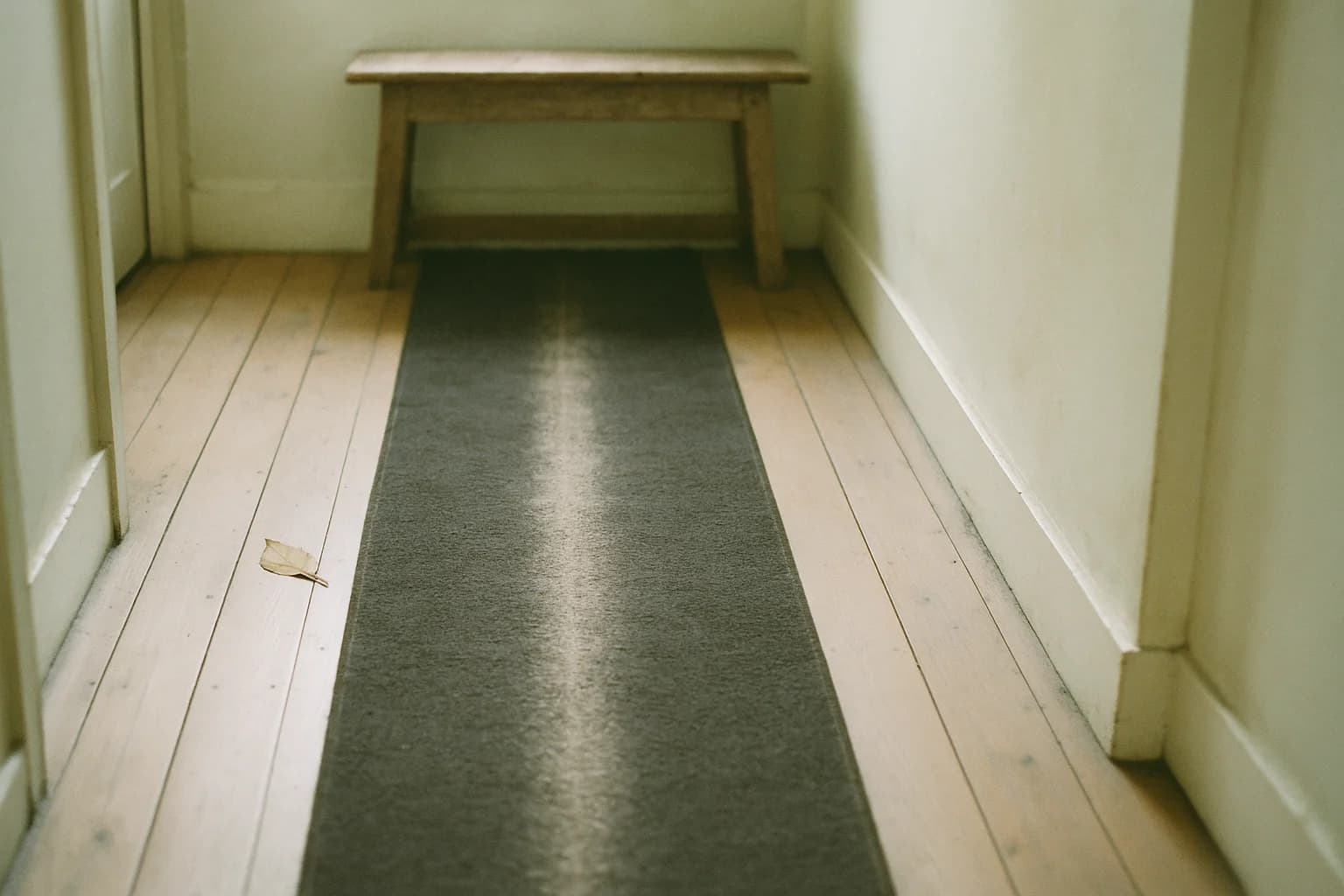
Resist the urge to go out for a thirty minute walk instead. A stroll is not a walking meditation: it has a route, scenery that changes, usually a schedule. All of that keeps attention busy with something other than walking. The tiny path feels absurd at first, and that is precisely its function.
Take your shoes off if the floor allows it. You feel far more barefoot, and the question of where to put your attention, in step 3, becomes obvious instead of theoretical.
2. Stand still before the first step (1 minute)
Stand at one end of the path, arms by your sides, without stiffness. Let your weight sink into your feet. Feel how it is actually spread: more on one heel than the other, more towards the outside of the soles, never perfectly symmetrical.
This standing minute does two things. It gives attention a stable starting point, and it installs the difference between walking and noticing that you walk. Without it, the first three lengths happen on autopilot, and many people conclude after five minutes that the practice does nothing for them.
The gaze stays open, resting three or four metres ahead, without fixing. Not on the floor: that closes the neck and gives you a searching posture. If feeling your weight in standing does not speak to you yet, the body scan from feet to head (in French) covers the same ground lying down, which is easier to start with.
3. Halve your speed and hold one point of the step (5 minutes)
Set off. Walk at half your ordinary speed, no slower and no faster. Excessive slowness is the classic trap: it takes balancing effort, it makes your posture odd, and it keeps attention busy watching you walk rather than feeling.
Now pick one single point, and keep it for the whole session. Three serious candidates: the heel lifting, the moment weight rolls from heel to the front of the foot, the toe that leaves the ground last. One only. Switching every thirty seconds amounts to observing nothing at all.
Your mind will wander. A lot, and fast. That is not a failure on your part: attention leaves the task at hand a good share of the time, and mind wandering is the ordinary mode of operation, not a breakdown. The instruction is only to return to your chosen point, without commentary, each time you notice.
What really separates this walk from a stroll has been measured. In 2018, Edwards, Rosenbaum and Loprinzi assigned one hundred and ten young adults to several ten minute conditions: walking alone, meditation alone, meditation then walking, walking then meditation, and a seated group with no instruction. State anxiety fell in the three groups that included an attentional instruction. It did not fall in the group that had only walked. Ten minutes of walking without directed attention, in that trial, was no better than sitting and doing nothing.
4. Turn around and count the returns (3 minutes)
At the end of the path, pause for a second or two before turning. It is a tiny moment and it carries the point: nothing happened at the end, nobody is waiting, and off you go the other way. Walking loses its function as transport.
Over the last few minutes, add a quiet count. Each time you notice attention had drifted, note one. Not to correct yourself. To know. The number of returns is an honest measure of your state that day, far more reliable than the impression of having meditated well or badly, which mostly tracks your mood.
An example of what that looks like in practice. Someone keeping this count for three weeks in the hallway of her flat, ten minutes each morning, might see figures running between eight and twelve returns, except for two days above thirty. On those same two days she had started her morning reading email in bed. The walk had repaired nothing; it had made visible something she could not see.
What is the difference between walking meditation and Afghan walking?
The confusion is common because both are practised standing and moving. They do not work on the same thing.
Afghan walking sets the breath onto the steps on a counted rhythm: three steps breathing in, one step with the lungs full, three steps breathing out, one step with the lungs empty, and round again. It is breath work, with a precise instruction to carry out, and its practitioners credit it with an effect on endurance. Walking meditation counts nothing and does not regulate the breath: it leaves it alone, and puts attention on the sensations of the step.
Which one to choose depends on what is weighing on you. A mind going round in circles often settles better with a rhythm to hold, because a counted instruction leaves no room for rumination. Physical agitation, on the other hand, tends to unwind by observing without imposing anything. Nothing stops you alternating from one session to the next.
Can you meditate while walking in the city?
Yes, with two adjustments. The short path disappears, replaced by an ordinary route: ten minutes to the underground, the last stretch of the way home, a block at lunchtime. And speed goes back to normal, because walking in slow motion on a pavement demands an awareness of your surroundings that will take up all the room.
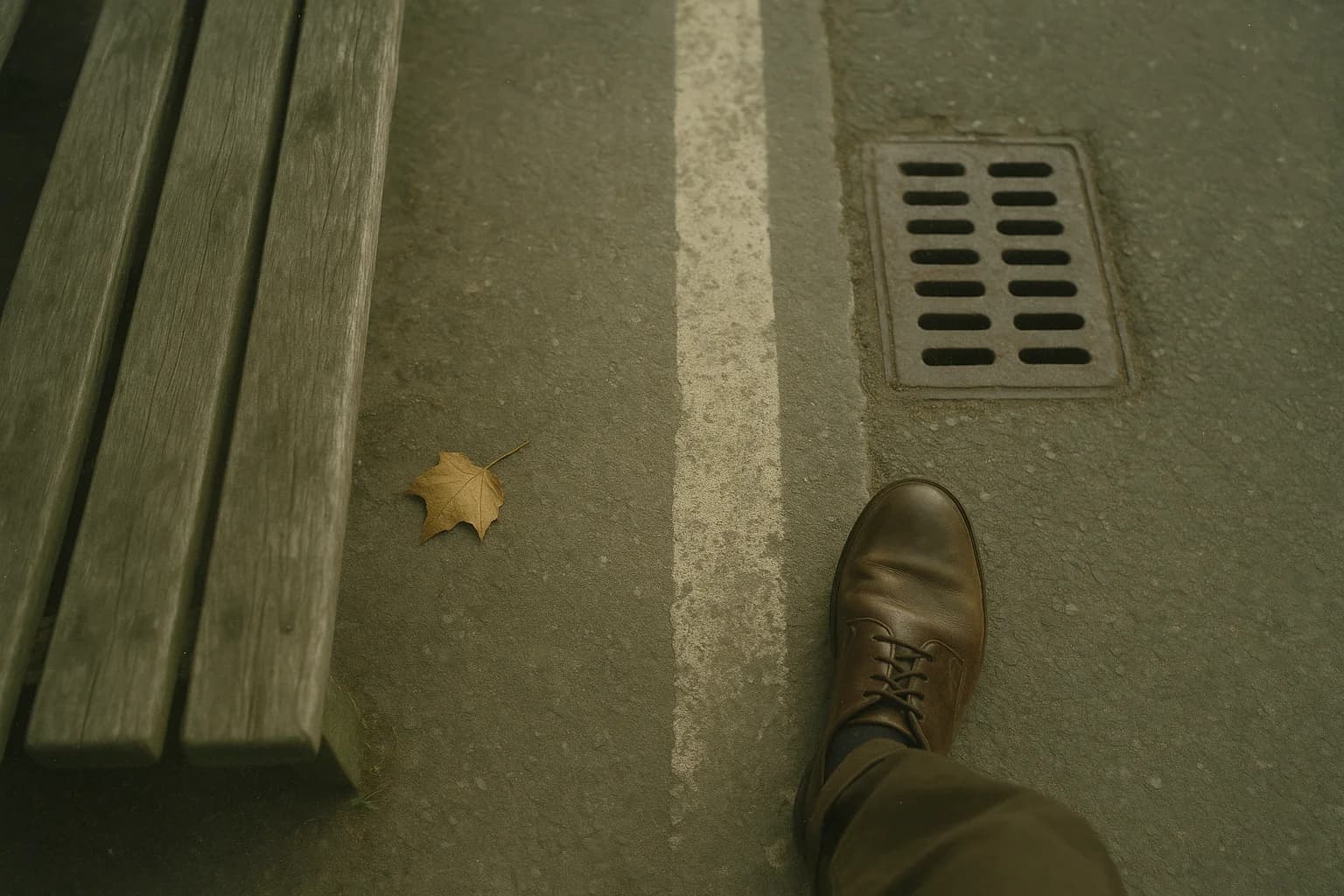
What remains is the point of attention chosen at the start and held to the end. The contact of the foot works, but in the city the swing of the arms works even better: it is regular, it does not require looking down, and it survives road crossings. The phone stays in your pocket, otherwise there is no session, only a walk with a fond memory of an intention.
Safety comes first, obviously. A crossing, a car pulling out of a car park, a bike on the pavement: you drop the instruction, you deal with it, you come back after. That is not an interruption of the practice, it is the practice. For a calmer setting and richer sensory anchors, how to meditate in nature in five steps describes the park and forest version.
When walking meditation is not the right fit
It is not the right fit when standing for ten minutes is already an effort: lower back pain, dizziness, balance disorders, late pregnancy, recovery from illness. Sitting or lying down becomes the better choice, and seated grounding exercises (in French) give the same attention work on your points of contact without asking you to stay upright.
It also fits badly on days of strong agitation, where slowing down mostly makes you want to run. Walk briskly for ten minutes first, then pick up the attentional instruction. The Edwards trial cited above rather suggests that order: the groups combining walking and attention, in either sequence, saw their anxiety fall.
A word on what you can reasonably expect. In the controlled trial by Teut and colleagues, adults in psychological distress followed eight mindful walking sessions spread over four weeks, with a drop in perceived stress greater than the group with no intervention. The limit of that trial is not the size of the effect, it lies elsewhere: the comparison group was a waiting list, with no activity at all. There is no way to separate what comes from attending to your steps from what comes from simply walking, and doing it in a group. The authors say so themselves and call for an active arm. The meta-analysis by Xu and co-authors, gathering seventy-five controlled trials and more than eight thousand participants, covers walking in general rather than its meditative version: it says walking weighs on depressive and anxiety symptoms, not that ten paces in a hallway will do. The two readings complete each other, and neither replaces proper support when distress settles in.
Frequently asked questions
- How long should a walking meditation last?
- Ten minutes to begin with, fifteen to twenty once the practice is settled. Research protocols on mindful walking use sessions of thirty to forty-five minutes, once or twice a week, but that is a supervised group format. For a daily solo practice, ten minutes every day beats forty on a Sunday.
- Do you have to walk very slowly to meditate while walking?
- No, and this is the most common mistake. Aim for half your usual speed, not slow motion. Exaggerated slowness throws off your balance, takes postural effort and turns the session into self-monitoring. Some traditions practise at normal speed: attention, not pace, makes the difference.
- Can you meditate while walking with your eyes open?
- Yes, and you should. The gaze stays open, resting three or four metres ahead without fixing on anything. Closing your eyes is unsafe standing up and pointless here: walking meditation is practised precisely with the eyes open, which is what makes it transferable to a pavement or an office corridor.
- What is the difference between walking meditation and Afghan walking?
- Afghan walking synchronises breath with steps on a counted rhythm, for example three steps breathing in, one step holding, three steps breathing out. Walking meditation counts nothing and leaves the breath alone: attention goes to the sensations of the step. One trains the breath, the other trains attention.
- Does it work when you are new to meditation?
- Often better than sitting. The body has something to do, the sensation you observe changes with every step, and boredom takes longer to arrive. Many people who had given up on sitting meditation after three days keep walking for several weeks.
- Can you meditate while walking on a daily commute?
- Yes, provided you give up two things: your phone, and the habit of arriving with no time to spare. A ten minute walk to the office becomes a session if you choose a point of attention at the start and keep returning to it. Crossing a road obviously takes priority.
Sources
- Mindful walking in psychologically distressed individuals: a randomized controlled trial — Teut et al., 2013
- Differential Experimental Effects of a Short Bout of Walking, Meditation, or Combination of Walking and Meditation on State Anxiety Among Young Adults — Edwards, Rosenbaum & Loprinzi, 2018
- The Effect of Walking on Depressive and Anxiety Symptoms: Systematic Review and Meta-Analysis — Xu et al., 2024