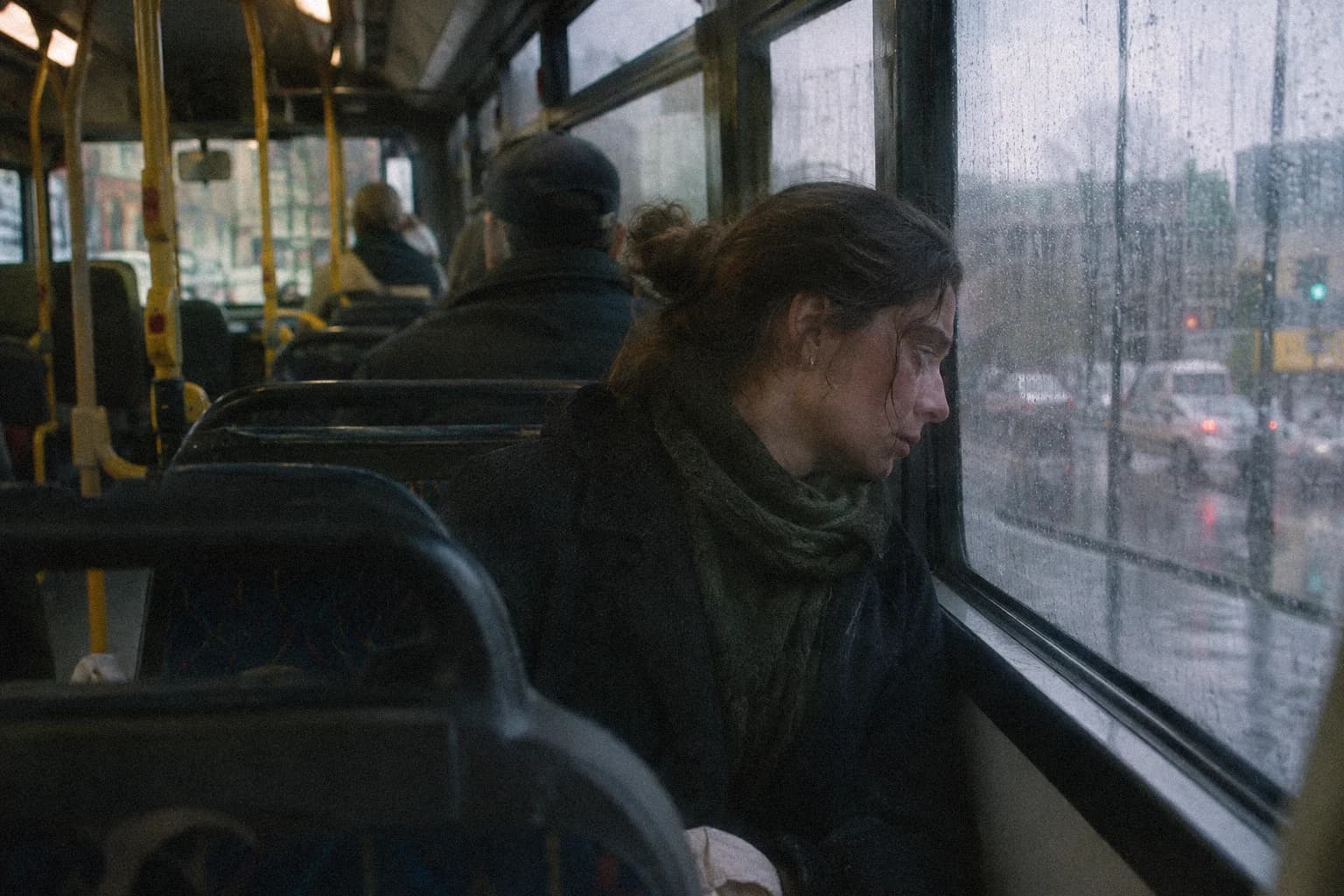
Why can’t I cry: what the absence of tears does not mean
Why can’t I cry
Because tears are not a gauge. They come at the end of a chain with several locks on it: the emotion has to rise, the body has to let it through, and the place you are in has to allow it. One closed lock is enough for nothing to come out, even though everything else is in place.
Most of the time, the lock that holds is the third one. A whole day goes by being available: answering, deciding, reassuring, driving. Nothing in that day looks like a moment where you could fall apart, and the body learns very quickly not to offer what has no place.
Then the day stops. A Tuesday in November, engine off in a supermarket car park, the bags still in the boot: that is usually where it should come. And it does not. The throat tightens, the eyes sting for a second, and the second passes.
This has nothing to do with a lack of feeling. It is closer to a door you have held shut with your shoulder all day: the moment you want to open it, your arm does not answer the way you hoped. What has settled in is not indifference, it is holding.
Two things get confused here. Not managing to cry while sadness is clearly rising is a problem of expression. Feeling nothing at all is something else, with its own mechanics: if you recognise yourself more in that sense of inner emptiness, the article devoted to it will speak to you more directly than this one.
Is it normal not to cry when you are sad?
Yes, and the research on this is more counter-intuitive than people assume. The common belief says that the more you suffer, the more you cry. It has been tested, and it did not hold.
In 2002, Jonathan Rottenberg and colleagues showed the same film clip, chosen to make people cry, to participants with major depressive disorder and to participants without depression. The result ran against the starting hypothesis: crying was no more likely in the depressed group. Among the non-depressed participants who cried, they also measured a clear rise in reported and displayed sadness, with greater cardiac and electrodermal activation. Among the depressed participants who cried, that activation was far less visible.
In other words, tears and the intensity of what is felt do not necessarily travel together. They can flow with little behind them, and stay away while everything is present. The authors read this as a clue about how emotions are dysregulated in depression, not as a measure of suffering.
This is worth saying plainly, because a lot of people hold it against themselves: not having cried at a funeral, at a diagnosis, at the end of a relationship. Grief has never needed to be visible in order to exist.
The reverse exists just as much: tears that arrive at work over something tiny, with no identifiable cause. That is the subject of another article, on tears that come for no reason, and it is the same chain seen from the other end.
What the throat is doing in the meantime
Something physical is happening, and it is often the only sign people notice. The throat closes. You swallow for nothing. The top of the chest locks in a high position, the in-breath turns short and the out-breath never reaches the end.
That sensation has a name in everyday language, and it is well documented on the stress side: it is the lump in the throat, a tension in the muscles of the neck and larynx that goes with holding back. It is not a sign that nothing is coming: it is precisely the mechanism that stops what is coming from reaching your eyes.

Try to notice what your jaw is doing at the same moment. In most cases it is clenched, the tongue is pressed to the palate, and the breath is suspended high in the chest. It is a posture of waiting, the one you take to hold on for another ten minutes.
The useful detail is that this posture keeps itself going. As long as the breath stays short and high, the body holds on to the message “this is not the moment”. So the job is not to produce tears: it is to remove what is holding them.
Tears are not the proof. They are a consequence, and a consequence has conditions.
Why forcing yourself to cry does not work
The sad playlist, the film that worked five years ago, the photograph you put in front of your eyes on purpose: these attempts almost always fail, and not by accident.
First because they set a goal, and therefore a judge. You watch yourself not crying. That is the situation in which holding back is strongest, and it is what the work on the social context of crying describes: Asmir Gračanin, Lauren Bylsma and Ad Vingerhoets note that embarrassment and shame block the expected benefit, and that the presence of several onlookers is linked to worse outcomes than the presence of one close person.
Second because the promise itself is shaky. The same authors conclude that evidence for a direct soothing effect of tears is largely inconsistent. In the lab, mood measured right after crying tends to be lower than before; the studies where people report feeling better afterwards rest on memory, and memory is shaped by the widespread belief that crying helps. If it exists, that benefit appears to be delayed by several minutes, which no two-minute attempt in front of a screen ever allows.
The nuance cuts both ways. It takes the weight out of the instruction to “let it all out”, and it explains why you sometimes feel hollow and worse right after a crying fit, when you expected the opposite.
What remains is the most common experience, in one sentence: it comes when you stop asking for it. Not because tears are capricious, but because the asking is one of the locks.
The conditions that loosen things, and how to set them up
So the work is not to aim at tears. It is to set up the three conditions the body waits for, and then to expect nothing. Count on twenty minutes, in the evening if possible, a slot after which nobody needs you.
Nothing to hold together afterwards
An emotion does not open if the next half hour requires you to look presentable. That is why so many people cry in the shower or in the car: they are the only places with no immediate sequel. Choose your slot on that criterion, not on your diary.
Alone, or with one person
Both of those work, the third does not. Someone you do not have to explain yourself to, or nobody at all. A group, however kind, puts an audience back in the room.
The out-breath, not the in-breath
This is the only technical move, and it runs against the reflex. We tend to look for a big in-breath, which lifts the shoulders further. Do the opposite: let the air leave through the nose, slowly, all the way to the end, without pushing, then wait for the in-breath to come on its own.
Put your attention on one precise point: the coolness of the air at your nostrils as it enters, and its warmth as it leaves. It is a tiny marker, and that is what makes it usable. There is nothing to tell yourself, nothing to provoke, just a place to come back to when your head wanders off.
After a few minutes, the jaw usually releases first, then the throat. At that point, if something rises, do not examine it: crying stops dead as soon as you comment on it. And if nothing rises, the session has not failed. You removed one lock out of three, and that was the one within reach tonight.
A useful detour for some people: putting a word on what is happening, before trying to feel it. Naming an emotion precisely changes how it presents itself, and sadness sometimes only recognises itself once it has been told apart from the anger or the tiredness covering it.
This approach does not suit everyone. If the absence of tears follows a specific, recent event, a bereavement or a shock, the body’s silence is often a protective measure, and pushing it brings nothing good. In that case the move to make is not a breathing one: it is to talk to someone qualified.
When the absence of tears deserves medical advice
Three situations fall outside this article, and it is better to say so than to imply that breathing fixes everything.
A treatment in progress. Emotional blunting on antidepressants is common and poorly known by patients. In a survey by Guy Goodwin and colleagues of 669 depressed people on treatment, 46 % reported it. This is neither inevitable nor a reason to stop anything on your own: it is a consultation topic, because adjustments exist.
Dry eyes. If the dryness is not limited to emotional moments, and comes with a dry mouth or constant discomfort, it is an eye question before it is an emotional one. A doctor will settle it in minutes.
A lasting absence of feeling. If nothing has reached you for weeks, neither bad news nor good, and pleasure has gone with it, tears are only the most visible symptom. The available data do not tell us how long is too long, but a few weeks is enough to justify an appointment with a GP or a psychologist.
For everything else, the good news is that this lock is not a broken part. It opens when the conditions return, and they return more often than people think once you stop watching for the result.
Frequently asked questions
- Is it bad if I can’t cry?
- In the vast majority of cases, no. The absence of tears says something about context and the habit of holding back, not about the intensity of what you are going through. It deserves medical advice in three cases only: antidepressant treatment in progress, permanently dry eyes, or an absence of feeling that has lasted several weeks and has taken pleasure with it.
- Why can’t I cry when I am sad?
- Because crying needs three things, not just sadness: the emotion, a body that lets it through, and a place that allows it. A whole day spent being available closes the third lock, and the throat stays tight even when everything else is there. A 2002 study also found that depressed participants did not cry more than others in front of a film chosen to make people cry.
- How can I make myself cry?
- By stopping aiming at tears. Set aside twenty minutes after which nobody needs you, stay alone or with one person you trust, then let the air leave slowly through the nose, all the way, without forcing the in-breath. The jaw releases first, the throat second. If nothing comes, that is not a failure: holding back rarely gives way on the first try.
- Do antidepressants stop you from crying?
- They can dampen the whole range of emotional reactions, pleasant ones included. A survey of 669 depressed patients on treatment reported emotional blunting in 46 % of them. The effects of the medication and those of the illness remain hard to separate, and adjustments exist: this is a conversation to have with the prescribing doctor, never a decision to stop taken alone.
- Why can I cry at a film but not about my own life?
- Because a film asks nothing of you afterwards. Tears about your own life bring consequences, decisions, sometimes people you will have to tell, and the holding back rises with those stakes. Crying over fiction is a real release valve, not cheating: it shows the chain works and that the context is what blocks it.
- Does crying actually help?
- Less mechanically than people say. The available work concludes that evidence for direct relief is inconsistent: in the lab, mood measured right afterwards tends to be lower, and the relief people report later is shaped by the belief that crying helps. When a benefit does appear, it seems delayed by several minutes and depends heavily on the comfort received.
Sources
- Crying threshold and intensity in major depressive disorder — Rottenberg, Gross, Wilhelm, Najmi & Gotlib, 2002
- Is crying a self-soothing behavior? — Gračanin, Bylsma & Vingerhoets, 2014
- Emotional blunting with antidepressant treatments: A survey among depressed patients — Goodwin, Price, De Bodinat & Laredo, 2017