Why I jump at every little noise: a threshold, not a weakness
The noise has not changed, your threshold has
If you have been jumping at every little noise for a few weeks, your nervous system is holding a lower alarm threshold than it used to, not picking up more sound. The front door of your building slams at exactly the volume it did six months ago. What moved is how much response your body puts into it.
The distinction sounds academic. It changes everything, because it moves the question. As long as you believe the noises are the problem, you try to remove them: close, insulate, move away, put on headphones. Once you understand it is a threshold, you look for what is holding it low, and that list is short.
It comes down to three things, each separately documented: a state of anxiety that lasts, sleep debt, and a sound environment that has become so quiet your hearing has recalibrated to it. None of the three is a personality trait, and all three can be removed.
There is also something rarely said: the threshold rises roughly as fast as it fell. Count days when sleep is the cause, weeks when it is a demanding stretch coming to an end.
The startle fires before you have identified the sound
The acoustic startle is not a reaction, it is a reflex. The difference is anatomical: the signal does not detour through the regions that recognise sounds and decide what to make of them. It takes a short route through the brainstem and comes out as muscle contraction a few tens of milliseconds after the sound.
In practice, you have already jumped by the time “it is only the door” arrives. Hence that strange, familiar sequence: the body goes first, then the head explains. You cannot stop the first with the second.
This circuit exists in every mammal and in every person. So there is nothing to correct in the reflex itself, and that is the first item to take off the table: startling is not a failure of composure, it is standard equipment.
What matters for us is that the reflex is adjustable. Its size is not constant: it is continuously modulated by the state of the nervous system at the moment of the sound. That is exactly what makes it a measuring instrument, and why labs studying anxiety have relied on it for forty years.
Anxiety does not create the startle, it turns up its volume
Christian Grillon, who has built most of his work on this measure, reviewed in 2008 what startle studies teach us about anxiety. His central distinction is useful here: fear is a brief response to an identified threat, anxiety a sustained state of apprehension about an uncertain threat, and it is the second state that comes with hypervigilance. Both amplify the startle, but only the second lasts for weeks.
The word uncertain does the work. A known danger mobilises you, then resolves. A threat that might arrive, with no clue as to when or in what form, requires staying ready continuously. The system cannot hold that posture without paying somewhere, and the startle is one of the places where the bill becomes readable.

Which is why the problem rarely arrives alone. Irritability climbs at the same time, for the same reason and by the same mechanism: a low threshold answers everything, including an unremarkable comment. We covered that side of it in our article on snapping at nothing (in French), and the two pieces describe the same setting seen from two angles.
Constant anticipation feeds the same state. Trying to foresee every eventuality means holding the system on alert all day, and that is a mental habit more than a trait: we described it in our article on the need to control everything.
Last night matters more than you think
One factor acts faster than all the others, and it is also the easiest to test on yourself: how you slept the night before.
In 2007, Seung-Schik Yoo and colleagues used imaging to compare the brain response of volunteers deprived of one night of sleep with that of rested volunteers, looking at negative images. The amygdala of the sleep-deprived participants responded markedly more strongly, and its functional coupling with the medial prefrontal cortex was weakened. The authors describe the result as a disconnect between the alarm and the brake.
A more sensitive alarm with a loosely connected brake: that is a precise description of a day spent jumping at a bin lid. If you test one thing this week, test two decent nights in a row before concluding anything about your sensitivity to noise.
Of course you have to be able to sleep, and that is often where the loop closes: a system on alert does not stand down on command. We went through that specific deadlock in our article on being exhausted and still unable to fall asleep.
Do I jump because I hear better than other people?
That is the conclusion almost everyone reaches, and the available data do not support it.
In 2001, Wolfgang Ellermeier and colleagues approached the question through audiometry: they compared people who described themselves as highly noise sensitive with people who did not, across a battery of psychoacoustic measures. The absolute hearing thresholds of the two groups did not differ, and the authors conclude that self-reported noise sensitivity reflects the appraisal of sound rather than its detection.
Put differently: the same intensity reaches the ear, and what is done with it afterwards differs. This is not good news in the sense that the problem would be imaginary. It is good news in the sense that the lever is not in the ear, which cannot be adjusted, but in the state of the system processing the signal, which can.
There is a practical corollary. Many noise-sensitive people reassure themselves that they simply have finer hearing, and conclude there is nothing to be done. The measurements suggest the opposite: nothing in the ear is at fault, so there is precisely something to be done elsewhere.
One caveat so as not to overread this study: it rests on a modest sample and on questionnaire-reported noise sensitivity, not on clinical hyperacusis, where everyday sounds become painful. The two are not the same thing, and the second belongs with an ENT specialist.
Incidentally, the same confusion turns up in meditation practice: plenty of people believe they need a silent room because they are more sensitive than average. That question deserves its own treatment, and we gave it one in our article on meditating in a noisy environment.
Why shutting out noise all day makes it worse
Here is the point where common sense turns against you.
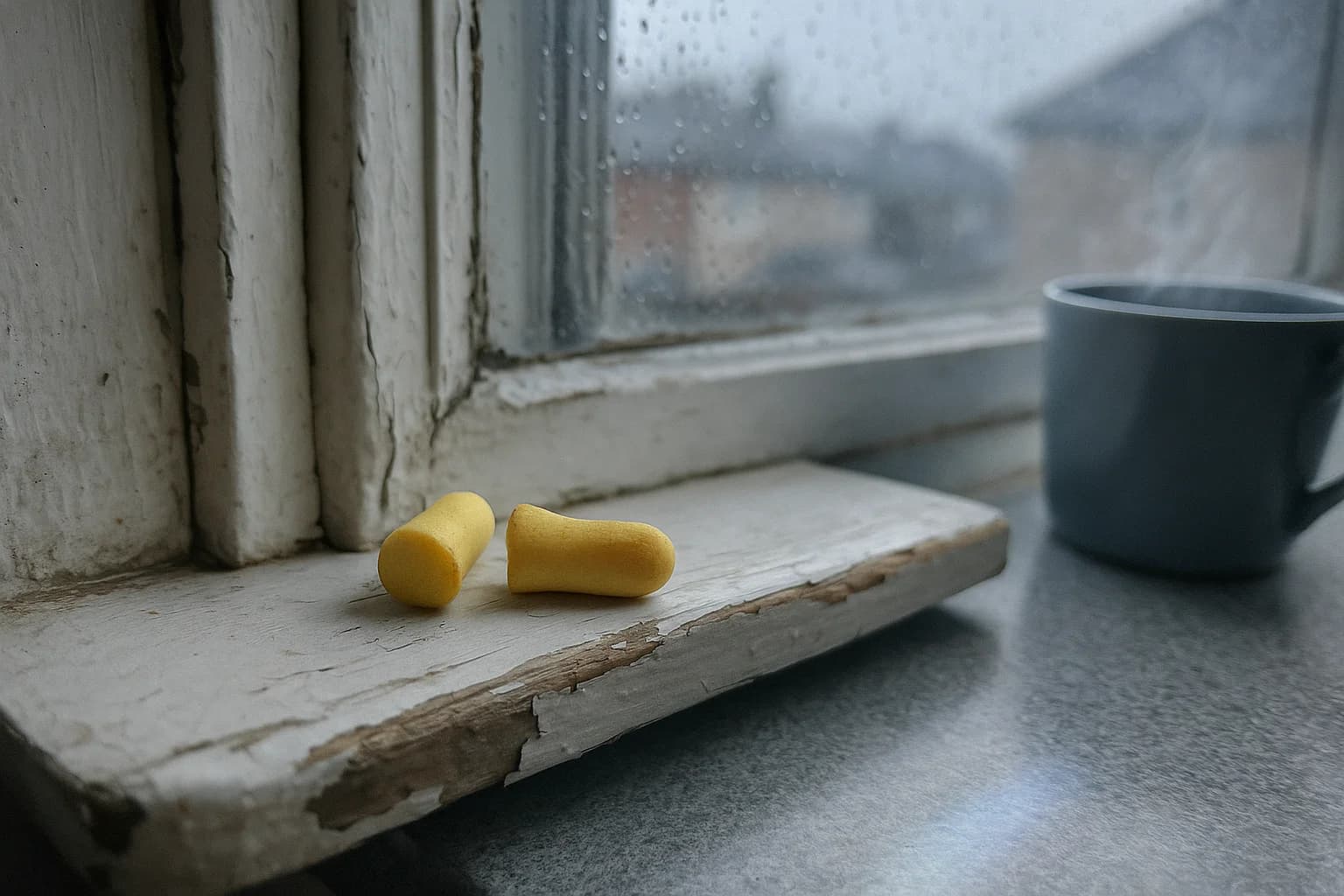
When sounds start to grate, the first measure that comes to mind is to dampen them: foam plugs at the office, noise-cancelling headphones on the train, then at home, then in the evening. The relief is immediate, which is exactly what makes what follows hard to see.
In 2003, Craig Formby and colleagues tested the hypothesis head on. Participants spent two weeks wearing either earplugs that attenuated the background sound level, or low-level noise generators that raised it. The group that had attenuated its environment afterwards judged sounds louder than before, and the group that had enriched it judged them softer. Loudness calibration had shifted in both directions, in two weeks.
Hearing tunes itself to the level you expose it to: permanently protecting an ear that is not at risk teaches it that the world is too loud.
The practical consequence is not to endure everything. A concert, a drill, a workshop warrant protection, and no data say otherwise. The problem is continuous use in places where the level is in no way hazardous, which is most of an ordinary day.
And there is an honest limit to this study: a small sample, two weeks, and adult participants whose sound tolerance was normal to begin with. It does not license removing hearing protection from people being treated for hyperacusis, where that decision is made with a professional.
Bringing the threshold back up, in practice
Three moves, in order of measurable effect, and none of them needs equipment.
1. A longer exhale than inhale, for two minutes
This is the only lever that acts within the minute on the state of the nervous system. The principle is plain: breathe in through the nose counting to four, then out through the mouth counting to six or eight. The ratio matters more than the exact numbers, and the lengthening has to be on the way out.
Zaccaro and colleagues' systematic review, published in 2018, pulled together the available work on slow breathing. The authors associate slow breathing with increased heart rate variability and a predominance of parasympathetic activity, with reported effects on comfort and alertness. They also note that protocols vary widely between studies, which limits firm conclusions.
For the shortest version of this move, two successive inhales through the nose followed by a long exhale, we wrote the protocol out step by step in our article on the physiological sigh (in French).
2. Two decent nights before any verdict
The second move is not really a move: it is a test. Before concluding that you have become sensitive to noise, give yourself two full nights of sleep and watch the following evening.
This test is worth running before the others, because it is usually decisive and costs nothing but time. It also fails for one simple reason sometimes: you cannot sleep. In that case it is the hyperarousal that needs attention, not the noise.
3. Make the background a little less silent
The third move runs against intuition, and it follows directly from what the Formby study shows. Rather than chasing silence, keep a low, steady background level: a window ajar, a fan, rain recorded at low volume.
The aim is not to cover the noises. It is to stop every sound standing out against total silence, and to stop training your hearing to find the world too loud. It is also what makes early evenings more bearable, when the street empties and every creak of the floor becomes audible.
A word on what to expect, because quick promises do not hold here. For the first few days you will startle just as much, and you will simply notice it slightly earlier. The change reads over two or three weeks, provided the underlying cause has shifted: no breathing exercise offsets a long stretch of pressure or four nights of five hours.
When it is more than stress
An article like this one has to say where it stops, and it stops in three places.
The first is auditory. If ordinary sounds become genuinely painful rather than merely unpleasant, if the discomfort comes with tinnitus, a sense of fullness in the ear or reduced hearing, or if it appeared suddenly after heavy sound exposure, seeing an ENT specialist is not a comfort measure. Hyperacusis is a documented condition, distinct from the noise sensitivity described above, and it has its own management.
The second is the intensity of the alert state. An amplified startle that comes with panic attacks, exhaustion that rest does not touch, a sense of danger with no identifiable cause, or that appeared after a violent event, is no longer a sleep-setting matter. A GP is the right first stop, and there is nothing to gain from waiting it out.
The third is avoidance. The day noise sensitivity starts deciding your routes, your invitations and which rooms you sit in, the problem is no longer the sound, it is the shrunken perimeter of your life. That is a reason to consult in its own right, with no pain and no tinnitus required.
For every other case, which is the vast majority, what is left is what this article describes: a threshold, three known causes, and a setting that rises once they are removed. The startle itself will stay. It will simply be proportionate to the noise, which is after all what it is for. If other physical signs come along during a stretch like this, they often belong to the same setting, as we saw with an eyelid that will not stop twitching.
Frequently asked questions
- Why do I jump at every little noise when I feel calm?
- Because the alarm threshold does not track your mood, it tracks the state of your nervous system, which stays elevated for days after a demanding stretch. You can feel settled on a Sunday morning and still jump at a shutter banging, simply because the week before was long. The lag is normal and it fades over the following days.
- Is being easily startled a sign of anxiety?
- It is one sign among several, never a diagnosis on its own. An amplified startle response is documented in sustained anxiety states, but it also follows a bad night, a recovery from illness, caffeine, or an environment that has become unusually quiet. What points somewhere is the rest of the picture and how long it lasts, not the startle alone.
- Is the jolt I get while falling asleep the same thing?
- No, that is a separate phenomenon: the hypnic jerk, the sudden twitch that happens during the transition into sleep, often with a falling sensation. It needs no sound to trigger it and a large share of the population experiences it. It is considered harmless, although it tends to become more frequent when you fall asleep in sleep debt.
- Why am I jumpier at night?
- Three things stack up at the end of the day. The background sound level drops, so every noise stands out more against the quiet. Accumulated fatigue has reduced your filtering capacity. And it is the hour when anticipatory thinking returns, which keeps the alert state going. The same sound simply does not land the same way at 9am and at 11pm.
- Should I wear ear plugs if I am sensitive to noise?
- In genuinely loud settings, yes: a concert, a drill, a workshop. All day in an office or a flat, no. The available data indicate that hearing recalibrates to the level you expose it to, so permanently attenuating a harmless environment lowers your tolerance for sound rather than preserving it. Targeted use beats continuous use.
- What does an ENT specialist do about noise sensitivity?
- They start by ruling out a hearing cause. The work-up usually includes an examination of the ear canal and eardrum, pure-tone audiometry to measure hearing thresholds, and often a measurement of loudness discomfort levels, which puts a number on where sound starts to become hard to bear. That last figure is what separates hyperacusis from discomfort kept going by an alert state, and the two are not managed in the same way.
Sources
- Models and mechanisms of anxiety: evidence from startle studies — Grillon C, 2008
- Psychoacoustic correlates of individual noise sensitivity — Ellermeier W, Eigenstetter M, Zimmer K, 2001
- The human emotional brain without sleep: a prefrontal amygdala disconnect — Yoo SS, Gujar N, Hu P, Jolesz FA, Walker MP, 2007
- Adaptive plasticity of loudness induced by chronic attenuation and enhancement of the acoustic background — Formby C, Sherlock LP, Gold SL, 2003
- How Breath-Control Can Change Your Life: A Systematic Review on Psycho-Physiological Correlates of Slow Breathing — Zaccaro A, Piarulli A, Laurino M, Garbella E, Menicucci D, Neri B, Gemignani A, 2018