Exhausted but can’t fall asleep: Rémi, 39, and the winter he stopped counting hours
Composite case: the first names, ages and situations in this story are drawn from several accounts and match no real person. No individual health outcome should be inferred from them.
I never fell asleep by trying. I fell asleep the night I stopped expecting anything from it.
Why you can be exhausted and unable to sleep
Because tiredness and sleep onset do not run on the same system. Sleep pressure builds in the body hour after hour, but it triggers nothing while your level of alertness stays high. You can be completely drained and perfectly awake, with no contradiction at all.
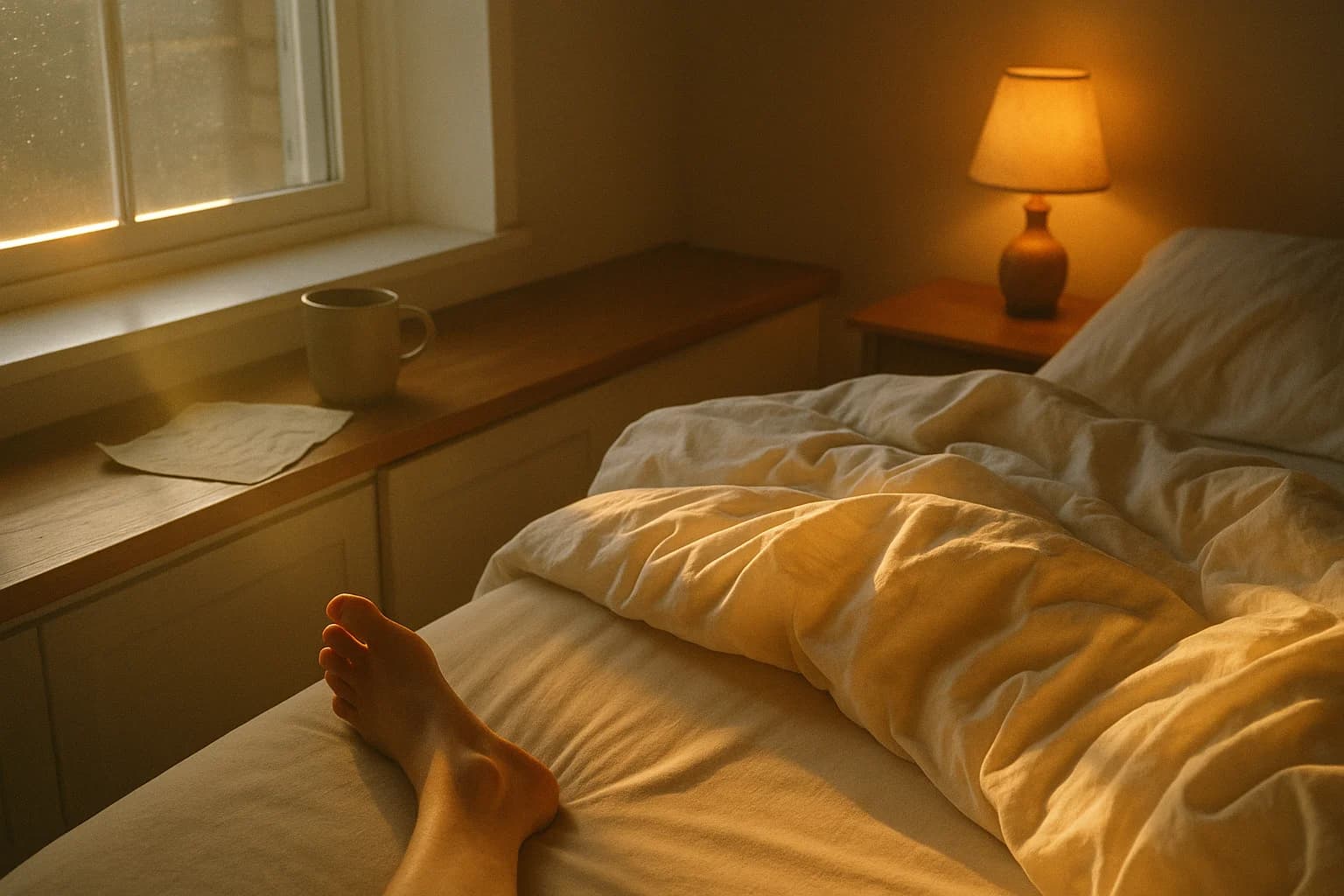
Rémi, 39, a project manager at a software company, puts it his own way: “my body was two days ahead of my brain, and nobody was closing the gap”. Between November 2025 and January 2026 he went to bed around midnight and fell asleep somewhere between one and two in the morning, for a 6.40 alarm. Spotting the fatigue took no effort. He felt it on the stairs, in the words that would not come during meetings, in a short temper he did not recognise.
The bed changed nothing.
This account belongs to one person, reconstructed from their testimony and anonymised. It illustrates a mechanism; it is neither a diagnosis nor a protocol.
Why won’t the brain sleep despite the fatigue?
The explanation that holds up best is hyperarousal. In a landmark review, Riemann and colleagues (2010) describe chronic insomnia as a state of activation that never comes back down: brain activity, the stress axis, heart rate, everything sits one notch above baseline, day and night. The problem is not a lack of fatigue, it is an excess of vigilance. Their synthesis is available in Sleep Medicine Reviews.
A second model fills in the picture, and this one stings more. Espie and colleagues (2006) propose a three-step chain: attention, intention, effort. Falling asleep behaves like a largely automatic process. The moment you pay attention to it, set yourself the goal of sleeping, then put effort into it, you inhibit exactly what you are after.
Put differently, the person trying hardest is often the one sleeping worst. That is not a character flaw.
This loop has a well known cousin, the night spent ruminating, where the mind circles the content of thoughts rather than sleep itself. We covered it in our piece on thinking too much to fall asleep (in French). The two mechanisms feed each other: you ruminate, so you do not sleep, so you monitor your sleep, so you ruminate.
Eight weeks of doing everything right
Before any of this, Rémi did what most people do. He did things properly.
Screens off at nine. Magnesium. Herbal tea. Bedroom at eighteen degrees. Lights out at half past ten, no exceptions, weekends included. A breathing app, six cycles a minute, fifteen minutes before bed. And a notebook where he logged his estimated sleep onset and the number of wake-ups.
“I was managing my sleep like a project running late”, he says. That is precisely what he was doing, and precisely the problem.
Slow breathing in particular made him angry. It worked for his partner, not for him. That gap is far from unusual and we documented it elsewhere, in the case of coherent breathing that does not work for everyone: a regulation tool turns against you as soon as you use it as a lever to obtain a result.
Eight weeks later, his notebook was full and his nights were identical.
The instruction that annoyed him: stop trying to sleep
In February 2026, a sleep nurse consulted about something else entirely gave him an instruction he found absurd. Stop trying to fall asleep. Go to bed, keep your eyes open in the dark as long as you can, and above all expect nothing from the night.
The method has a name, paradoxical intention, and it has circulated in psychotherapy since the 1960s. The principle fits in one sentence: if effort blocks sleep, you remove the effort by removing the goal.
It is no curiosity. Jansson-Fröjmark and colleagues (2022) published the first meta-analysis of it, across ten eligible trials. Against passive comparators, paradoxical intention produced large improvements in key insomnia symptoms, along with a marked drop in what the authors call sleep-related performance anxiety. Against active treatments, the effect held but became moderate. The authors themselves conclude that methodologically stronger studies are needed before firmer conclusions can be drawn.
Contrary to what you often read, the instruction is not to fight to stay awake. Rémi started there and spent two nights worse than the previous ones: he had swapped one goal for another, with the same effort and the same tension. What counts is dropping the stakes, not the direction you push in.
The kinship with the observing stance trained in meditation is obvious, the one that consists of watching your thoughts without trying to fix them. In both cases, you take your hand off the wheel.
The hourglass, from week three onward
Rémi did not last three nights lying with his eyes open in the dark. Too uncomfortable, too mechanical. What took hold, in week three, came from an image.
An hourglass. Nothing else.
Lying down, he pictured an hourglass on the nightstand and watched the sand fall. Not to count. Not to measure. The value of the image rests on one simple property: you can watch an hourglass, you cannot hurry it. Each exhale matched a little less sand in the upper bulb.
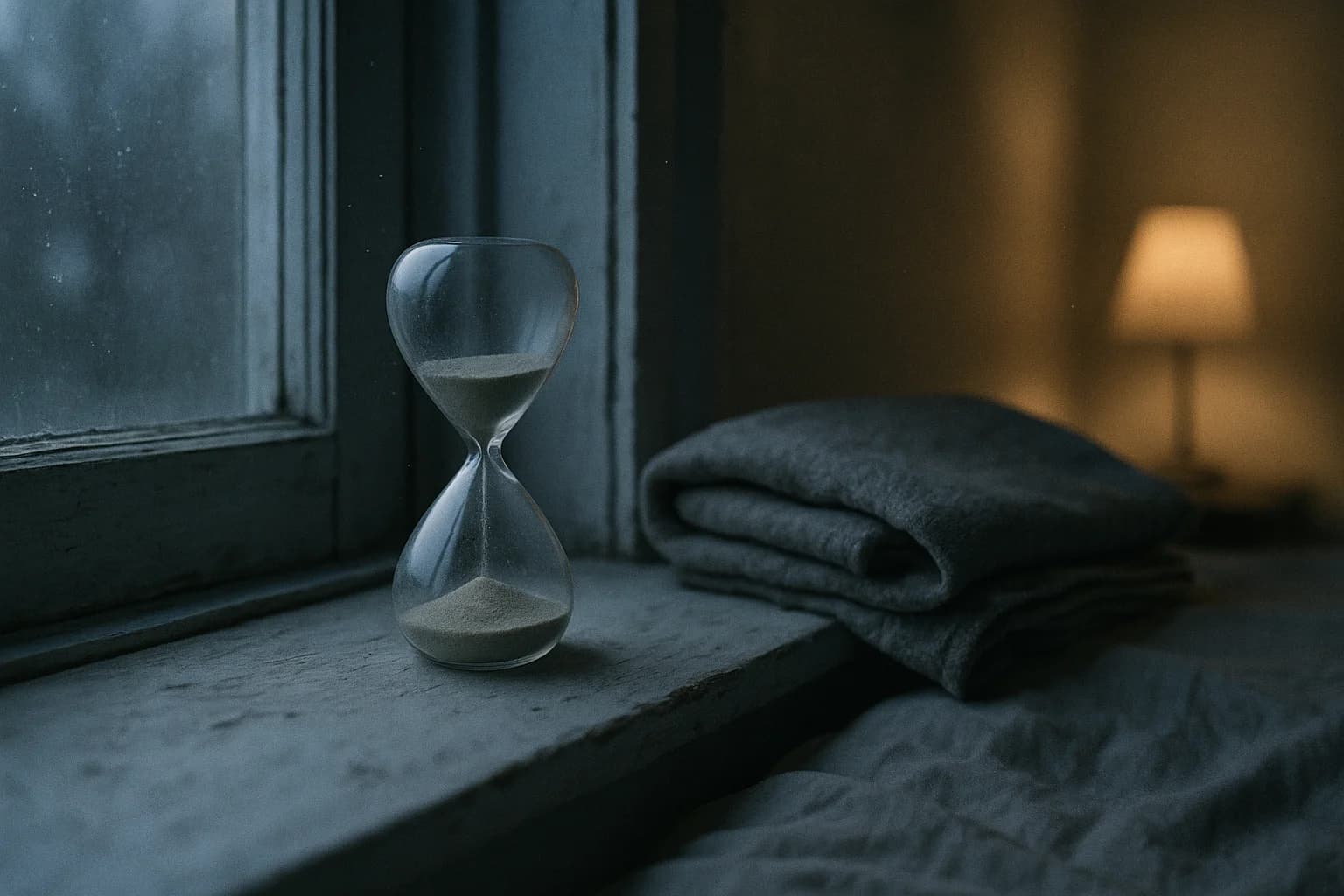
What made the image workable comes down to very little. It occupies attention without handing it a task, which prevents the slide into monitoring. It already contains the idea of waiting, so waiting stops being a failure. And it has no end state to reach: when the sand has run out, you turn the hourglass over, and that is all.
The first few nights, he turned his imaginary hourglass ten or twelve times. He never remembered it in the morning.
For mid-night wake-ups he kept the same image rather than getting up, which does not suit everyone: our guide on what to do after waking in the night (in French) sets out the cases where staying in bed backfires.
Six weeks later: what moved, and what did not
In mid-March 2026 the notebook was read one last time before going into a drawer.
He described falling asleep markedly sooner than before, with a minority of nights still bad. This is not a cure, it is a problem moved out of the zone where it did the most damage.
What changed most is not in the numbers. Rémi describes the disappearance of what he calls “the three o’clock minute”: that moment, awake, when he counted the hours left and concluded the day was already ruined. The arithmetic went before the insomnia did.
What did not move: he is still a fragile sleeper, sensitive to the week’s stress, and bad news still keeps him up. Physical tension at bedtime took far longer to ease than the rest, which is common and which we cover in our article on being unable to relax on command.
When this is the wrong track
This approach does not fit every sleepless night, and that needs saying plainly.
It does not address insomnia with a physiological cause. Snoring with breathing pauses, morning headaches, heavy daytime sleepiness, a dry mouth on waking: these point to sleep apnoea, and no mental image treats apnoea. The same goes for chronic pain, restless legs, a thyroid disorder or a medication side effect.
Nor does it address exhaustion that comes with a loss of interest in everything, dark thoughts, or very early waking with no way back to sleep. That picture calls for medical advice, not a technique.
Then there is the most ordinary limit. Beyond three months of difficult nights at least three times a week, this is chronic insomnia, and cognitive behavioural therapy for insomnia sits among the recommended first-line treatments. Paradoxical intention is in fact one of its components, which partly explains why it beats nothing and loses to the full programme.
Rémi did eventually see someone, six months after that instruction, about something else. He still sleeps badly two nights a week. He no longer counts them.
Frequently asked questions
- Why am I exhausted but can’t fall asleep?
- Because tiredness and sleep onset rely on two distinct mechanisms. Sleep pressure builds in the body across the day, but it only triggers sleep if your level of alertness comes down. When the nervous system stays activated, through stress, anticipation or sheer habit, fatigue can be at its peak while sleep stays out of reach.
- Can forcing yourself to sleep make insomnia worse?
- The available evidence points that way. The attention, intention, effort model describes sleep onset as a largely automatic process that gets inhibited by the attention you pay to it and by attempts to control it. In practice, watching the clock, counting the hours left and setting yourself the goal of sleeping all sustain the very wakefulness you want to end.
- How long should you stay in bed when sleep does not come?
- There is no universal figure, and checking the clock to measure it is already counterproductive. A common marker in behavioural therapy is irritation: once frustration builds, the link between bed and sleep erodes, and getting up for a few minutes of something calm beats turning over in the sheets.
- Does meditation help when you are tired but wide awake?
- It can, as long as you do not use it as a tool to fall asleep. A practice used as a performance lever becomes one more attempt at control. What seems to help is occupying attention without giving it a goal, through an image or a sensation that asks for no result.
- When should you see a doctor about exhaustion without sleep?
- Beyond three months of difficult nights at least three times a week, this is chronic insomnia and medical advice is warranted. Seek it sooner if you snore with breathing pauses, wake with headaches, feel heavy daytime sleepiness, or if the exhaustion comes with a broad loss of interest and dark thoughts.
Sources
- The hyperarousal model of insomnia: a review of the concept and its evidence — Riemann et al., 2010
- The attention-intention-effort pathway in the development of psychophysiologic insomnia: a theoretical review — Espie et al., 2006
- Paradoxical intention for insomnia: A systematic review and meta-analysis — Jansson-Fröjmark et al., 2022