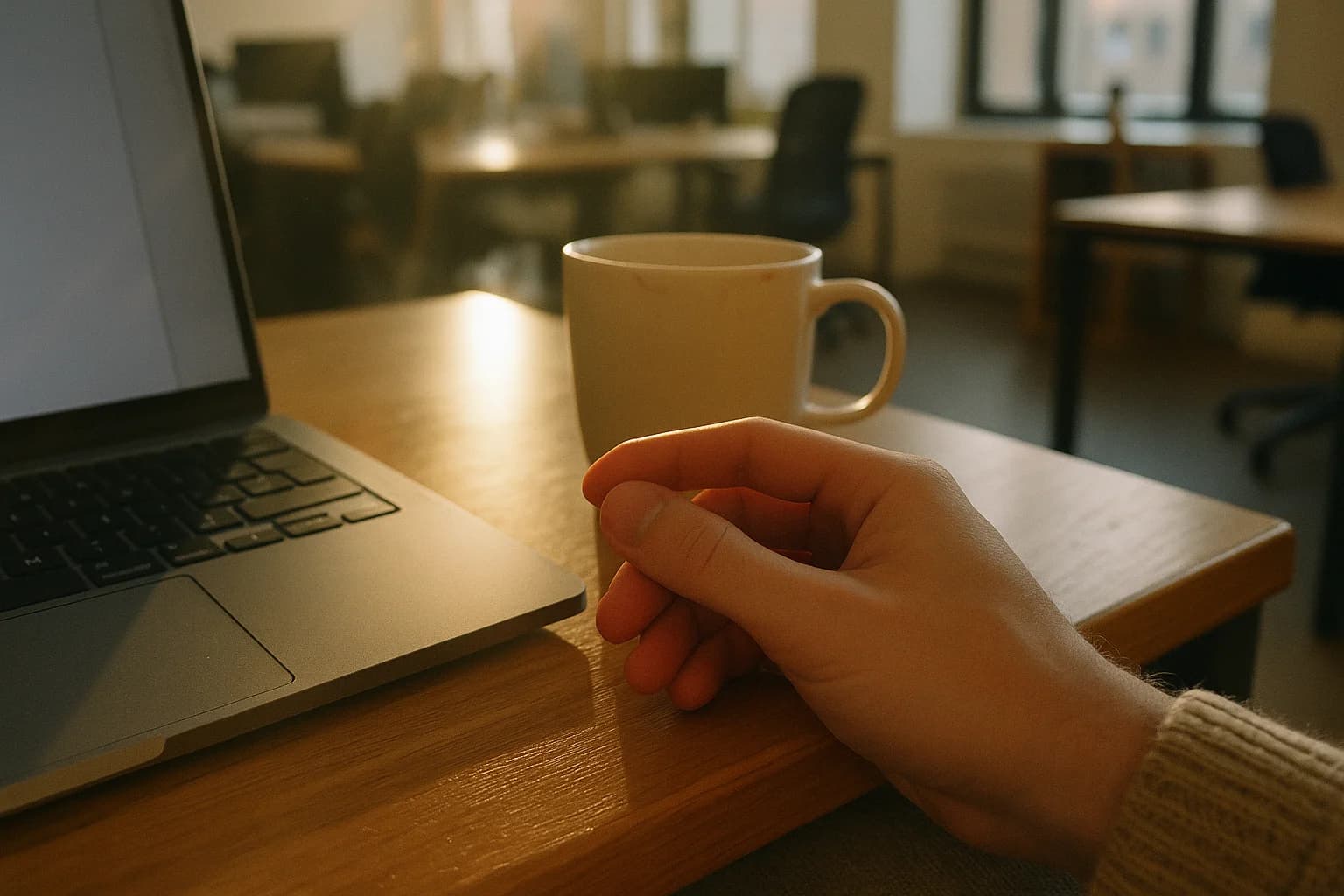
How to calm down discreetly at work: 5 moves nobody sees
How do you calm down discreetly at work?
It comes down to one rule: work on what nobody can see. Hands, breath and body weight can all be adjusted without the face, the voice or the posture moving, and that single criterion is what kept the five moves below.
It is more selective than it sounds, because it rules out most of the usual exercises. Closing your eyes, breathing out loudly, placing both hands on your belly, lying down: all impossible during a tense meeting or a client call going sideways.
The five moves take between ten seconds and two minutes. You can run them in order or keep just one, whichever comes most naturally. If what you actually want is a steady footing when everything scatters at once, our guide to grounding exercises (in French) covers the same intention with different supports.
How do you avoid showing stress at work?
By stopping holding it in. It sounds backwards, and yet what shows from the outside is almost never the emotion itself: it is the effort of containing it.
Watch someone tense in a meeting: what stands out is unnatural stillness, a breath held high in the chest, shoulders raised by two centimetres. Stress does not read on the face, it reads in the rigidity. Releasing a little of that rigidity therefore makes you more discreet, not less.
There is a second layer, and that one really is invisible. Plenty of people double the tension with a harsh internal commentary: « it shows », « I am going to blow this ». That commentary soothes nothing and eats the attention you are short of at that exact moment, as our piece on being too hard on yourself (in French) sets out.
The jaw deserves its own mention: it is the muscle you can clench for hours without anyone noticing, and usually without noticing yourself. Our jaw relaxation exercises cover that point in detail.
Step 1: Rub your thumb against your index finger, slowly (30 seconds)
Hand on your thigh or on the edge of the table, slide the pad of your thumb across the pad of your index finger. Slowly, no pressure, roughly one back-and-forth per second. Then return to that sensation every time your head wanders off.
The slowness is not a stylistic detail. A fast, nervous rub is just one more discharge of tension; a slow, regular movement works as an anchor attention can come back to. It is the role the breath plays in seated meditation, moved to a place where closing your eyes is not an option.
Try counting, next time a budget meeting goes nowhere good: seven times in twelve minutes your attention leaves for a disaster scenario, and seven times the thumb brings you back into the room. The meeting does not become pleasant. It simply becomes a meeting again.
The same gesture is the heart of a more personal piece on what the fingers know and the head forgets (in French), if you want the substance rather than the instructions.
Step 2: Rest one hand flat, and stop moving it (1 minute)
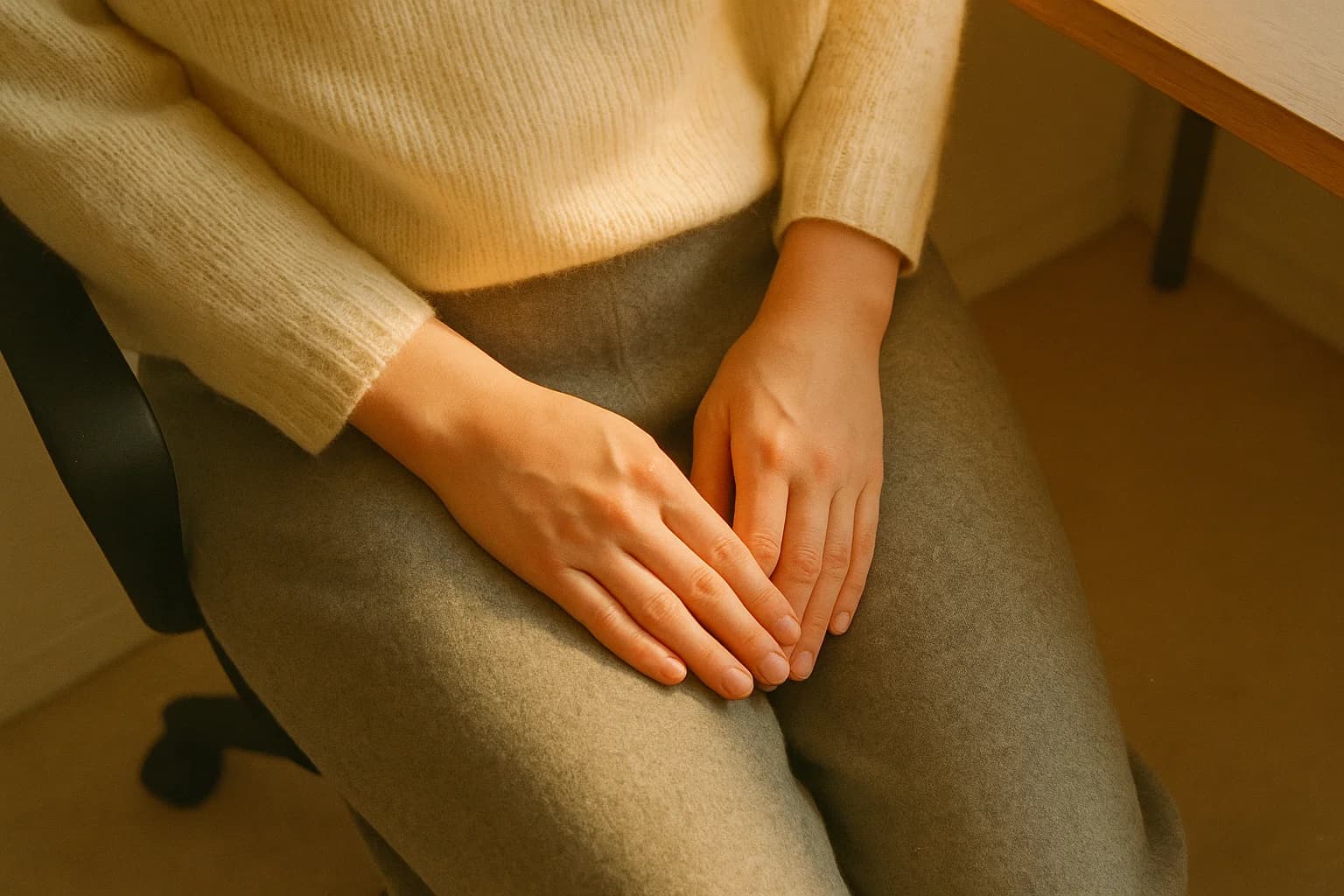
Place one hand flat on your thigh, palm against the fabric, and leave it there. No tapping, no shifting. If you are alone at your desk or off camera, a hand on the breastbone works even better.
This is not autosuggestion. In a randomised trial with 159 people put through a standardised social stressor, those who used a self-soothing touch gesture showed a lower cortisol response than the control group, at a level comparable to those who received a hug (Dreisoerner et al., 2021). The contact of your own hand is enough to engage the physiological route that brings alertness back down.
One minute is enough. The warmth building under the palm is the sign that something has shifted, and it is also what makes the gesture easy to find again next time. We covered its best-known version in hand on the heart to calm down (in French).
Step 3: Lengthen the exhale without changing posture (2 minutes)
Breathe in through the nose, normally. Then breathe out for longer than you breathed in, through barely parted lips, without blowing. About ten cycles.
The only variable that matters is the ratio between the two. Not the volume of air, not what the belly does, not the exact count. A controlled trial run at Stanford compared several five-minute daily practices and suggests that those built around a lengthened exhale improve mood and lower respiratory rate more than an attention meditation of the same length (Balban et al., 2023).
At the office, the difficulty is not getting noticed. Keep the shoulders still and let the air leave as if you were about to say something and thought better of it: nobody hears a thing. The physiological sigh (in French) is a faster variant, useful when there are twenty seconds left before you have to speak.
Step 4: Say to yourself what you would say to a colleague (10 seconds)
Put together a short sentence in silence, the one you would offer a colleague in the same spot. « This is a hard meeting, of course you are tense. » « You are allowed not to have the answer right now. »
The exercise looks naive until you measure the gap between the two registers. Nobody tells a colleague « you are pathetic » before a presentation. Plenty of people say it to themselves, and pass it off as high standards. A meta-analysis of twenty-seven randomised trials reports that self-compassion interventions move eleven psychosocial outcomes, with particularly marked effects on rumination (Ferrari et al., 2019).
Ten seconds is enough. No memorised formula, no ritual. What counts is the tone, not the content: a lukewarm sentence delivered kindly beats an ambitious one recited in a reproachful voice. Our piece on talking to yourself with kindness explains why even the pronoun you use changes what the sentence does.
Step 5: Give your weight back to the chair and the floor (30 seconds)
Stop holding yourself up. Let the pelvis press into the seat, the feet press into the floor, the forearms press into the table.
Under tension, we hold ourselves up without deciding to: the abdominals close, the thighs push, and you spend the whole meeting hovering a centimetre above your chair. Handing that weight back to the furniture takes half a second to grasp and half a minute to do. A body that no longer has to carry itself struggles to stay on alert.
This one works especially well right after the third, because a lengthened exhale lowers the centre of gravity on its own.
What these moves do not fix
They buy two minutes. That is useful, and that is all.
No discreet exercise offsets an impossible workload, a manager who sets you up to fail, or a conflict that has run for months. Calming down faster inside an environment that is making you ill mostly lets you stay longer in that environment, which is not always the right goal. The question worth asking afterwards, in the quiet, is not « how do I cope better » but « what do I do with this information ».
Two more concrete caveats to close. If you have repeated panic episodes at work, with a sense of suffocation or a racing heart, that calls for medical advice or an occupational health consultation, not one more set of exercises. And monitoring your own stress permanently ends up adding tension exactly where you meant to remove some: these moves belong to the moments when tension climbs, not to the whole day.
Frequently asked questions
- How long do these moves take to work?
- Between ten seconds and two minutes, depending on the move. The tactile anchor and the self-compassion sentence act on attention almost immediately; the lengthened exhale needs about ten cycles, roughly two minutes, before tension really drops. Expect one notch down rather than a clean disappearance: the aim is to become available again, not to pretend nothing is happening.
- Can people see these moves in a meeting or on video?
- No, as long as your shoulders and face stay put. The thumb-and-index rub happens under the table, a hand resting on your thigh is out of frame on video, and a long exhale through barely parted lips is inaudible a metre away. What gets noticed is a loud sigh or a sudden straightening up, not a slow gesture.
- What should I do when stress spikes right before I speak?
- Keep the shortest move. One exhale clearly longer than the inhale, twice, then both feet flat on the floor: that fits in fifteen seconds. Avoid running a full routine at that point, it would occupy the attention you need for your first sentence.
- Do these exercises work in an open-plan office?
- Yes, and they are about the only ones that do. None of them asks you to close your eyes, change posture or find a quiet room. The easiest to install in an open-plan office is the thumb-and-index rub, because it works with one hand while the other stays on the keyboard.
- What is the difference between calming down and suppressing stress?
- Suppressing means clamping down so nothing shows: the jaw locks, the breath holds, and the tension is still there in full once the meeting ends. Calming down goes the other way, you release a little of that contraction and let the emotion exist without commenting on it. A useful test: if the move costs you an effort of control, it is suppression.
Sources
- Self-soothing touch and being hugged reduce cortisol responses to stress: A randomized controlled trial on stress, physical touch, and social identity — Dreisoerner et al., 2021
- Brief structured respiration practices enhance mood and reduce physiological arousal — Balban et al., 2023
- Self-Compassion Interventions and Psychosocial Outcomes: a Meta-Analysis of RCTs — Ferrari et al., 2019