
How to be more patient with your child: 6 short moves
What actually makes a parent more patient
You become more patient with your child by acting on the physical state that comes before the shout, not by promising to be calmer tomorrow morning. The promise is made cold, the scene plays out hot, and between the two sits a day of tiredness that was never on the schedule.
That gap is what wears people down. You read ten tips on Sunday, forget them on Tuesday at 6.55 pm, and conclude that you lack character.
The six moves below ask for no resolution. They lean on levers that act within seconds: the volume of your voice, the length of an exhale, the state of your jaw. Patience looks far less like an effort of will than like a release of tension. Which is why it gets so much harder when the body never comes off alert, the state this piece on not being able to relax describes.
Why do I lose patience with my child?
Because the reserve was already low before your child walked into the room. Emotional regulation costs energy, and that energy drops with missed sleep, late-afternoon hunger, continuous noise, and the list of tasks waiting behind.
Your child’s behaviour is the trigger, rarely the cause. A spilled glass at nine in the morning gets a smile; the same glass at 7.15 pm raises the voice a notch, and nothing has changed in between except the adult.
That asymmetry is information, not an excuse. It shows where to act: on the conditions, and on the few seconds between the trigger and the reaction. Everything that follows lives in those seconds.
Step 1: Find the exact hour when it breaks
For one week, write down the time of every surge of irritation. Not the reason, not the culprit, just the time. Three lines in your phone will do.
Most parents find a surprisingly narrow window: often between 5.30 and 7.30 pm, sometimes the quarter of an hour before leaving in the morning. An identified window can be prepared for; a vague sense of irritability cannot.
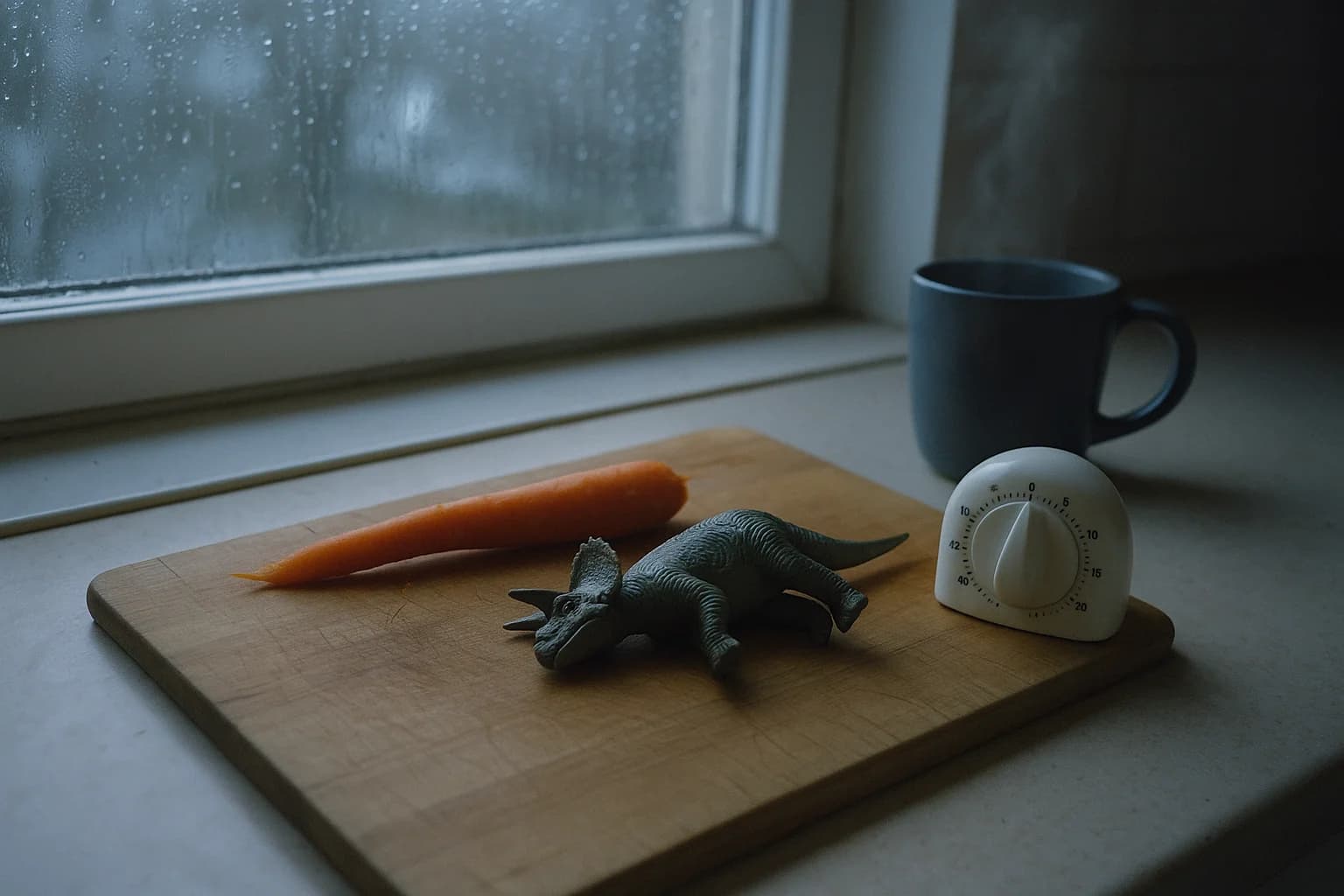
Preparing means very unglamorous things: putting out a piece of bread before the meal, starting the music before the argument rather than after, moving the phone call that always lands right then. You are not working on your patience yet. You are removing fuel.
Step 2: Lower the volume instead of raising it
When the tone climbs, try the opposite move: speak more quietly than usual, almost under your breath, and walk closer instead of shouting from another room.
Two things happen at once. Your child has to go quiet to hear you, which breaks the loop of voices answering each other. And you cannot hold a rising anger on a low voice: the body follows the volume it is given, not the other way round.
This is not a manipulation technique, and it is not staying silent either. The message stays firm. Only the delivery changes.
Step 3: Two long exhales before you answer
Before the sentence that is about to come out, take two breaths: in through the nose, then out slowly through the mouth, the exhale clearly longer than the inhale. It takes about ten seconds and can be done standing in the middle of the kitchen, with nobody noticing.
The randomised trial by Balban and colleagues, published in Cell Reports Medicine in 2023, compared several five-minute daily practices over a month. The protocol with the strongest effect on mood and on resting respiratory rate was the one built around a lengthened exhale, ahead of mindfulness of breath. Zaccaro and colleagues had already mapped the physiological correlates of that slowdown in 2018: higher heart rate variability, lower markers of arousal.
The effect is not that the anger disappears, it is that it arrives late. The sentence that comes out ten seconds later is almost never the one that was about to. The shortest version of that mechanism is described in this piece on the physiological sigh (in French).
Step 4: Unclench the jaw and drop the shoulders
Impatience shows in two places before it is heard: clenched teeth and shoulders pulled up towards the ears. Both release on command, and the release is immediate.
Open your mouth about two centimetres, let your tongue fall away from the palate, then let the shoulders drop on an exhale. Five seconds, and your face is no longer sending the same signal to the child in front of you, who is mostly reading faces.

If the jaw is your usual tension point, at night included, these exercises to relax your jaw go further than the emergency release.
Step 5: Say what is rising, in one sentence
“I can feel myself getting angry, I’m going to talk more quietly.” Said out loud, in front of your child, that sentence does two things at once.
It pulls you out of autopilot, because you cannot name an emotion and be fully swept along by it in the same second. And it shows your child that an adult can feel something rise without pouring it out, which is exactly the skill they are being asked to learn.
The wording matters. “You’re making me angry” names a culprit and restarts the scene; “I’m getting angry” describes a state and closes it. Two words apart, two opposite directions.
Step 6: Repair afterwards, without putting yourself on trial
A Wednesday in November, 6.40 pm, a plate of mashed potato tipped over a clean jumper: the shout comes out before any thought. What follows counts for more than the shout.
Come back once you have cooled down, and hold to two sentences: “I shouted earlier. It wasn’t your fault.” No justification through tiredness, no promise that it will never happen again, no request for immediate forgiveness. A short repair beats a speech, which shifts the load onto the child.
The hard part comes later: not replaying the scene on a loop once the house is asleep. Evening rumination repairs nothing and eats into tomorrow’s reserve, which makes the next shout more likely. There is a way of speaking to yourself after a bad evening, set out in this piece on talking to yourself with kindness, and it has nothing to do with letting yourself off.
When patience is no longer the subject
These moves address the ordinary irritability of family life. They do not fit everything.
The work of Mikolajczak, Gross and Roskam, published in Clinical Psychological Science in 2019, describes parental burnout as a state distinct from depression and from job burnout: an exhaustion that rest does not lift, emotional distance from your own children, the sense of no longer recognising yourself as a parent. No breathing exercise treats that, and trying anyway adds guilt to a state that has no shortage of it.
If the irritability has lasted weeks, if it comes with a sense of emptiness or with actions you regret, the right person is a doctor or a psychologist, not a list of tips. Asking for help is not an admission of impatience. It is recognising that this was something else all along.
Frequently asked questions
- How long does it take to become more patient with your child?
- There is no honest deadline to give, and these moves do not work on the same timescale. Lowering your voice or lengthening an exhale changes something within the minute, because both are immediate physiological levers. Spotting your difficult time slot takes about a week of noticing. What takes longest is the reflex: aiming for one time in three at the start is a fair target, and already far better than none.
- Is it bad to yell at your kids sometimes?
- One shout inside an otherwise secure day does not carry the weight of a household where shouting is the climate, and parents who worry about yelling are rarely the ones to worry about. What counts is less the incident than what follows: a child who is told, calmly, that the adult lost their temper and that it was not their fault learns something useful about emotions. If the shouting becomes daily and comes with actions you regret, it is no longer an incident, and a professional will help more than a tip.
- What should I do right after yelling at my child?
- Wait until you have come back down, then go to them and say two things, one sentence each: that you shouted, and that the problem came from you. There is no need for a speech or for justifying yourself with tiredness, your child does not need the full file. Apologies that work are short and ask for nothing back, not even immediate forgiveness.
- Why do I lose patience in the evening more than in the morning?
- Because the end of the day stacks everything that wears down emotional regulation: the tiredness of the day, hunger before dinner, noise, and a queue of tasks to finish in a short window. Your child is often not the cause, they simply arrive on a reserve that is already low. That is also why the moves that help in the evening are the ones that cost least: slowing the voice, breathing out, dropping the shoulders.
- Does meditation actually help parents be more patient?
- The available data point that way without allowing a promise. The systematic review by Burgdorf, Szabó and Abbott, published in Frontiers in Psychology in 2019, pooled mindfulness programmes aimed at parents and found a drop in reported parenting stress, small right after the sessions and moderate two months later, with widely varying protocols. These programmes usually run for several weeks: they do not replace the in-the-moment moves, they make them easier to find.
- Do these moves work with a teenager?
- The first four do, since they act on your own state and do not depend on the age of the person opposite. The last two need rewording: naming what is rising lands badly with a teenager if the sentence sounds like a disguised reproach, and repair usually happens later in the evening, once the bedroom door is open again. The principle holds, the timing changes.
Sources
- Brief structured respiration practices enhance mood and reduce physiological arousal — Balban et al., Cell Reports Medicine, 2023
- The Effect of Mindfulness Interventions for Parents on Parenting Stress and Youth Psychological Outcomes: A Systematic Review and Meta-Analysis — Burgdorf, Szabó & Abbott, Frontiers in Psychology, 2019
- Parental Burnout: What Is It, and Why Does It Matter? — Mikolajczak, Gross & Roskam, Clinical Psychological Science, 2019
- How Breath-Control Can Change Your Life: A Systematic Review on Psycho-Physiological Correlates of Slow Breathing — Zaccaro et al., Frontiers in Human Neuroscience, 2018