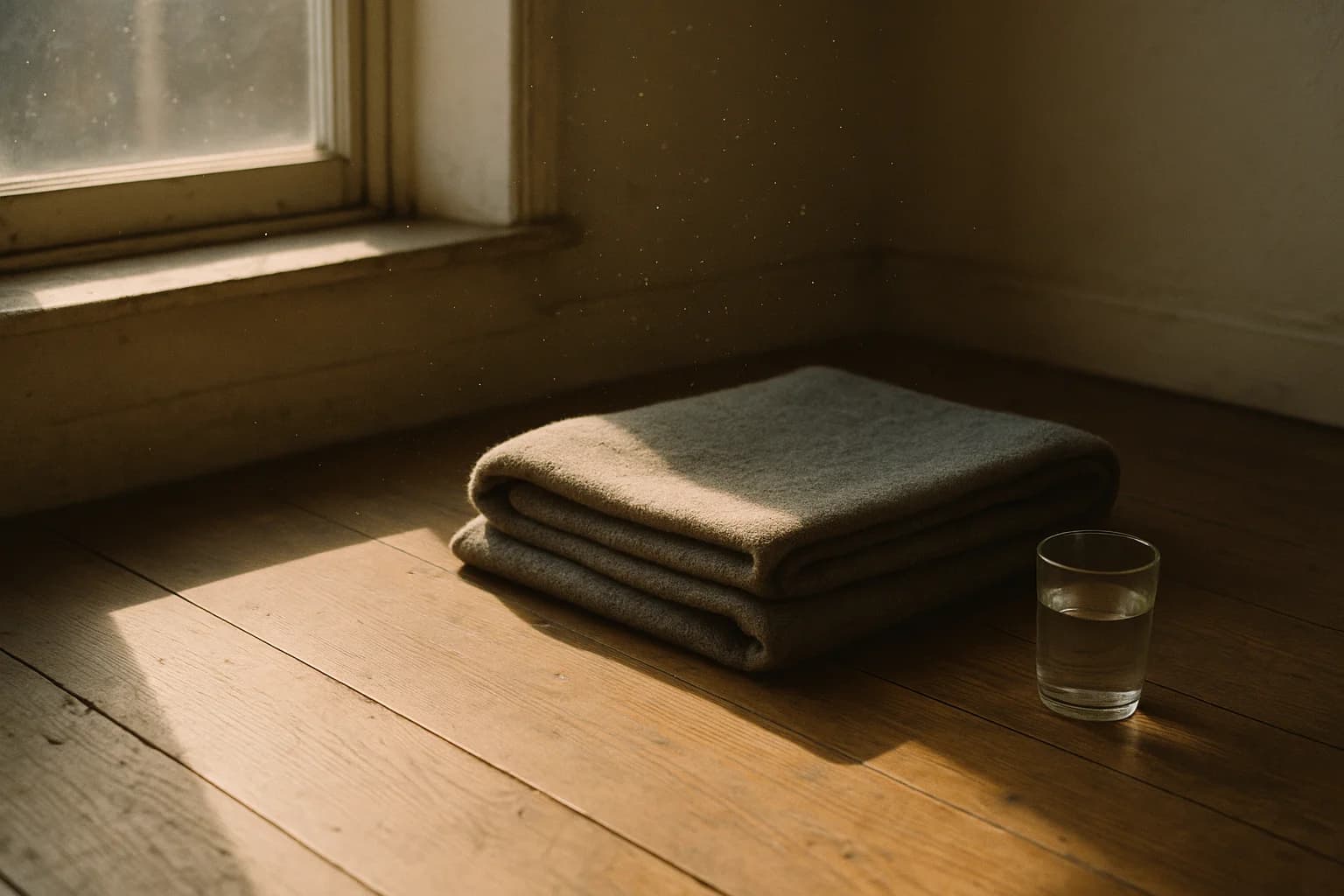
A five minute concentration exercise: the ordinary object method
A five minute concentration exercise, on any ordinary object
Five minutes are enough because you never ask attention to concentrate. You hand it a description task fine enough to fill it completely, on a support with no stakes. Attention settles badly on nothing; it settles well on a precise, boring detail. A key meets both conditions, a family photograph neither.
That point decides everything else. A scattered mind is not short on willpower, it is short on a foothold: « empty your mind » gives no executable instruction, whereas « describe the exact spot where the glaze turns matte » gives one. The four steps below only put that instruction in order.
Unlike most tip lists on the subject, the goal is not to hold five minutes without thinking of anything else. Nobody manages that. The goal is to come back to the object every time you have left it, and to notice how often. That count tells you what state you are in, and it is often more informative than the session itself.
1. Pick the most boring object within reach (30 seconds)
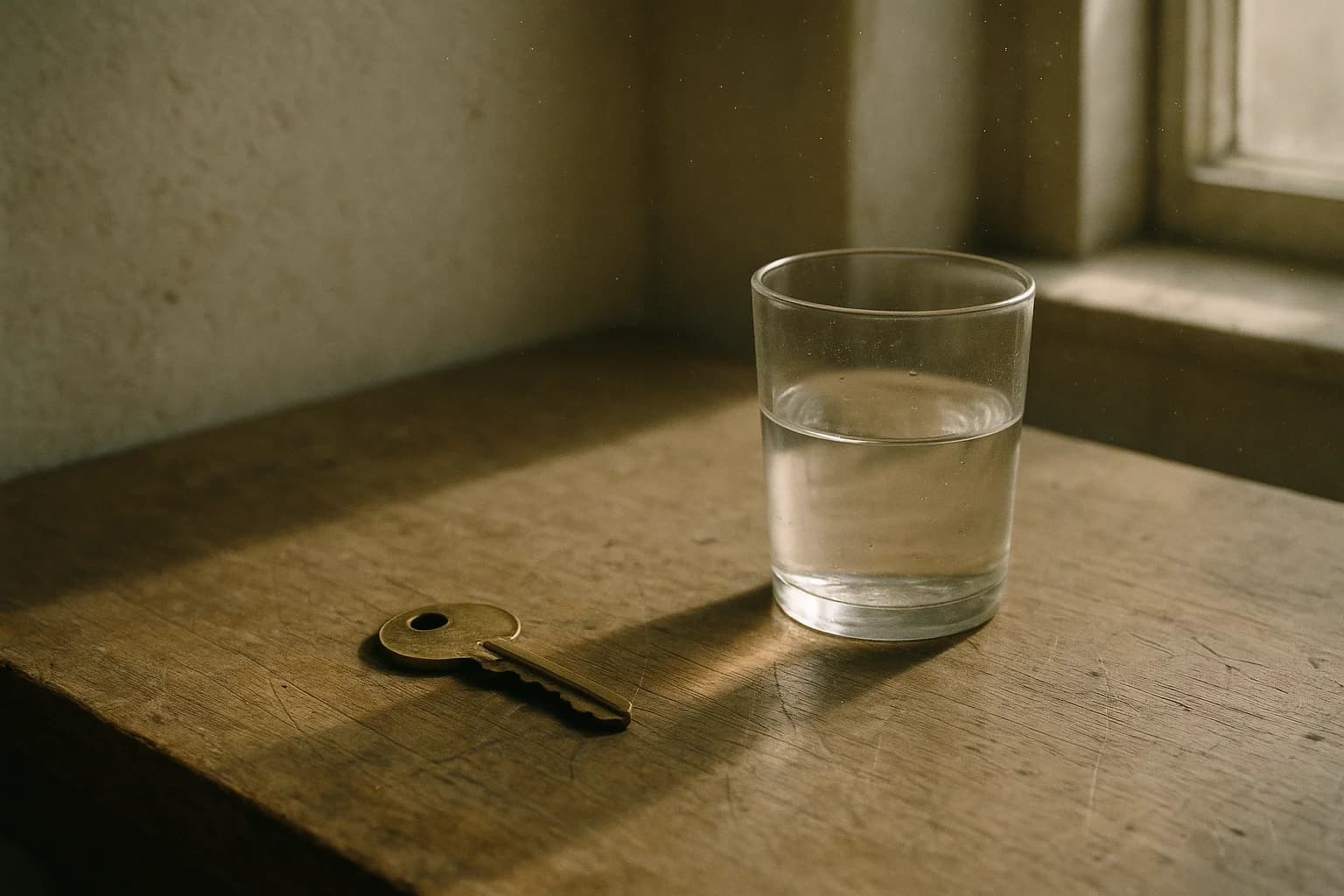
Look around and grab whatever is lying there: a key, a ballpoint pen, a clothes peg, a charger, an empty mug. The only rule is a negative one. No object loaded with memory, no inherited jewellery, no notebook you write in. An emotional object opens a door, and attention rushes through it within fifteen seconds.
Set it thirty or forty centimetres away, in decent light. Sit normally. Put a timer on five minutes, with a single chime at the end: interval reminders break exactly what the exercise is trying to build.
One detail that matters: do not swap objects halfway. If the one you picked bores you after a minute, that is a good sign. Boredom is the ground of this exercise, not its failure.
2. Describe the material and the flaws, not the function (2 minutes)
This is where most people go wrong. You look at a mug, the word « mug » arrives, and attention considers the job done. It leaves at once. The word that names an object is precisely what excuses you from looking at it.
So describe, in your inner voice, what a word does not cover: the exact shade of the glaze, the place where it turns matte, the length of the chip, the way light stops at the rim, the dried circular mark beside it. One sentence, one detail. When you run dry, change scale: go from the overall shape to one square centimetre, then to the texture of that square centimetre.

What this constraint does to the mind is measurable. In a 2013 controlled trial, Mrazek and colleagues compared two weeks of attention training with a nutrition programme among students. The trained group showed less mind wandering, better working memory and improved reading comprehension scores. Two caveats the original paper states and summaries almost always drop: the sample was small, forty eight people, and the mind wandering measure relied partly on what participants reported themselves.
Another useful point, rarely made. Mental fatigue gets described as a tank running dry, but the review by Boksem and Tops frames it differently: as a trade off between the cost of effort and its expected reward. It is not that you have no resources left. It is that your brain no longer finds the effort worth it. A tiny object to describe puts an immediate reward back within range, and that may be why the exercise restarts a work session better than a break does.
If you are after other supports of this kind, this list of concrete anchors to rest your attention on (in French) covers the cases where a visual object does not work.
3. Close your eyes and rebuild the object from memory (1 minute 30)
Close your eyes and remake the object mentally, as complete as you can: shape, colour, the flaws you just spotted, its position on the table. Hold the image. It will fade in pieces, distort, come back. That is how a mental image behaves, not a shortcoming on your part.
This is the only stretch where attention has no outside crutch, so it is the one doing real work. Each time the image dissolves, rebuild it from one precise detail rather than from the whole: the handle, the chip, the coffee mark.
Plenty of people see nothing at all with their eyes closed, and notice it right here. That is not an obstacle. Replace the image with the memory of the proportions, or with how the object felt in your hand if you held it. The real instruction is to hold a representation, not to produce an inner photograph.
4. Reopen your eyes and measure the gap (1 minute)
Open your eyes and look at the object. Hunt for what your reconstruction lost: a wrong proportion, a colour duller than expected, a whole detail gone. That gap is the only honest measure of your attention today, and it asks for no extra judgement.

On a scattered day the gap is enormous: the imagined mug had neither handle nor chip. On a day when attention holds, it narrows to shades. This is more reliable than the general impression of having meditated « well » or « badly », which mostly tracks your mood.
Write the result down in three words if you repeat the exercise over several days. Kept over three weeks, that log often surfaces a pattern nobody expected: for many people the worst gaps land on the days that began with their messages. The exercise had not improved their concentration, it had shown them what was destroying it.
How long does it take to improve your concentration?
The immediate benefit shows up in the first session: after five minutes, picking a task back up is usually cleaner. That benefit is short, roughly half an hour to an hour. It restarts; it repairs nothing.
Lasting gains ask for more. The Mrazek trial mentioned above measured its effects after two weeks of daily practice, and that is a reasonable order of magnitude for an exercise like this one: expect ten to fifteen days before the difference becomes noticeable outside the sessions.
Be careful not to set your expectations from the most quoted studies. The work of MacLean and colleagues, which shows clear gains in sustained attention and perceptual discrimination, involved a three month intensive retreat. Nothing comparable to five minutes in front of a mug. The same attentional mechanisms are involved, on a wildly different scale.
On that point, the article on meditation to get your energy back (in French) spells out the difference between a one off restart and real recovery.
When this exercise is not the right tool
It does not replace a night of sleep. On settled sleep debt, pushing through mostly delivers the unpleasant proof that you can no longer hold an image for ten seconds.
It also sits badly with physical agitation: fast heart, tight throat, no way to stay seated. The object is too fine a support then, and it is better to go through the breath with a breathing exercise for focus (in French). If your mind loops on one single thought, the subject is no longer attention but rumination, covered in these received ideas about mental exhaustion (in French).
One methodological note to close. Research on attentional practices is shakier than it looks: the critical evaluation by Van Dam and co authors points to unstable definitions, often weak control groups and effects overstated in the press. None of that invalidates five minutes that cost nothing. It does invite you to measure what it does for you, rather than to believe a promise. The same patient description of an ordinary object is explored from another angle in the neutral memory meditation (in French).
Frequently asked questions
- Which object should I use for a concentration exercise?
- The dullest one within reach: a key, a ballpoint pen, an eraser, a clothes peg, an empty mug. The object must carry nothing emotional. A photograph, a wedding ring or a gift pulls attention straight into a memory, and the exercise turns into daydreaming. A boring object is a good object.
- How many times a day can I do this exercise?
- Two to four, placed where concentration actually gives way: after lunch, mid afternoon, before a task that needs precision. Repeating it more often strengthens nothing and makes it mechanical, which is exactly what removes its effect.
- Does it work when I am very tired?
- Less well, and that is normal. On real sleep debt the exercise compensates for nothing: it mostly makes your current state visible. If you cannot hold the image for more than ten seconds with your eyes closed three days running, the issue is rest, not attention.
- Do I keep my eyes closed the whole time?
- No. The first two minutes happen with your eyes open, on the real object. Only the third step, rebuilding it from memory, asks you to close them. If closing your eyes makes you uneasy, rest your gaze on a plain surface, a wall or a table, without fixing on anything.
- How is this different from a breathing exercise for focus?
- Breathing works mainly on physiological agitation: heart rate, tension, a sense of urgency. The object exercise works on attentional scatter, which can exist without any agitation at all. When you are both tense and scattered, start with a few long exhales, then move on to the object.
Sources
- Mindfulness training improves working memory capacity and GRE performance while reducing mind wandering — Mrazek et al., 2013
- Mental fatigue: costs and benefits — Boksem & Tops, 2008
- Intensive meditation training improves perceptual discrimination and sustained attention — MacLean et al., 2010
- Mind the Hype: A Critical Evaluation and Prescriptive Agenda for Research on Mindfulness and Meditation — Van Dam et al., 2018