A visualization exercise to relax in 10 minutes
How does a visualization exercise actually relax you?
A visualization exercise to relax means occupying your attention with one simple mental image, usually a light or a place, while your breathing slows on its own. The body follows the breath: sweating drops, the pulse settles. Ten minutes are enough in the large majority of cases.
Toussaint and his team ran a trial in 2021 on sixty students comparing three techniques side by side: progressive muscle relaxation, slow breathing, guided imagery. All three raise felt relaxation. But imagery and muscle relaxation also produce a steady drop in electrodermal activity, the faint hand sweating that gives away nervous tension. Breathing on its own first pushes it up before returning to baseline. These methods do not take quite the same route.
What follows is a light-based relaxation sequence in five parts, ten minutes in total. Nothing mystical about it: if the subject strikes you as surrounded by dubious promises, we already sorted through the common misconceptions about light visualization (in French). Here we go straight to the practice.
Step 1: Settle the body before you place the image (1 minute)
The most common mistake is to close your eyes and summon an image immediately. The mind grabs it, comments on it, decides it is too blurry, and the session becomes a reflection about visualizing rather than visualizing.
So start with weight. Sitting or lying down, find the points where your body presses against something: your seat, your heels on the floor, the back of your skull if you are lying down. Name them mentally, one by one, changing nothing about your position. One minute by the clock is longer than you think.
If you are unsure which position to adopt, lying down is perfectly acceptable for this exercise, as long as you know its main flaw: it is easy to slide into sleep. We cover that point in detail in our article on meditating lying down (in French).
Step 2: Three exhales longer than the inhale (2 minutes)
Still no image. Breathe in through the nose for four counts, out through slightly parted lips for six or eight. Three times, no more. Then let your breathing return to its own rhythm and stop attending to it.
That asymmetry is not a comfort detail. An exhale longer than the inhale favours the parasympathetic side of the autonomic nervous system, the one that slows the heart instead of speeding it up. It is the mechanism we detail in our article on the physiological sigh (in French), and it is what makes the rest possible.
Without those two preliminary minutes, the image lands in a body still under tension and gets no purchase on it. Plenty of people conclude that visualization "does not work on them" when they simply skipped this step.
Step 3: Let the light in at the crown of the head (2 minutes)
Now the image. Picture a warm light, the colour of late afternoon, settling on the crown of your head. Not a spotlight. More like the warmth of a beam coming through a window pane.
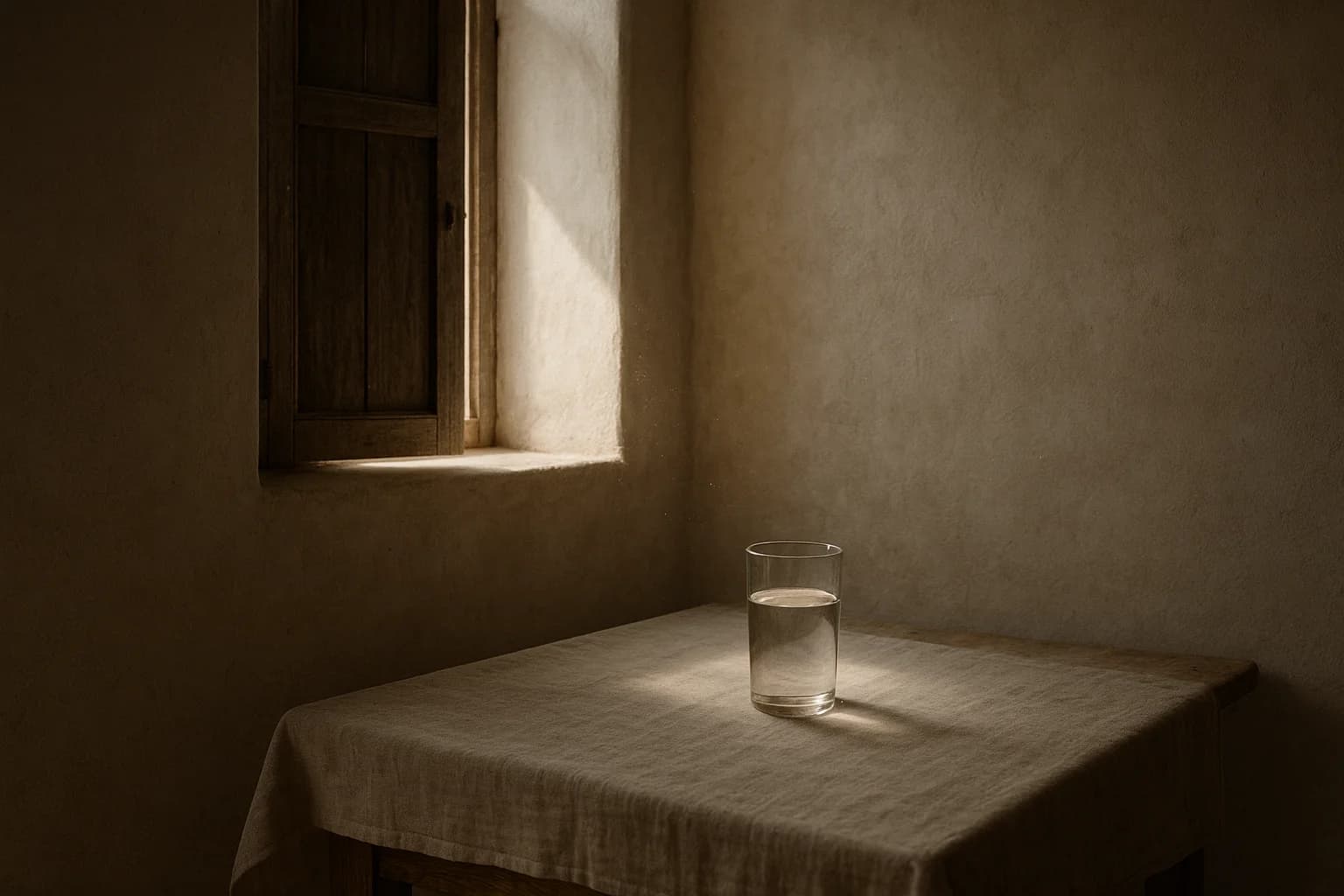
Stay there for two full minutes without moving it. This feels counter-intuitive: you want to press on. But it is holding the image still in one place that builds the effect, not the richness of the scenery. A band of brightness on a wall is plenty.
If you do not "see" anything sharp, look instead for a sense of warmth or tingling at the crown. That counts just as much. The section below comes back to it.
Step 4: Let it move down to where it meets resistance (3 minutes)
Bring the light down very slowly: forehead, jaw, neck, shoulders, chest, belly, then the arms and legs to the extremities. Three minutes for that journey is the right tempo. Most beginners finish it in forty seconds and then wonder why nothing happened.
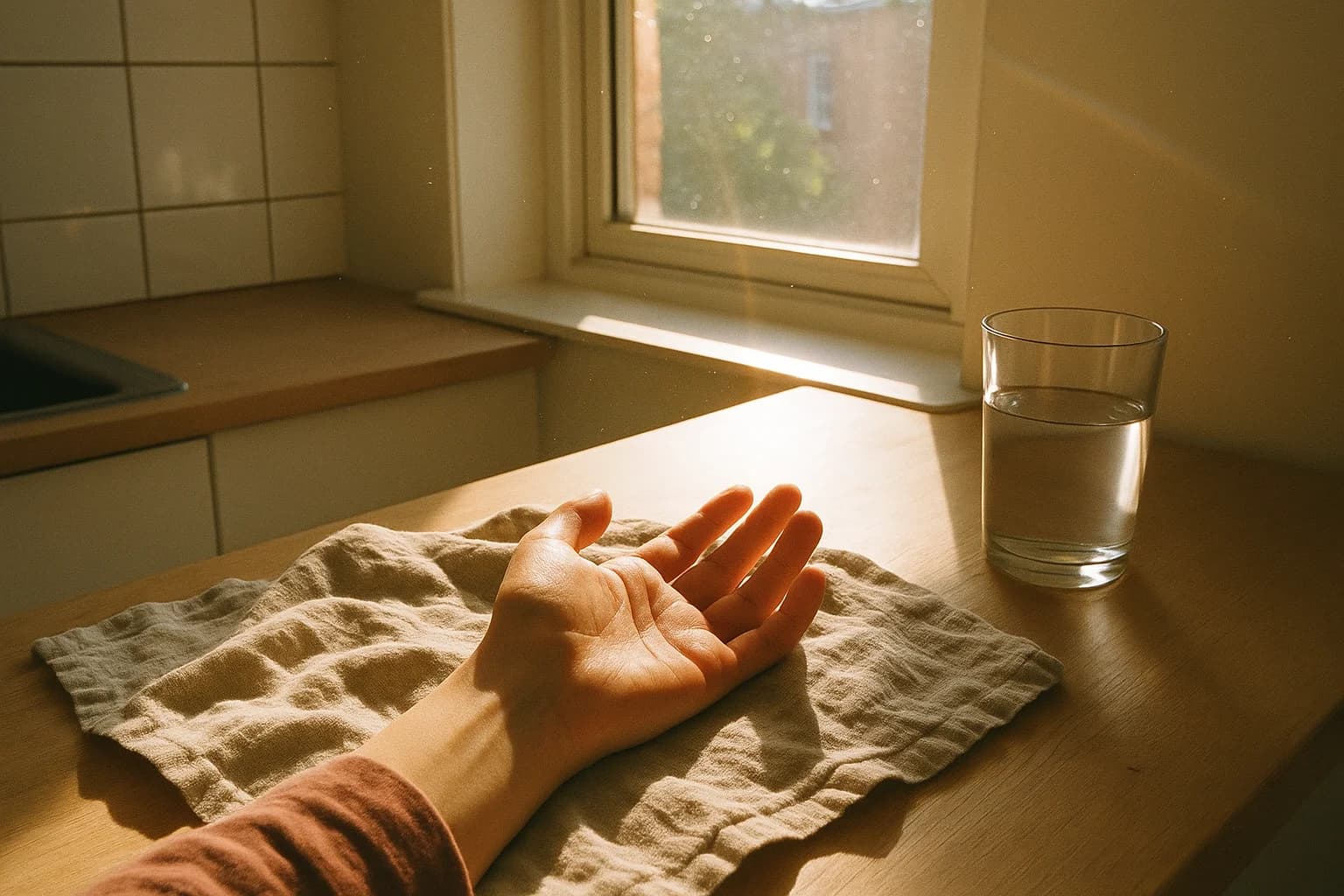
The real work happens at the spots that do not answer. There are always one or two: a jaw that stays clenched, a solar plexus that will not let anything through, a shoulder that seems opaque. Do not force the passage and do not loop back over the area. Rest the light there the way you would rest a warm hand, count three breaths, then carry on down even if nothing has shifted.
A common report is that after a few weeks of daily practice, a stubborn neck finally "opens" one ordinary evening, with nothing done differently that day. That is often how it goes. The release arrives once you have stopped chasing it.
The areas that resist most often are the jaw, the throat and the upper belly. No surprise there: those are also the three places where tension settles first in most people.
Step 5: Open your eyes without breaking the effect (2 minutes)
Coming out is the most neglected step, and the one that decides what is left ten minutes later.
Let the light fade on its own instead of switching it off. Return to the contact points from the start, the same ones, in the same order. Move a finger, then a foot. Open your eyes onto a fixed, neutral spot on the floor, not onto a screen. Count one full minute before standing up and picking anything back up.
That transition minute is not decorative. It prevents the abrupt drop that leaves you with the unpleasant feeling of having lost the benefit of the session by getting up too fast.
What if you cannot visualize anything?
This is by far the most frequent question, and the answer is simpler than people expect: go through sensation instead.
The ability to form mental images varies enormously from person to person. The international estimate by Wright and colleagues, published in 2024 across more than nine thousand participants, puts the share of people who produce no mental imagery at all, aphantasia, at around 0.9 percent, and those whose imagery stays very faint at 3.3 percent. About one person in a hundred will never see golden light when they close their eyes, and three more will only catch a faint trace of it. Neither is a practice failure.
For them as for everyone else, the exercise works by replacing the image with what it is meant to produce: a warmth that travels. Run the five steps again thinking "warmth moving down" instead of trying to see anything. The descent is the same, and so is the tempo.
Another way in is to swap the light for a colour, drawn in and pushed out with the breath rather than moved downward: that is the principle behind coloured breathing (in French), often easier to hold on to when the luminous image stays out of reach.
And if you have long told yourself that meditation is decidedly not for you, that belief deserves a close look: we took apart four versions of it in "I can't meditate".
How long before a visualization exercise takes effect?
For a single session, the effect is measurable straight away. The clinical trial by Felix and colleagues, run in 2018 with patients awaiting surgery, recorded after one guided imagery session a drop in state anxiety and a fall in blood cortisol markedly steeper than in the control group. Read it carefully, though: the sample was only twenty-four people, and a pre-operative ward is not an ordinary evening at home.
Over time, the rule is dull and holds across nearly every practice of this kind: ten minutes three to five times a week produce more than one hour on a Sunday. Give it three weeks before judging. That is short. It is also exactly the stretch most people will not grant before concluding that it does not work.
If your trouble is less nervous tension than background fatigue, the sequence to favour is a different one and we set it out in our guide to getting your energy back (in French).
When this exercise is not the right tool
Two cases deserve an honest mention.
The first concerns people prone to panic attacks: closing the eyes and turning attention inward can amplify unpleasant sensations rather than soothe them. If the session raises agitation instead of lowering it, stop and keep your eyes open on a fixed point. That is not a failure, it is information.
The second is about what visualization does not claim to do. The review by Giacobbi and colleagues catalogues hundreds of trials using guided imagery on outcomes as varied as pain and stroke recovery, with uneven results depending on the area. A relaxing visualization helps a nervous system come down. It does not treat a medical condition and replaces no clinical care.
What remains is what it does well, and that is not nothing: giving attention an object simple enough that it stops spinning, long enough for the body to catch up with the breath.
Frequently asked questions
- What if I cannot see any images when I try to visualize?
- Go through sensation instead. A 2024 international estimate across more than nine thousand participants puts aphantasia, producing no mental imagery at all, at around 0.9 percent, with another 3.3 percent whose imagery stays very faint. Run the same five steps thinking of a warmth moving down instead of trying to see anything: the descent and the tempo are identical, and the exercise still works.
- How long should a visualization session last?
- Ten minutes covers the full five-step sequence: one minute to settle the body, two for the long exhales, two holding the light at the crown, three for the slow descent, and two to come back out. Over time, ten minutes three to five times a week produce more than one hour on a Sunday.
- Does guided imagery work from the very first session?
- A measurable effect can show up straight away: a 2018 clinical trial with patients awaiting surgery recorded a drop in state anxiety and blood cortisol after a single session. That sample was only twenty-four people in a pre-operative ward, though, so give the practice three weeks of regular sessions before judging what it does for you.
- Why does visualization not seem to work on me?
- The most common reason is skipping the preparation: without one minute of settling your weight and three exhales longer than the inhale, the image lands in a body still under tension and gets no purchase on it. The other frequent mistake is sweeping the body in forty seconds instead of taking three full minutes for the descent.
- Is it better to visualize sitting or lying down?
- Both work. Lying down is perfectly acceptable for this exercise, as long as you know its main flaw: it is easy to slide into sleep. If you want to stay alert through the ten minutes, sitting is the safer choice.
- Is this exercise suitable for people prone to panic attacks?
- Not always. Closing the eyes and turning attention inward can amplify unpleasant sensations rather than soothe them. If the session raises agitation instead of lowering it, stop and keep your eyes open on a fixed point: that is not a failure, it is information about which tools suit you.
Sources
- Effectiveness of Progressive Muscle Relaxation, Deep Breathing, and Guided Imagery in Promoting Psychological and Physiological States of Relaxation — Toussaint et al., 2021
- Guided imagery relaxation therapy on preoperative anxiety: a randomized clinical trial — Felix et al., 2018
- An international estimate of the prevalence of differing visual imagery abilities — Wright et al., 2024
- A Scoping Review of Health Outcomes Examined in Randomized Controlled Trials Using Guided Imagery — Giacobbi et al., 2017