Chest tightness from stress: breathing deeper will not loosen it
Where chest tightness comes from when you are stressed
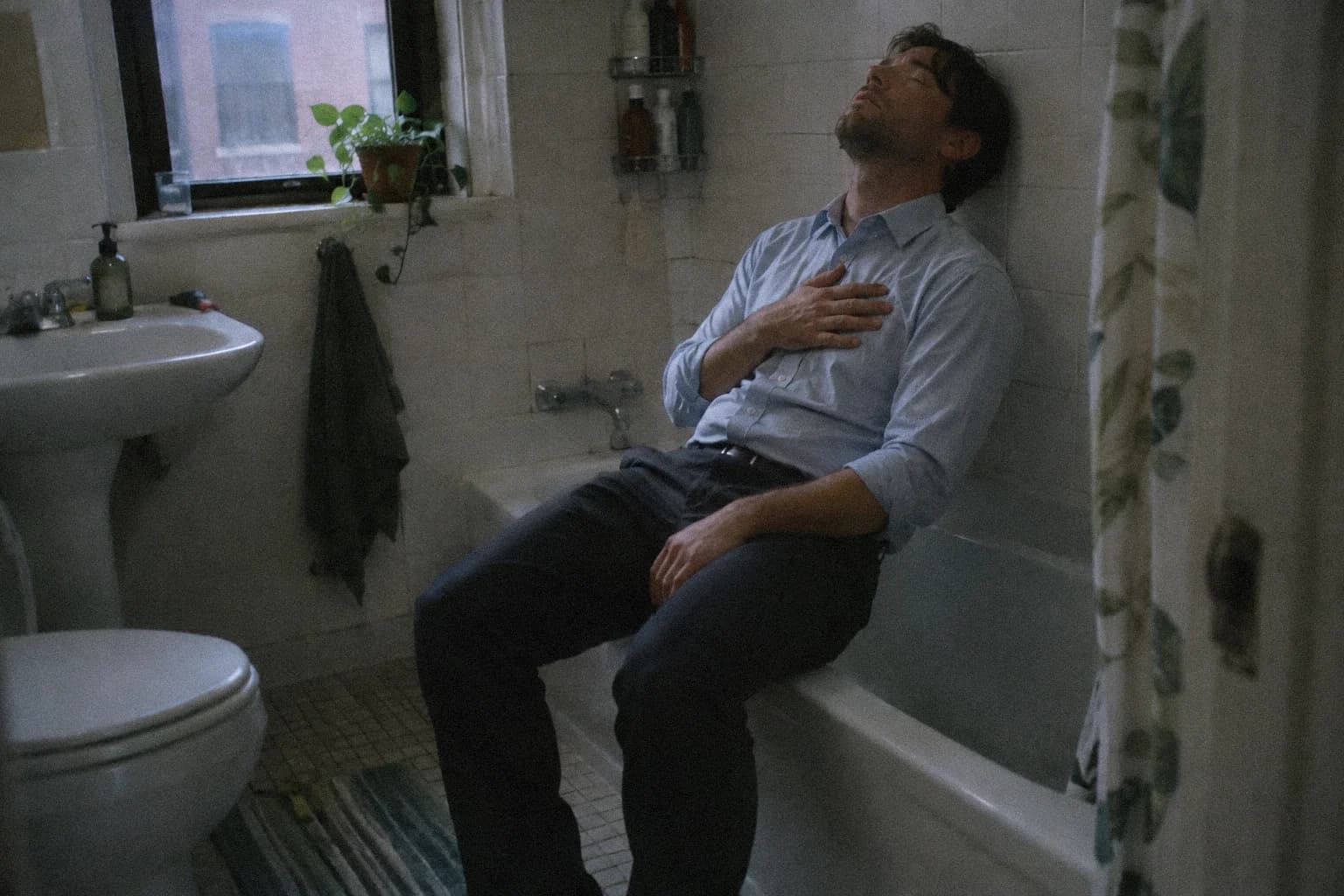
Under stress, breathing moves up into the chest and speeds up, and the muscles that lift the ribs stop releasing fully between cycles. The ribcage stays held in a raised position, and it is that held position, not an obstruction, that you feel as a vice.
Here is the detail that changes how the symptom reads: the sensation is not that of an empty lung. It is that of a chest that no longer comes back down. The volume of air moved goes up while the volume actually renewed stalls, because you keep adding inhales without finishing the exhales.
An attention loop sits on top of that. A tight chest is alarming information, the alarm speeds up breathing, and the speeding up tightens things further. The symptom becomes its own cause. That is why it sometimes lasts long after whatever set it off, and why it comes back at the mere thought of the situation.
None of this says there is no cardiac cause. It says only that when the workup is normal, the mechanism above is still available to explain what you feel, and that it can be reached without medication.
When chest tightness means calling emergency services
This section comes before the practice: no breathing exercise replaces an electrocardiogram.
The NHS asks for an immediate emergency call in three situations. Sudden chest pain or discomfort that does not go away, which it describes as feeling like squeezing or pressure inside the chest, burning, or indigestion. Pain that spreads to your left or right arm, or to your neck, jaw, stomach or back. And chest pain alongside sweating, nausea, light-headedness or breathlessness.
The number depends on where you are: 911 in the United States and Canada, 999 in the UK and Ireland, 112 across the European Union and in much of the rest of the world. The threshold does not depend on where you are. If you are weighing whether it is bad enough to call, that is the situation the guidance was written for.
Tightness you already know, returning in the same circumstances after a normal cardiac workup, is not a new pain. A first episode gets examined. The rest of this article assumes that sorting is done.
The NHS page on chest pain is short, and worth reading before you need it.
Why breathing deeper tightens the chest instead of releasing it
The reflex, when your chest tightens, is to go looking for air. Big inhale, shoulders rising, and the sensation returns ten seconds later, sometimes worse. This is not a failure of willpower. It is the logical consequence of what is happening.
A chest held high is a chest already close to its capacity. Adding air asks the accessory muscles of the neck and shoulders to pull harder, when those muscles are precisely what is tiring and what is squeezing. A full inhale soothes the idea of running out of air while it worsens the mechanics producing the sensation. It is the same misunderstanding as in that feeling of never being able to finish an inhale: the blockage is not at the entrance.
There is a second term, and it is chemical. Breathing more than you need lowers the carbon dioxide dissolved in your blood. That drop does not feel like breathlessness: it produces tingling in the hands and around the mouth, dizziness, a light head, and a chest tightness that closely resembles the one you were trying to shift. The loop closes there. A symptom of over-breathing gets treated with more over-breathing.
Which gives a counter-intuitive rule, consistent with both mechanisms: the variable to work on is not how much air you take in, it is how long you spend letting it out. The exhale is the only moment in the cycle when the ribcage can come back down and the accessory muscles have nothing to do.
The available data point that way on the nervous side. The systematic review by Laborde and colleagues, published in 2022, pooled 223 studies on voluntary slow breathing and reports an increase in vagally mediated heart rate variability during the technique, immediately after a single session, and after a multi-session intervention. What is measured there is the state of the autonomic nervous system, not the chest sensation itself: the link between the two is plausible, it is not established by that work.
What remains usable without overstating the studies: slowing down and lengthening the exhale costs nothing, cannot sustain hyperventilation, and acts on the one parameter a big inhale leaves untouched.
The muscles doing the squeezing, and why you cannot feel them working
Three muscle groups do most of the work when breathing rides high in the chest, and none of the three is built to hold for hours. The intercostals spread the ribs apart. The scalenes and the sternocleidomastoid, in the neck, lift the first ribs and the sternum. The diaphragm, meanwhile, descends less than it should, because the belly stays locked.
A muscle working continuously at low intensity does not announce itself as a muscle. It does not burn, it does not shake. It produces a dull, poorly located discomfort that the brain readily reads as coming from inside the chest rather than from its wall. That is one reason the symptom is so unsettling: it does not feel like a strain.
Posture keeps the whole thing going without anyone noticing. Eight hours seated, shoulders rolled forward, forearms resting on a desk, puts the ribcage in a position where a complete exhale takes effort. Add a clenched jaw and mouth breathing, and the pattern locks in for the day.
Which is why it pays to check the lower storey before fussing over the upper one. When the belly starts moving again, the neck muscles have no reason to pull. Bringing the breath back down into the belly is less dramatic than a big inhale, and considerably more effective on a tight chest. The same mechanism produces its abdominal equivalent on waking, with the same remedy.
One caveat: pain that wakes up when you press a precise point between two ribs, or that changes markedly with arm movement, belongs to the chest wall rather than to breathing. It is not serious, but it is not what this article describes, and a doctor confirms it in thirty seconds. The two often coexist, incidentally, in people who have been breathing high for months, which is why a reassuring examination rarely makes the sensation disappear on its own.
What to do in the moment, when your chest tightens
The principle fits in one sentence: add nothing to the inhale, give everything to the exhale.
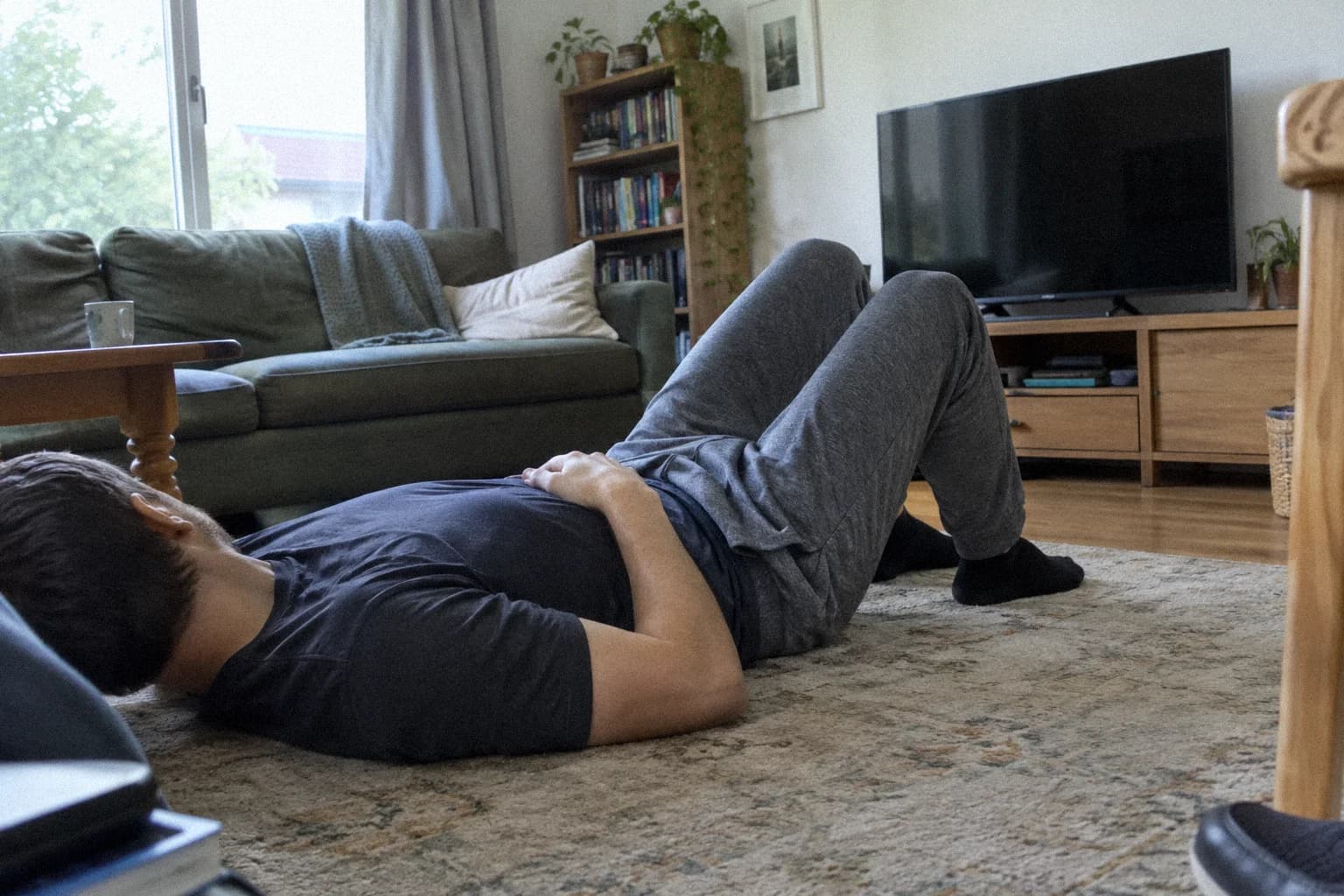
Sit down if you can, both feet flat. Put one hand flat high on your chest and the other on your belly, not to control anything, but to see which of the two moves. During an episode of tightness, it is almost always the upper one.
Then let the air go, slowly, through a barely opened mouth, as if keeping a flame alive without blowing it out. Go all the way to the end of the exhale, then wait a second before letting the inhale come back on its own. It does come back, and it will be smaller than the one you would have taken deliberately. That is the sign it is working, not a sign that something is missing.

A rough duration, not a prescription: an exhale twice as long as the inhale, for three to five minutes. Many people naturally land around six breaths per minute (in French), which is the best studied tempo. If that rhythm forces you to hold your breath or makes you dizzy, it is too slow for you today: the frequency a given heart responds to best varies from one adult to another, and the right value is the one that takes no effort.
Two details that matter more than they look. Do not count out loud and do not clench your teeth: the jaw and the floor of the mouth are part of the locking. And drop your shoulders deliberately on each exhale, because they are the ones carrying the useless work.
If the sensation has not moved after ten minutes or so, stop. Pushing turns an exercise into an ordeal, and the ordeal feeds the attention loop described above. A ten-minute walk, even a slow one, often beats a tenth attempt sitting down: standing up alone changes the position of the ribcage, and attention drifts away from the chest without being asked.
How long does chest tightness from stress last?
The durations circulating on this subject contradict each other, and that is itself useful information. Some pages say a few seconds, others twenty to thirty minutes, others a discomfort that settles in for the day.
The spread is not surprising: it mixes up different things. A spike of tightness during an argument, a residual ache following an anxious episode, and chest-wall tension sustained by posture and by weeks of high breathing have no reason to last the same time.
What to take from it is that duration does not sort a cardiac cause from an anxious one. Not in either direction: a brief pain rules nothing out, and discomfort dragging on for three days does not prove it is harmless. That is why the warning signs above describe the nature of the pain and what comes with it, rather than the clock.
In practice, once a cardiac workup has come back normal, if the episode eases within a few minutes of slow exhaling and resembles the previous ones, the breathing reading holds. If anything about it is new, it no longer does.
What breathing does not fix
A breathing exercise acts on the episode. It says nothing about what sets it off three times a week.
Chest pain without a cardiac cause is a common reason for an emergency visit: McDevitt-Petrovic and colleagues found it well represented among the diagnoses recorded after a chest pain presentation, across three years of Northern Irish data. Published counts vary with how they are built.
More directly useful is what the follow-up shows. Among 915 patients assessed after non-cardiac chest pain, Hamel and colleagues (2022) found panic disorder and generalised anxiety frequent, and associated with more intense chest pain later on. Tightness that keeps returning is therefore not only a symptom to shift: sometimes it is a sign that a panic attack or an anxiety disorder deserves to be named.
That does not make the slow exhale useless: knowing how to loosen your chest in three minutes takes away part of what makes the episode frightening. But it is a dressing, not a treatment. If the episodes repeat or keep sending you back to the question of your heart, a doctor or a psychologist is the right person to ask.
Frequently asked questions
- Can stress really make your chest feel tight?
- Yes, and the mechanism is muscular and respiratory before it is psychological. Under tension, breathing moves up into the chest and the muscles that lift the ribs release less between cycles, which keeps the ribcage in a raised position. That held position is what feels like a vice, even when cardiac tests come back normal.
- How do you tell chest tightness from stress apart from a heart problem?
- You do not make that call alone at home, and duration is not a reliable test. The NHS lists sudden chest pain that does not go away, pain spreading to an arm, the neck, jaw, stomach or back, and chest pain with sweating, nausea, light-headedness or breathlessness as reasons to call emergency services immediately: 911 in the US, 999 in the UK, 112 across the EU. A first episode gets examined.
- Why do I feel short of air when I am already breathing a lot?
- Because the sensation does not measure available oxygen. Breathing more than you need lowers the carbon dioxide dissolved in your blood, and that drop produces tingling in the hands and around the mouth, dizziness and chest tightness. Feeling short of air can therefore be the consequence of breathing too fully, not the cure for it.
- How long do you need to breathe slowly before it loosens?
- Count in minutes rather than in cycles, and expect the delay to vary a lot between people. Studies on slow breathing report measurable effects on the autonomic nervous system from a single session, but they measure the nervous system, not the chest sensation itself. If nothing shifts after ten minutes or so, stopping beats pushing harder.
- Should you see a doctor if the tightness keeps coming back?
- Yes, and not only about your heart. Among 915 patients assessed after non-cardiac chest pain, panic disorder and generalised anxiety were frequent and associated with more intense pain later, which makes them worth raising with a doctor or a psychologist. A breathing exercise helps in the moment; it does not treat an anxiety disorder.
Sources
- Chest pain — NHS, 2026
- Effects of voluntary slow breathing on heart rate and heart rate variability: A systematic review and a meta-analysis — Laborde et al., 2022
- Anxiety disorders in patients with noncardiac chest pain: association with health-related quality of life and chest pain severity — Hamel et al., 2022
- The prevalence of non-cardiac chest pain (NCCP) using emergency department (ED) data: a Northern Ireland based study — McDevitt-Petrovic et al., 2017