How to Overcome a Creative Block: a 4-Step Method
How do you overcome a creative block?
Getting out of a creative block starts with giving something up: the search itself. Put the work down, set five minutes, and hand your attention a task with nothing at stake, counting the out-breaths. The idea will not come back because you hunted it down, but because you stopped hunting.
The usual reflex runs the other way. You sit back in front of the page, you reread, you push. The demand to produce is exactly what locks things up: as long as the mind is ordered to deliver, it stays in control mode, and control does not manufacture unexpected associations.
Research on incubation points the same way. Baird and colleagues found that a break filled with an easy task improves creative problem solving more than complete rest or a demanding task (Baird et al., 2012). An easy task, not nothing at all: that distinction is the whole protocol. Breath counting sits in exactly that slot, and what it does to the creative brain (in French) has been measured elsewhere.
Count for four minutes. Not forty.
Step 1: Put the work down and set five minutes
Close the screen, or turn the sheet over. Comfort is not the point: the point is to take the thing that is blocking you out of your field of vision. As long as it stays visible, part of your attention keeps working on it in the background, and the break turns into surveillance in disguise.
Set a timer for five minutes and put the phone face down on the table. Without a timer you check the clock every forty seconds and you have never really left the work.
Sit normally. No particular posture, no cushion, nothing to set up. An office chair does the job, feet on the floor, hands on your thighs. If you have been sitting for two hours, do it standing near a window instead: the change of position does part of the work on its own.
Step 2: Count the out-breaths, 1 to 10
Breathe normally, without lengthening or holding anything. At the end of each out-breath, place a number: one, two, three, up to ten. At ten, go back to one and start again.
Count out-breaths, not in-breaths. The difference is not cosmetic: the out-breath is the phase where heart rate slows, and putting the marker there lines the counting up with release rather than effort. It is also the movement that is easiest to follow without modifying it.
The number is placed mentally, not spoken. Some people see it, some hear it, some feel it as a plain marker. Take whatever comes, do not choose.
The protocol is not a magazine invention: it is used as a behavioural measure of attention in the lab, precisely because losing count is an event you can spot and timestamp (Levinson et al., 2014). So you have an instrument in your hands, not just a relaxation exercise.
In practice, most people hold three or four complete cycles before it drifts. That is the norm. If you string ten clean cycles together on your first attempt, you are probably counting too hard, clutching the number like a float. Loosen up: the counting has to stay boring enough that the mind wants to go elsewhere. That departure is the part we are after.
The pattern most people describe goes like this. You run the count for four minutes staring at the radiator, and nothing arrives while you are counting. The solution turns up two minutes later, while filling the kettle, and it fits in one sentence you would never have written in front of the screen.
One aside. Imposed rhythms, such as box breathing (in French), ask for noticeably more attention: excellent for settling down, less suited to a moment when you are specifically trying to let go.
Step 3: Lose the count without repairing it too fast
At some point you will be at « seven » with no idea whether it is the first or the second seven. Or you will find yourself at twenty-three, which proves the counting was running by itself while your head was somewhere else.
That is the useful event, not the failure of the exercise. The instant you notice you had drifted is also the instant attention comes back on its own, and that return movement is what the practice actually trains.
One instruction only: no commentary. No « I am no good at this », no stern taking of oneself in hand. You go back to one, you start again. If the commentary settles in anyway, observing your thoughts without judging them is a skill in its own right, and it serves you directly here.
Losing count four times in five minutes is a good score.
Step 4: Come back through a gesture, not through rereading
The timer goes off. Do not reread anything.
The classic trap is to reopen the file and pick the reading up where you left it: within thirty seconds the earlier state is rebuilt exactly as it was, block included. Start again with a gesture that produces something new, however tiny. A sentence written by hand on a loose sheet, a line, three words of a title, an annotated screenshot.
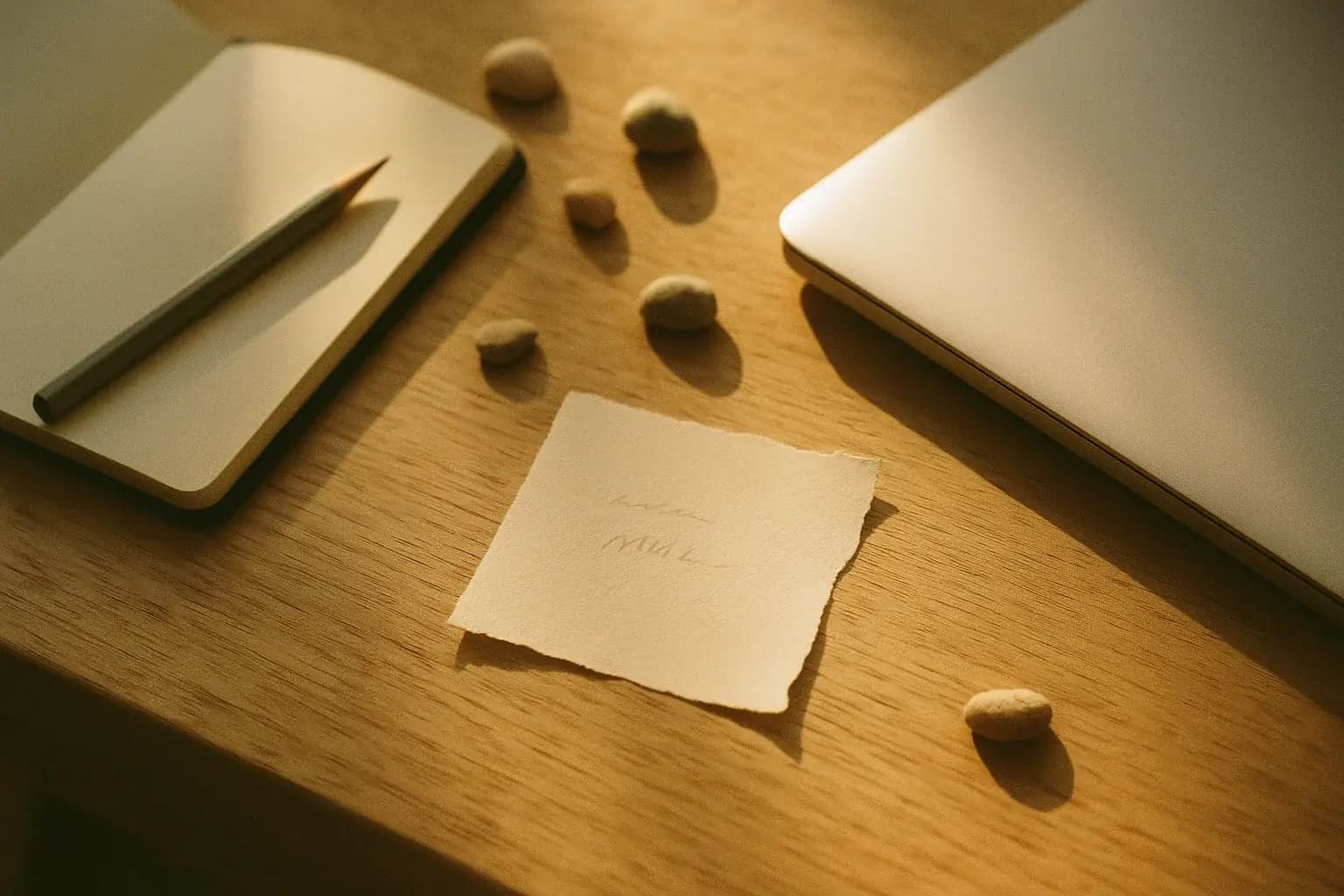
Zedelius and Schooler described two distinct routes to a creative solution: the insight route, which surfaces after mind wandering, and the slower, deliberate route of methodical reasoning (Zedelius & Schooler, 2015). Counting prepares the first. The concrete gesture opens the second. Chaining them leaves you two doors instead of one, which counts on the days when insight does not show up.
If nothing arrives in the next ten minutes, stop for today. A second cycle straight afterwards almost never does better than the first.
How long does a creative block last?
No serious data puts a number on how long a creative block lasts, and for good reason: it is not a clinical object. The word covers a one-hour stall as easily as a months-long disengagement. The two are not handled the same way.
An empirical sorting rule helps. If the block fits inside a single session, it almost always comes down to attentional fatigue, and an occupied break like the one above is often enough to lift it. If it has lasted weeks, look elsewhere. A long block is rarely an attention problem: more often it is a question of meaning, outside pressure or exhaustion, and no breathing exercise settles those three.
In between, regularity weighs more than intensity. Five minutes at the start of every session beats an hour on the day everything jams, exactly as with breathing exercises for concentration (in French).
When this method does not work
Counting does not suit everyone, and it is worth knowing that before insisting.
If bringing attention to your breathing sets off anxiety or a feeling of suffocation, stop. It is common, it is not a training deficiency, and an external support works better in that case: count passing cars, or your steps during a walk. The task stays easy, the incubation effect holds, and ambient noise is not the obstacle people assume.
The research has blind spots too. The work linking meditation and divergent thinking rests on small samples, compares very different styles of practice, and the results do not all converge (Colzato et al., 2012). We know an easy task helps incubation. We cannot yet predict for whom, or by how much.
A last word on honesty here: this method does not replace working time. It removes an obstacle, it does not draw anything in your place.
Frequently asked questions
- How long does a creative block last?
- There is no typical duration, because the term covers very different situations. A block that lasts one working session usually comes down to attentional fatigue and clears in a few minutes of occupied rest. A block that has been settled in for weeks answers to something else: outside pressure, loss of meaning, exhaustion. The first responds to the breath, the second to a change in working conditions.
- Should I count in-breaths or out-breaths?
- Out-breaths. That is the phase where heart rate naturally slows, and placing the number there lines the counting up with release rather than effort. The out-breath is also easier to spot without altering your breathing, which matters a lot here: the exercise loses its point the moment you start controlling the breath instead of simply following it.
- Does this work if I have never meditated?
- Yes, and it is one of the few exercises that requires no prior experience at all. Counting to ten is not something you learn. The only difficulty for a beginner is accepting that you will lose the thread without correcting yourself, a reflex that settles after two or three sessions. No posture and no equipment are needed: an office chair and five minutes will do.
- What if the block comes back every day?
- A daily block rarely signals an attention problem. Look first at sleep, workload and how much control you actually have over the current project: those three weigh far more than any breathing technique. Counting stays useful as a preventive measure, five minutes before you start rather than as a repair once you are stuck, but it does not replace a change in conditions.
- Are five minutes really enough?
- To restart a working session, yes, in most cases. Incubation studies use breaks of around twelve minutes, part of which is taken up by the control task. In practice, four to six minutes of counting is enough to leave production mode, and a second cycle straight afterwards rarely does better than the first. Better to stop and come back later in the day.
Sources
- Inspired by distraction: mind wandering facilitates creative incubation — Baird, Smallwood, Mrazek, Kam, Franklin & Schooler, 2012
- A mind you can count on: validating breath counting as a behavioral measure of mindfulness — Levinson, Stoll, Kindy, Merry & Davidson, 2014
- Mind wandering « Ahas » versus mindful reasoning: alternative routes to creative solutions — Zedelius & Schooler, 2015
- Meditate to create: the impact of focused-attention and open-monitoring training on convergent and divergent thinking — Colzato, Ozturk & Hommel, 2012