How to Stop Scrolling Before Bed: 6 Steps That Actually Hold
Why stopping by willpower almost never works
Stopping scrolling before bed fails for the same reason nearly every time: the decision has to be made at the hour when you have the fewest resources to keep it. Tiredness removes exactly the function that would let you resist. A rule set on Sunday with the best intentions gets renegotiated on Tuesday at eleven at night, and it loses.
There is something more useful than that observation. A Belgian team measured not one hour but two in adults: bedtime, and shuteye time, meaning the moment you actually decide to sleep. The phone pushes both back, and it pushes them back separately. They call it sleep displacement in two steps: you go to bed later, then you lie there for a while without trying to sleep.
The distinction changes everything in practice. Almost all available advice targets the first step, the evening one: cut screens an hour before, switch off the television, set a limit. That is the hardest step to move, because it means rearranging the end of the day around a family, a job, a social life.
The second step asks for none of that. It happens in one room, with one object, across the gap between the moment you get into bed and the moment you actually switch off. It is the cheapest part of the night to win back, and it is the part the available guides leave alone. The six steps below are ordered accordingly: first what you gain without rearranging anything, then what requires touching the evening itself.
Step 1: Move the charger, not the phone
This is the dumbest step and the one that makes the most difference. Do not decide to leave your phone out of the bedroom: move the charger. Into the hallway, the entrance, the kitchen, anywhere further than arm's reach from the bed.
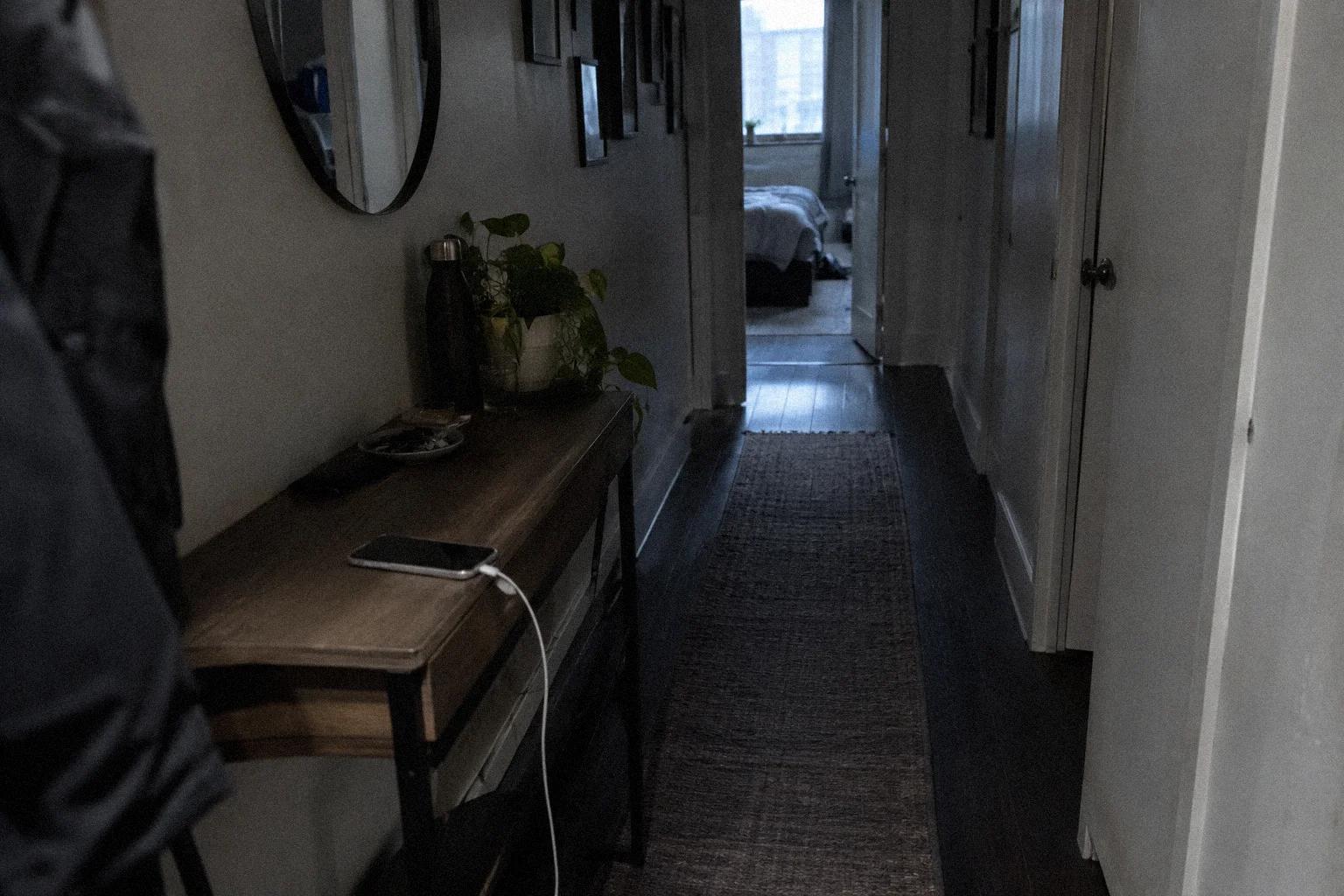
The difference between those two sentences is not cosmetic. “I will not take my phone to bed” is a decision you have to make again every night, three hundred and sixty-five times a year, always at the worst moment. “The charger lives in the hallway” is a decision made once, on a Saturday afternoon, in full possession of your faculties. A rearrangement holds where a resolution gives way.
Expect a week of genuine discomfort. For the first few nights the absence of the object is noticeable, and that is normal: the hand goes looking for it. What fades after that is not the urge, it is the reflex.
If leaving the phone in another room is impossible, because you are on call, have a sick child or someone who may need to reach you, the useful fallback is distance: across the room, screen down. Three metres is enough to turn a reflex into a conscious decision, and that is all we are after.
Step 2: Buy an alarm clock
As long as the phone is the alarm, it has an alibi. This is the objection that comes up every time the previous step is suggested, and it is a fair one: nobody is going to miss a train over a principle.
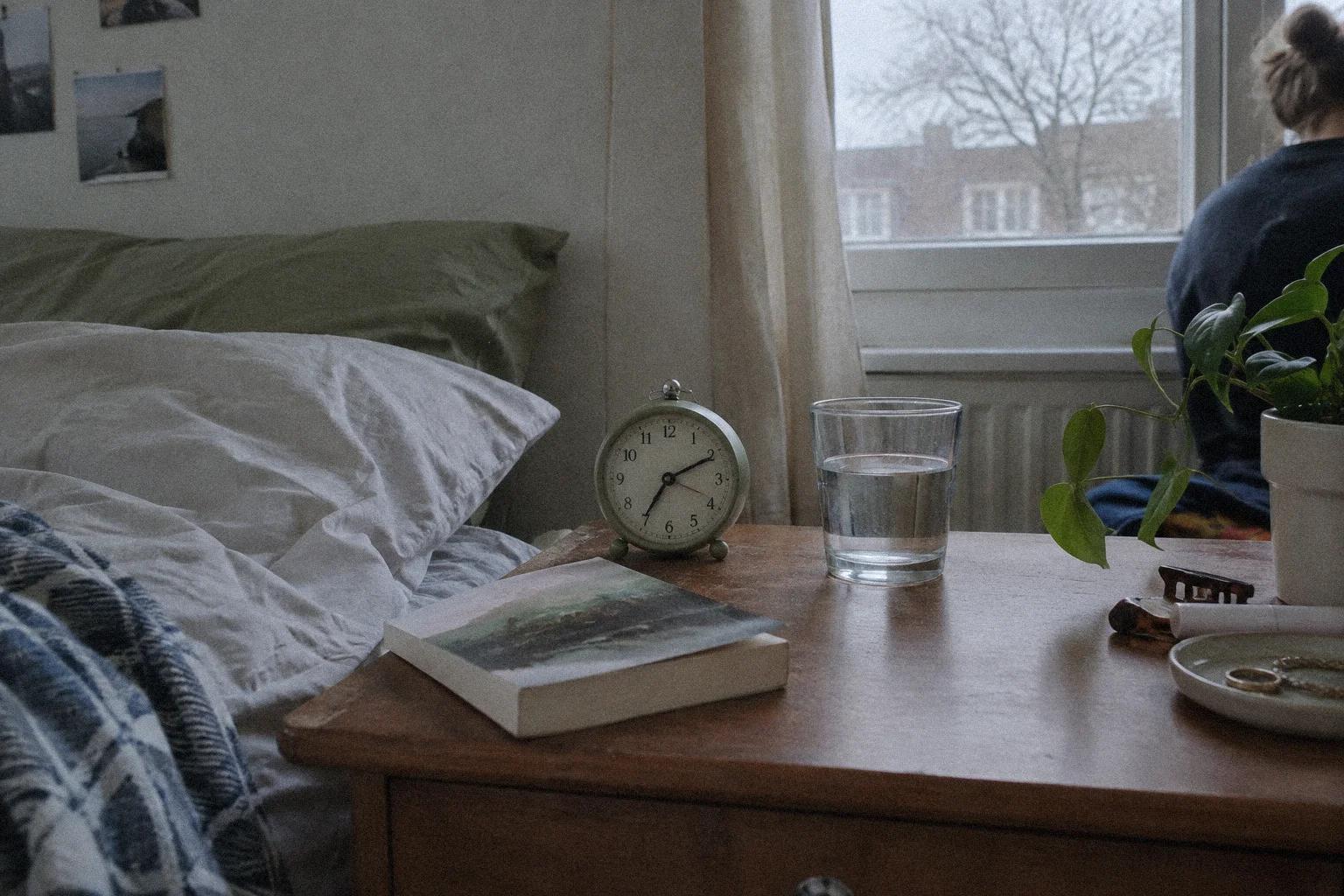
An inexpensive alarm clock removes the argument for good. Choose one without a permanently lit face, or one you can turn away: a glowing dial facing the bed creates a problem of its own, which is checking the time at three in the morning. Analogue models, which you have to lean towards to read, have an accidental advantage here.
One detail that matters: the phone alarm is not only a reason to keep the device overnight, it is also the first thing your hand touches in the morning. Silencing an alarm at seven and opening an app at seven oh one is one continuous gesture. A separate clock breaks the chain at both ends.
Step 3: Choose what you watch, not just when
This is where most writing on the subject aims at the wrong target. Not all screen time is equal, and the “screen versus no screen” framing is too crude to be useful.
The same Belgian team published work on the use of media as a sleep aid in adults. Two things come out of it, and they belong together. On one hand, a proportion of people deliberately use calm, familiar content as a transition into sleep, and experience it that way. On the other, and this is the measured part, those same people sleep worse and report more fatigue than those who do not. Using a screen as a sleeping pill is not a practice the study endorses.
What follows is an editorial reading, not a result of that study: between two kinds of content, the most useful distinction is not light, it is unpredictability. Content that is known, that ends, that does not answer back, lets the nervous system come down. Content that is infinite, personalised and built to re-engage attention at every thumb flick does the opposite by design. The first is the lesser evil. The second is a stimulant.
Two simple consequences. If you want to watch something in the evening, choose it before you lie down rather than letting an algorithm choose it for you. And treat work messaging as the most expensive category of all: a single line read at eleven at night can occupy an hour of your brain without any blue light at all.
Step 4: Write the list down before bed, on paper
A large share of in-bed scrolling is not curiosity, it is avoidance. You are not looking for information, you are avoiding being alone with what is waiting tomorrow. Removing the phone without addressing that is removing the anaesthetic and leaving the pain.
There is a precise and useful measurement on this point. A laboratory study compared two writing instructions before bed: list what is left to do, or list what you completed during the day. The people who wrote their to-do list fell asleep faster than those listing completed tasks, by roughly nine minutes on average, measured in a sleep laboratory rather than self-reported. The completed-task list did not produce that effect. The authors also report diverging associations depending on how detailed each list was: read that as a lead, not a rule.
Five minutes, paper, not an app. The gesture loses its point if you perform it on the object you are trying to leave, and typing reopens the door to everything else. Be specific rather than tidy: “call the garage, ask for a quote on the brakes” works better than “car”.
When it is not tasks but thoughts going round in circles, the problem is no longer tomorrow's organisation and a list will not settle it. That case is covered separately in our piece on meditation for sleep, which goes through the evening formats and their limits.
Step 5: Put a gesture where the gesture was
A habit is not deleted, it is replaced. The hand that used to reach for the phone needs something to do, and “nothing” is not an instruction the body knows how to carry out at eleven at night.
The replacement has to meet three conditions to hold: it works lying down, in the dark, holding nothing. That rules out reading, which needs a lamp, and writing, which means getting up. What is left is short and unspectacular: lengthen the out-breath and count backwards.
In practice, for about five minutes: breathe in normally, then let the air leave for roughly twice as long as it took to come in, without forcing and without counting seconds. After a few cycles, add a slow countdown from three hundred, subtracting three on each out-breath. The arithmetic is deliberately just hard enough to occupy the space the feed used to fill, and just monotonous enough that you lose track. Falling asleep before you reach the end is the intended outcome, not a failure.
This is also the point where a guided session does more than a written instruction, because it removes the last thing left to do: remembering the steps.
Step 6: If you are already in bed, phone in hand
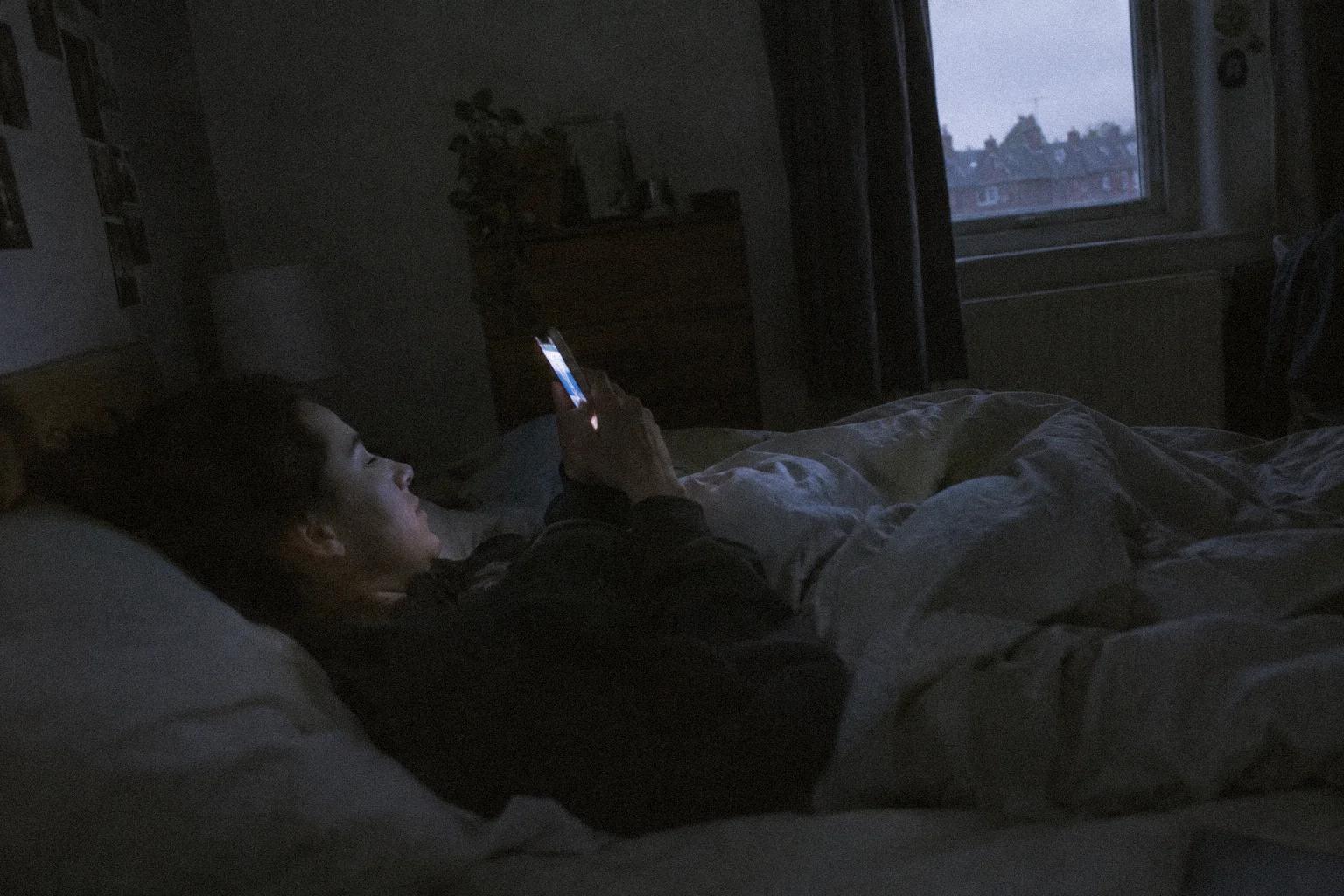
The five steps above are prepared in advance. This one is for the moment when nothing was prepared, when it is twenty past midnight and you may well be reading this on the phone in question.
In that situation, do not aim for the whole night. Aim for the next ten minutes, with one action: put the phone down outside the bed, and not on the nightstand. On the floor, across the room, in a drawer. The gesture looks trivial. It turns picking it up again into a decision that requires standing, which is exactly the friction that was missing.
Then step 5, lying down, changing nothing else. No review of the day, no resolution for tomorrow, no counting of the hours left, which is the single most reliably alerting thought available.
And if sleep has not come after twenty minutes or so, the right answer is not to insist: get up, change rooms, do something dull in low light, come back when your eyelids get heavy. Staying awake in bed teaches the body that the bed is a place where you are awake. That is the mechanism described in the case of people who are too tired to fall asleep, and it is worth knowing before it settles in.
How long before bed should you cut screens?
None of the sources consulted gives a threshold, and the figures in circulation, from thirty minutes to two hours, rest on no clearly cited study. The honest answer is that there is no number, and that the question deserves to be asked differently.
What the data does support is more useful: in adults, phone use at bedtime is associated with poorer sleep quality, more daytime tiredness and a later bedtime. The dominant mechanism is the time taken, not the light received.
Which gives a practical rule that needs no timer: the useful limit is not a duration, it is a place. “No phone in the bed” is instantly verifiable, cannot be negotiated, and attacks the most recoverable stretch of the night. “No screens an hour before” requires estimating your bedtime, which nobody does accurately on a Tuesday evening.
If you still want an order of magnitude for the evening, take the last thirty minutes. Thirty minutes kept beat two hours imagined.
Is blue light really the problem?
Partly, and a good deal less than a decade of advice built on it suggests. The effect is real and has been measured properly: a trial compared reading on a backlit e-reader with reading on paper before bed, and found delayed melatonin secretion, longer time to fall asleep and reduced alertness the next morning.
Two reading precautions, though. That protocol had participants reading four hours an evening for several days under controlled conditions, which does not describe fifteen minutes of phone in bed. And a systematic review of light exposure and circadian rhythm concludes on effects that depend on intensity, duration and timing, not on a switch.
The practical consequence is the one step 3 already drew. Filters and night modes are a good idea at no cost, and they do not address the main problem: a feed tinted orange is still an endless feed. Hunting for the right screen setting is a comfortable way of not changing the habit.
One limit worth stating to close. Everything above targets habitual scrolling, the kind that costs twenty minutes a night to someone who otherwise sleeps reasonably well. If your nights have been bad for months, if you wake at a fixed hour in the middle of the night, or if daytime tiredness does not lift despite nights of normal length, the phone is probably not the main cause and these six steps will not fix it. A general practitioner is the right starting point.
Frequently asked questions
- How long before bed should I stop looking at my phone?
- The figures that circulate run from thirty minutes to two hours, and none of the studies consulted sets a threshold. The question is better framed differently: an hour of abstinence followed by half an hour of scrolling in bed leaves the dominant mechanism untouched, which is the waking time spent under the covers. So start with the in-bed window, which is short and easy to check.
- Is night mode or a blue light filter enough?
- They reduce the light side of the problem, which is real but modest in adults. They do nothing about what delays sleep most: the time the phone keeps you awake in bed, and the arousal that comes from what you are reading. A filter applied to a feed at midnight leaves the bulk of the problem untouched.
- Is it bad to scroll in bed now and then?
- No, and guilt improves nothing. What matters is regularity: one late night is recoverable, a daily habit costs twenty to forty minutes a night, which adds up to several hours a week. Aim for most evenings, not every one.
- What if I scroll precisely because I cannot fall asleep?
- That is a different situation and the causality is reversed: the phone is not keeping you awake, the insomnia is making you reach for the phone. These six steps will not be enough. Getting up, changing rooms and doing something undemanding works better than staying in bed, with or without a screen.
- Is reading on an e-reader or on paper really different?
- On light, a backlit e-reader sits closer to a phone than to paper. On what matters, the difference lies elsewhere: a book ends at the end of a chapter, a feed does not end at all. That missing stopping point, more than the device, is what costs you the extra twenty minutes.
- What if my phone is my only alarm clock?
- This is the most common sticking point, and an inexpensive alarm clock solves it. As long as the phone has a legitimate reason to sit on the nightstand, no rule will hold: the hand that silences the alarm in the morning is the same one that opens an app at night. A separate clock removes the argument.
Sources
- Bedtime mobile phone use and sleep in adults — Exelmans & Van den Bulck, 2016
- Bedtime, shuteye time and electronic media: sleep displacement is a two-step process — Exelmans & Van den Bulck, 2017
- Evening use of light-emitting eReaders negatively affects sleep, circadian timing, and next-morning alertness — Chang, Aeschbach, Duffy & Czeisler, 2014
- The Use of Media as a Sleep Aid in Adults — Exelmans & Van den Bulck, 2014
- The effects of bedtime writing on difficulty falling asleep: A polysomnographic study comparing to-do lists and completed activity lists — Scullin, Krueger, Ballard & Pruett, 2018
- Systematic review of light exposure impact on human circadian rhythm — Tähkämö, Partonen & Pesonen, 2018