Meditation for sleep: what actually works in the evening
Is it good to meditate before sleeping?
Yes, for most people, and the effect is real without being spectacular. A meta-analysis of randomised controlled trials found that mindfulness meditation programmes improve sleep quality, with a modest benefit that holds at follow-up (Rusch et al., 2019). A trial in adults over 55 showed a greater improvement than a sleep education programme over six weeks (Black et al., 2015).
The mechanism is worth understanding, because it determines how to practise. Evening meditation does not act like a sleeping pill: it acts by removing the goal. Espie and colleagues describe sleep onset as a largely automatic process, inhibited by the attention paid to it and by attempts to control it (Espie et al., 2006). Watching the clock, counting the hours left, setting yourself the aim of sleeping: each of these sustains the wakefulness it is trying to end.
Hence the paradox that runs through this whole article. A meditation used as a tool to fall asleep becomes one more attempt at control, and works badly. The same meditation practised while expecting nothing from the night often works well. That is exactly what the account in exhausted but can't fall asleep describes, where dropping the stakes did more than eight weeks of good habits.
One practical note: there is no known downside to meditating in the evening, other than the risk of adding one more obligation to an already crowded routine. If the session becomes a chore, it has stopped helping.
How do you calm your brain for sleep?
By giving it something else to do, not by asking it to stop. A brain running at midnight is not broken: it is vigilant, and vigilance does not switch off by decision.
Three levers work, in this order.
Get the content out of your head. What circles at night is almost always a list: tasks, a conversation to have, a pending decision. Michael Scullin and his team compared, in a sleep laboratory, participants who spent five minutes before bed writing either their to-do list for tomorrow or a list of completed tasks: the first group fell asleep significantly faster, and the effect grew with the level of detail (Scullin et al., 2018). Writing solves nothing. It moves the worry out of a place where it had no chance of being handled.
Bring the body down. An exhale clearly longer than the inhale tips the nervous system towards the brake. That principle is shared by 4-7-8 breathing, coherent breathing and the physiological sigh: the exact rhythm matters less than the ratio between the two phases.
Occupy attention without giving it a goal. This is the least intuitive point and the most decisive one. A mental image with no end to reach, a neutral sensation, a count with nothing riding on it: attention settles, and since there is nothing to succeed at, sleep monitoring switches itself off. If the thoughts themselves are the problem, our French article on stopping thoughts in order to sleep (in French) covers that case in detail.
What is the best evening meditation for deep sleep?
The body scan is the practice best suited to bedtime. Three reasons: it is done lying down, it requires no elaborate visualisation, and it occupies attention continuously without ever demanding a result.
The principle is simple. You travel through the body zone by zone, feet to head or the reverse, pausing a few breaths on each, without trying to relax anything. You notice, you do not correct. That absence of any performance instruction is what makes the practice so compatible with sleep. The full protocol is laid out in the body scan for sleep.
Two alternatives are worth trying depending on temperament. For people who think in images, our French article on an evening visualisation (in French) works better than scanning sensations: a calm place, a path, a slow descent. For those who need a numbered structure, counting backwards (in French) provides a steady anchor that demands nothing.
As for the word "deep", it needs an honest qualification. None of these practices increases deep sleep on its own; that depends mostly on bedtime, regularity and accumulated sleep debt. What they change is time to fall asleep and the perceived quality of the night. That is already a lot, and it is not the same promise.
The guided evening practice, step by step
Here is a complete session of about fifteen minutes, lying down, lights off or very low. There is nothing to memorise: each step leads into the next, and falling asleep before the end is the intended result, not a failure.
Before getting into bed (5 minutes). At your desk or on the edge of the bed, write down what is still open: three to five lines, no elaboration. Tomorrow's tasks, the sentence that annoyed you, the pending decision. Close the notebook. This is not a nicety, it is the best-documented step of the whole session.
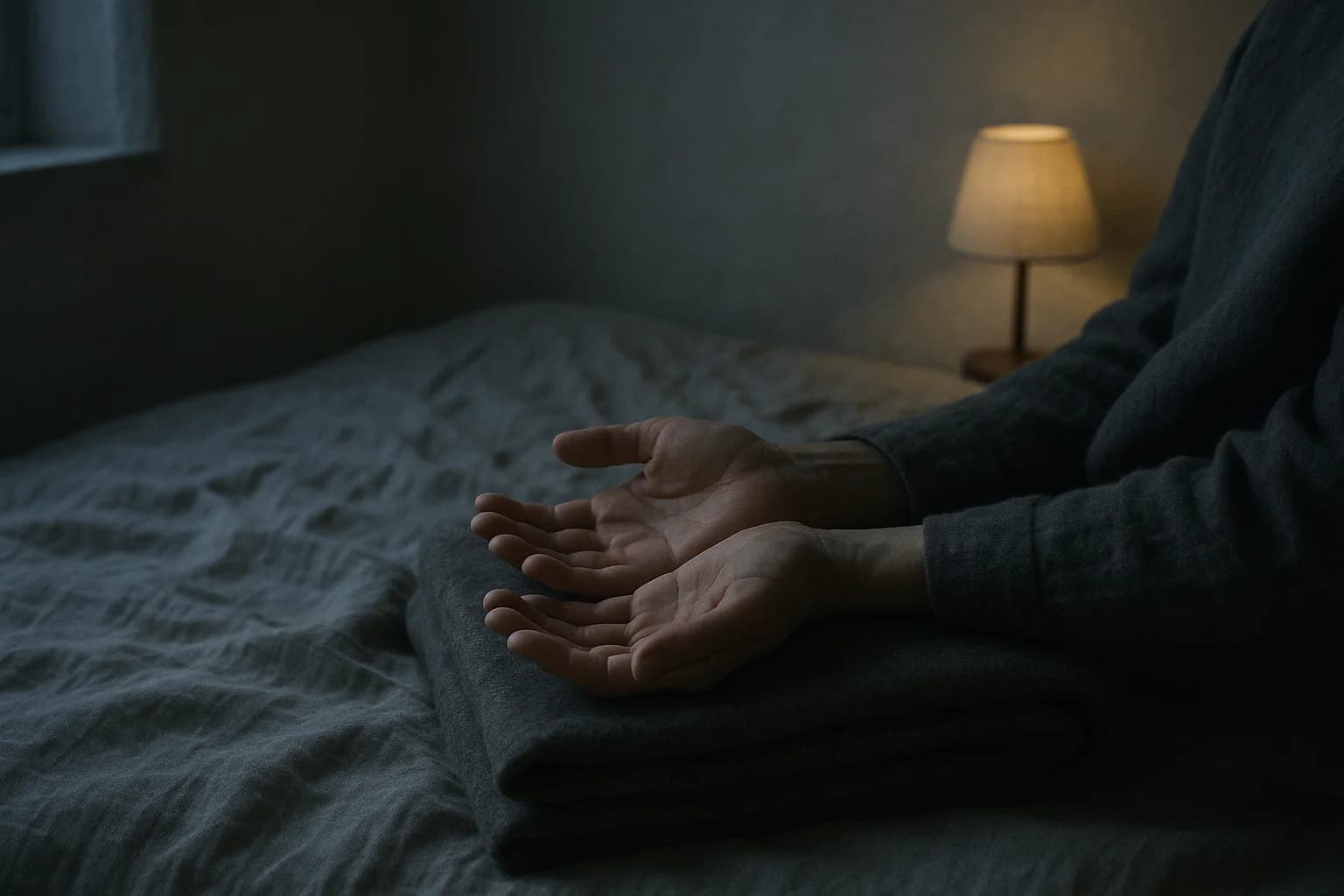
Step 1: settle (1 minute). Lying on your back, arms alongside the body, palms up. Feel the contact points: the back of the head, the shoulder blades, the pelvis, the heels. Three ordinary breaths, unmodified.
Step 2: lengthen the exhale (3 minutes). Inhale through the nose for about four counts, then exhale slowly through the mouth for six to eight, letting the air leave rather than pushing it. Around ten cycles. If counting tenses you, drop the count and keep only the idea of an exhale longer than the inhale.
Step 3: scan the body (6 minutes). Bring attention to the left foot: sole, toes, ankle. Two breaths, then move up: calf, knee, thigh. Switch to the right foot and do the same. Then pelvis, stomach, chest, hands, arms, shoulders, throat, face. At each zone you are looking for nothing: you notice what is there, including the absence of sensation. If your mind wanders, resume at the last zone you remember.
Step 4: the image with no goal (4 minutes). Set an image that asks nothing of you. An hourglass whose sand runs down, a wave rising and falling, a staircase you descend slowly. It has no end to reach: when the hourglass is empty, you turn it over, and that is all. That absence of purpose is what stops attention from turning back into monitoring.
Step 5: conclude nothing. If you are still awake at the end, draw no conclusion and do not restart the session to "do it better". Simply stay with the long exhale, no counting, no expectation. Sleep cannot be summoned; it is allowed to arrive.
A word on guided audio: many people fall asleep more easily with a recorded session than by guiding themselves, because following a voice removes the last mental task that remained. That also explains why the same instructions, read and then practised in silence, work less well on the first few nights.
What are 3 exercises to sleep better?
Three exercises cover most evening needs. Each stands on its own, and the best one is the one you will do again tomorrow.
1. Long-exhale breathing (3 minutes). Inhale for four counts, exhale for six to eight. Ten cycles. It is the fastest way to bring physiological activation down, and the only one that also works in the middle of the night, with no equipment and no light.
2. The body scan (8 to 10 minutes). Zone by zone, feet to head, two breaths per zone, without trying to relax. It is the most reliable exercise for falling asleep, because it occupies attention for a long time and has nothing riding on it.
3. The written drop (5 minutes, before bed). Tomorrow's tasks on paper, five minutes before lights out. It is the exercise that acts furthest upstream, and the only one that addresses the common cause of the 3 am waking, the one where an unclosed subject suddenly comes back.
Anyone wanting a fourth option can add a mental image, hourglass or descending staircase, once the scan is finished. The order hardly matters. What matters is never to chain three techniques in the same night looking for "the one that works": that is sleep monitoring, and it keeps people awake more reliably than coffee.
How do you fall asleep fast with the 4-7-8 method?
The 4-7-8 method means inhaling through the nose for four counts, holding for seven, then exhaling through the mouth for eight, lips slightly pursed. Four cycles are enough, lying down, before you stop counting.
The principle is that of every calming breath, pushed one notch further: the exhale lasts twice the inhale, and the hold slows the overall rhythm further still. You end up well below the usual respiratory rate, which favours parasympathetic activity.
On the evidence, stay measured. An experimental comparison of three slow breathing patterns, including 4-7-8, measured their effects on heart rate variability, exhaled CO₂ and mood: all three conditions produce effects, without one pattern clearly standing out (Marchant et al., 2025). To our knowledge, no controlled trial has measured the effect of 4-7-8 on time to fall asleep itself. What can reasonably be said: it is an effective slow breath for immediate relaxation, neither more nor less magical than the others.
Two concrete precautions. The seven-count hold leaves many people short of breath on the first nights: drop to 4-4-6 while you adjust, since the ratio matters more than the exact numbers. And if counting tenses you instead of relaxing you, abandon the count, it is a sign the technique has become a task. The full protocol and its variants are covered in our French article on 4-7-8 breathing for sleep (in French).
What is the military method to sleep in 10 seconds?
The "military method" is a four-part progressive relaxation, popularised by a 1981 sports preparation book and attributed to a pilot training programme. The protocol circulates everywhere in the same form:
Relax the face, including forehead, jaw, tongue and the area around the eyes. Drop the shoulders, then the arms, one after the other. Exhale while releasing the chest, then the legs, thighs then calves. Finally, clear the mind for ten seconds by repeating "don't think" or holding a fixed image, a boat on a lake, a hammock in the dark.
What it is worth, honestly. The "in 10 seconds" does not refer to time to fall asleep: it refers to the last step of the protocol. The widely repeated promise of falling asleep in ten seconds after six weeks of training comes from the book itself, and to our knowledge no published controlled trial has evaluated this method. That does not make it absurd: its first three steps are progressive muscle relaxation, an old and well described technique in the management of insomnia.
The fourth step, however, contains the usual trap. Repeating "don't think" amounts to monitoring the absence of thoughts, which keeps them available. Replace it with an image that has no goal, exactly as in step 4 of the guided practice above. On that mechanism, our French article on emptying your head (in French) explains why the instruction turns against itself.
The common mistakes that keep you awake
Five mistakes come up almost every time, and they share one trait: each turns sleep into a goal to achieve.
Looking at the clock. The most costly one. Every check restarts a calculation, and the calculation restarts wakefulness. Turn the clock around, put the phone face down.
Chaining techniques in the same night. Trying 4-7-8, then the scan, then counting, inside twenty minutes, is performance monitoring dressed up as practice.
Measuring your nights. Tracking apps, sleep scores, detailed logs: useful in consultation, counterproductive in daily use, because they hand you a score to improve.
Going to bed before you are sleepy. Moving bedtime earlier to "catch up" lengthens the time spent awake in bed, and the bed ends up signalling wakefulness rather than sleep.
Staying in bed getting annoyed. When frustration builds, the association between bed and sleep erodes. Past twenty minutes or so of irritation, it is better to get up for a calm activity, without bright light or screens. The middle-of-the-night waking is covered in our French article on getting back to sleep after waking in the night (in French).
A sixth mistake, rarer, deserves a mention: expecting a meditation to make up for absent sleep hygiene. No session neutralises three coffees after 5 pm, a bedtime that swings by three hours from one day to the next, or a bright screen right up to lights out.
When to see a doctor rather than meditate
It needs saying plainly: an evening practice does not treat established insomnia, and it treats no physiological cause at all.
Beyond three months of difficult nights at least three times a week, this is chronic insomnia, and cognitive behavioural therapy for insomnia is among the recommended first-line treatments. It is structured, it is done with a professional, and it produces better results than any isolated technique.
Some signs call for advice without waiting: snoring with breathing pauses, morning headaches, a very dry mouth on waking, significant daytime sleepiness. That picture suggests sleep apnoea, and no breathing pattern treats apnoea. The same goes for chronic pain, restless legs syndrome, a thyroid disorder or a medication side effect.
Finally, if exhaustion comes with a loss of interest in everything, very early waking with no way back to sleep, or dark thoughts, this is no longer a matter of technique. In the United States, 988 answers free of charge, day and night; in the UK and Ireland, 116 123.
For everything else, the instruction fits in one sentence: practise while expecting nothing from the night. It is the only known way of not getting in the way of your own sleep.
Frequently asked questions
- How long should a sleep meditation last?
- Ten to twenty minutes suits most people, and falling asleep before the end is not a problem. A shorter session, five minutes of slow breathing, beats a long one you abandon after three nights. Regularity matters more than duration: the body recognises a repeated signal, not an isolated feat.
- Should you meditate in bed or before getting into bed?
- Both work, but they do different jobs. A seated session before bed prepares the transition and brings the day's activation down. A session lying in bed accompanies sleep onset directly, provided you do not turn it into a technique for falling asleep, which reinstalls the very stake you wanted to remove.
- Can meditation replace a sleeping pill?
- No, and no decision about a prescription is taken without the doctor who wrote it. Available data show modest benefits of mindfulness meditation on sleep quality, comparable to those of other sleep education programmes. It is a useful support, not a pharmaceutical substitute.
- What if I fall asleep during the evening meditation?
- Nothing, that is the intended outcome at this hour. The instruction to stay awake during practice applies to daytime sessions, not to an evening one whose purpose is precisely to let sleep take over. If you fall asleep within the first two minutes every single night, sleep debt is probably significant and deserves attention in its own right.
- Does meditation work when you wake at 3 am?
- Often yes, provided you do not turn on a screen or look at the clock. Returning to slow breathing or a mental image gives the brain something to do other than counting the hours left, and that counting is what wakes people most reliably. If irritation builds past twenty minutes or so, it is better to get up for a calm activity without bright light.
- When should you see a doctor about sleep?
- Beyond three months of difficult nights at least three times a week, this is chronic insomnia and medical advice is warranted. Seek advice quickly if there is snoring with breathing pauses, morning headaches, significant daytime sleepiness, or if exhaustion comes with a generalised loss of interest and dark thoughts.
Sources
- The effect of mindfulness meditation on sleep quality: a systematic review and meta-analysis of randomized controlled trials — Rusch et al., 2019
- Mindfulness meditation and improvement in sleep quality and daytime impairment among older adults with sleep disturbances: a randomized clinical trial — Black et al., 2015
- The attention-intention-effort pathway in the development of psychophysiologic insomnia: a theoretical review — Espie et al., 2006
- The effects of bedtime writing on difficulty falling asleep: A polysomnographic study comparing to-do lists and completed activity lists — Scullin et al., 2018
- Comparing the Effects of Square, 4-7-8, and 6 Breaths-per-Minute Breathing Conditions on Heart Rate Variability, CO2 Levels, and Mood — Marchant et al., 2025