Why I fall asleep when I meditate: the problem isn’t relaxation
Why I fall asleep when I meditate
Three causes account for almost every case, and none of them is “you meditate too well”: the sleep pressure built up since you woke, a posture your body reads as permission, and instructions written to send people to sleep. Fix them in that order, because that is the order of their actual weight.
What makes this hard to sort out alone is that the opposite belief is everywhere. Someone has probably told you that you were “so relaxed your body took what it needed”. It is a reassuring line and it holds a grain of truth, since a sleep debt does deserve to be repaid. But it answers a different question. It treats drowsiness as the point of the session, when it is in fact one of its two classic failures.
The second difficulty is more mechanical. You do not remember falling asleep, so you have no grip on the moment it was decided. Yet several minutes passed between your attention starting to come apart and the head nod that woke you. That is where everything is settled, and most of this article exists to make those minutes visible to you.
Meditation is not relaxation: it is relaxed alertness
This is the original misunderstanding, and it is documented.
In 2013, an interdisciplinary review led by Willoughby Britton made a point that sits awkwardly with the wellness industry. Traditional formulations describe meditation as a state of relaxed alertness that must guard against two symmetrical excesses: hyperarousal, meaning restlessness, and hypoarousal, meaning drowsiness and sleep. Both are run-offs, equally. Nobody congratulates themselves on twenty minutes spent rehearsing a shopping list; falling asleep is the twin error, and it gets praised.
The authors go further and name the bias. Modern applications have emphasised meditation's relaxing, calming effects without giving equal room to its arousing, alertness-promoting ones. That is not a scientific mistake, it is a marketing choice: “unwind” sells better than “stay attentive without tensing up”. But it has a direct effect on your session. If every word you were taught points downward, you simply have no instruction for the opposite edge.
There is a simple way to test yourself. A session is going well when both of these are true at once: you could answer if someone spoke to you, and nothing in you is braced. Both, together. If one is missing, you are on an edge.
The same review notes that the relationship between meditation and arousal is not linear, and that it depends on dose, expertise and where you are in the trajectory. In other words, the drowsiness of your first weeks predicts nothing final about your aptitude for meditation. It says where you are, not what you are worth.
Sleep debt decides before you do
Before any question of technique, there is a question of accounting.
The two-process model of sleep regulation, revisited by Alexander Borbély and colleagues in 2016, describes a sleep pressure that accumulates with every waking hour and only dissipates through sleep. It combines with the circadian clock, which is what produces the familiar early-afternoon dip. No posture, no attention exercise and no app subtracts anything from that counter.
The practical consequence is unpleasant but useful: if you have slept six hours a night all week, your 2pm session on the sofa was lost before it started. That is not a meditation problem. It is a sleep problem showing up during meditation, because you have just removed every stimulation that had been masking it all day.
Falling asleep is not a moment, it is a slope
We picture sleep onset as a switch. It behaves more like a gentle descent whose beginning goes unfelt.
Robert Ogilvie's 2001 review of the sleep onset process describes a gradual transition rather than a flip: depending on which measure you watch, the crossing from wakefulness lands in a different place, and responsiveness to stimuli degrades progressively. That in-between zone has a name, the hypnagogic state, and a signature you will recognise: images arriving unbidden, fragments of sentences, a thought wandering somewhere absurd without striking you as odd at the time.
This is exactly what makes it so slippery in meditation. Your attention began fraying two or three minutes before your chin dropped, and throughout those minutes you still felt like you were meditating. You did not fall asleep all at once at minute fourteen. You began sliding around minute eleven, and the head nod is only the point at which your body informs you.
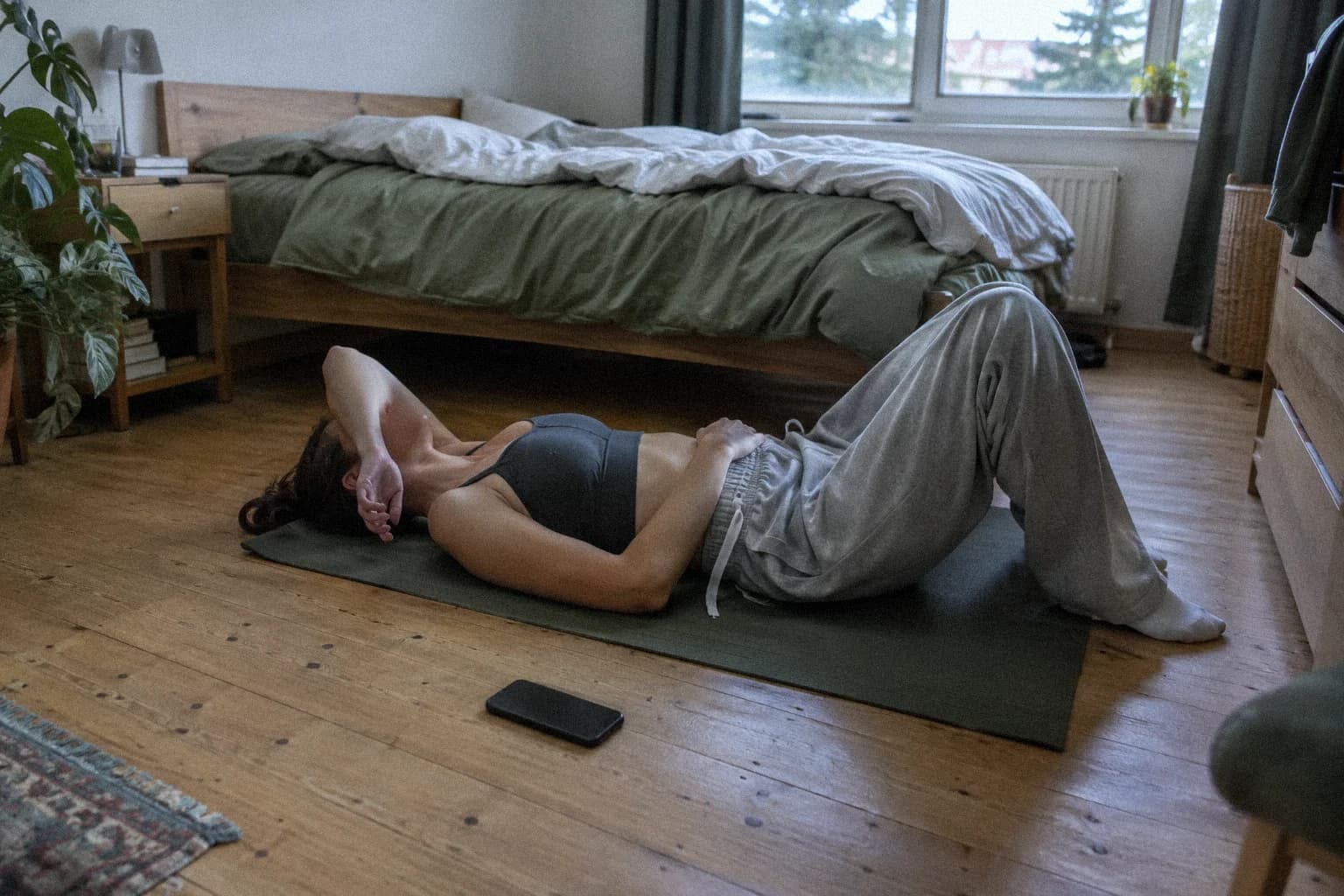
Hence a marker that changes everything, and the one thing worth keeping from this section. Do not wait for the head nod to react: the image that shows up on its own is already the top of the slope. At that point, straightening the spine, opening the eyes for a few seconds, or making one exhale more active will usually do. Thirty seconds later, they will not.
One counter-example, because the rule is not absolute: hypnagogic imagery also turns up in perfectly awake practitioners, particularly in long, low-stimulation practices. Its presence alone does not prove you are going. What signals the slope is that imagery combined with an attention that does not come back when you call it.
Meditating lying down or sitting: what posture changes
Posture is the fastest lever, and the one most often skipped by people hunting an attention fix for what is a posture problem.
Lying down, two things happen together. The muscle tone that held you upright has no reason to exist, so it releases; and the position itself has been paired with sleep for years, which makes it a learned cue. Meditating in bed stacks both, plus the location. This is not a matter of willpower.
Sitting, back unsupported, neck continuing the line of the spine, the body has a small ongoing job: holding itself up. That job costs little and it reports back. The moment attention lets go, the back rounds, and you get a signal before the drowsiness. A chair does the job perfectly well, feet flat, without leaning into the backrest.
Two details help, without working miracles: keeping the eyes half-open rather than closed, and resting the hands on the thighs rather than letting them drop. If all of that still is not enough, try standing, with your back to a wall and your head off it.
Is it bad to fall asleep while meditating?
No, and that is not the useful question. The useful question is: what are you getting instead?
A 2010 study led by Prashant Kaul answers it with rare precision, because it compares the two directly. Ten students with no meditation experience took a psychomotor vigilance test after three 40-minute conditions: a breath-focused concentrative meditation, a nap, and a control activity. All ten improved their reaction time after meditating, while nine out of ten got worse after the nap. Lapses, those abnormally slow responses, dropped after meditation. A nap and a session are not interchangeable, and on vigilance they point in opposite directions.
The same protocol then pushed participants deliberately into the wall: after roughly 32 hours without sleep, their baseline reaction time had slowed from 255 to 289 milliseconds. Meditation still produced an improvement from that degraded level. It does not replace the missing night, but it does something a nap does not.
So here is the honest answer. Falling asleep is not bad, it is not dangerous and it damages nothing. But a session where you sleep fifteen minutes out of twenty is not a successful meditation: it is a short nap, with grogginess on top. If sleep is what you need, better to take it outright, lying down, without dressing it up as practice.
A word of caution about what meditation does to sleep, because the subject is routinely oversold. In 2019, a systematic review led by Heather Rusch pooled eighteen randomised trials and 1,654 participants. Compared with already-validated sleep treatments, mindfulness meditation showed no greater effect on sleep quality, at a low strength of evidence; the improvement appears against non-specific active comparators. The available data therefore do not support treating it as a treatment for insomnia.
The scan that wakes you: change the instruction, not the route
One lever is left, and it is the one nobody mentions: the instruction.
Most body scans travel the same way, from the feet up to the head, and we set out the protocol in our article on how to do a body scan from the feet up (in French). What changes everything is not the route, it is what you are asked to do at each stop. Written for bedtime, most of them ask you to release: the zone grows heavy, settles, lets go. Every instruction then runs with the slope. When that is the intended effect there is nothing to fix, and the dedicated protocol is in our article on the body scan for sleep.
Keep the route, reverse the instruction. You start at the toes, climb slowly to the crown of the head, and at each zone you are not asked to release: you are asked to find the sensation, as if it were the first time you had paid attention there. Searching requires an effort of attention, and that effort is what keeps you awake. Finishing at the crown rather than at the feet helps too, for a simple reason: the last zone you visit is the one where attention stays sharpest.
The sequence, in eight minutes
Sitting, back unsupported, eyes half-open. Allow roughly a minute per step, including the time it takes to settle.
- The toes, one at a time. Not “the feet”: the big toe, then the little one, then whatever is in between. Precision is the engine.
- The soles, then the heels and ankles. Look for temperature, not for release.
- Calves, knees, thighs. Note which of the two sides answers more clearly.
- The pelvis and lower back, climbing vertebra by vertebra to mid-back.
- The belly and ribcage, letting the breath do its work without regulating it.
- Hands, forearms, shoulders. The hands are usually the most talkative zone.
- The neck, the jaw, the forehead, then the crown. Finish there, and stay ten seconds.
Two rules make the difference. First: a silent zone stays silent, and that is a valid answer. Note “nothing” and move on without pressing. Second: when a hypnagogic image arrives, do not fight it, drop back one zone and redo that zone. Stepping back works better than forcing yourself forward.
This kind of practice is not judged on a single session. In 2017, Dana Fischer and colleagues had participants practise a body scan over eight weeks. Measures of interoceptive processing, meaning the perception of the body's internal signals, improved by the end of the intervention. What you are training here is that perception, and it takes weeks to build, not days.
And if your problem is not drowsiness but the sense of feeling nothing at all, that is a different question, which we covered in our article on living too much in your head.
When drowsiness is about something else
An article like this one owes you its limits, and there are three.
The first is the commonest and the least medical: you are short on sleep, full stop. If you also drop off in front of a film, on the train or in meetings, meditation is not the subject. It is simply the only part of your day quiet enough for the debt to make itself heard. Two weeks of full nights beat any posture correction, and if it is falling asleep at night that defeats you, we described that in our article on being exhausted but unable to sleep.
The second belongs to a doctor. Drowsiness that persists while you sleep seven or eight hours, waking with a dry mouth or a headache, snoring someone else has mentioned, dropping off mid-conversation without warning, fatigue that no rest resolves: these are patterns that get assessed in consultation, and some of them treat very well once named. A GP is the right first port of call, and waiting another six months adds nothing.
The third is often forgotten. A good many common medicines list drowsiness among their side effects, and it is not always printed large: some antihistamines, anxiety treatments, blood pressure medication, painkillers. If your sleepiness appeared alongside a new prescription, the coincidence deserves a question to your pharmacist rather than a new cushion.
For everything else, which is the large majority, there is this week to try: sit upright, in the morning, eight minutes, climbing from the toes to the crown. And if you still nod off, at least you will know the answer is not in the practice. It is in the night before.
Frequently asked questions
- Do I lose the benefit of a session if I fall asleep halfway?
- You lose what sustained attention was giving you, not the rest. It is measurable: in Kaul's study, reaction time improved after a meditation session and got worse after a nap of the same length. So a session where you sleep twenty minutes out of thirty looks more like a short nap, with grogginess thrown in. It is not a wasted session, it is a session replaced by something else.
- Should I meditate lying down or sitting when I am tired?
- Sitting, and preferably without leaning your back against anything. Lying down, the body releases the postural tone that helped keep you awake, and the position itself is a learned sleep cue. If tiredness makes sitting genuinely painful, the real answer is not a halfway posture: it is to sleep first and meditate afterwards.
- How long should I meditate if I fall asleep every time?
- Drop to five or eight minutes, long enough for alertness to hold from start to finish. A short session finished awake beats a twenty-minute one you sleep through, because the awake part is what trains attention. Lengthen it once five minutes feels easy, not before.
- Why do I fall asleep during guided meditation but not in silence?
- Often because of the instructions themselves. Many recordings are written for bedtime and only ever pull downward: release, let go, sink, feel the body grow heavy. A slow, even voice adds a well-known drowsing effect on top. Pick a session that asks you to look for a sensation rather than release it, or sit in silence until you have a reference point again.
- Is it normal to fall asleep while meditating as a beginner?
- It is common, and it says nothing about your technique. Beginners usually stack all three conditions: sleep debt that was never repaid, a posture chosen for comfort, and long sessions chosen out of ambition. All three can be fixed inside a week. If drowsiness persists while you sleep enough and sit upright in the morning, the practice is no longer the thing to look at.
- Can meditation replace hours of sleep?
- The available evidence does not let anyone claim that. Kaul's study reports that seven experienced practitioners slept 5.2 hours on average against 7.8 hours for twenty-three controls, but the authors present this as preliminary, on a very small sample and without randomisation. Treating meditation as a substitute for sleep would go well beyond what is established.
Sources
- Awakening is not a metaphor: the effects of Buddhist meditation practices on basic wakefulness — Britton, Lindahl, Cahn, Davis & Goldman, 2013
- Meditation acutely improves psychomotor vigilance, and may decrease sleep need — Kaul, Passafiume, Sargent & O’Hara, 2010
- The two-process model of sleep regulation: a reappraisal — Borbély, Daan, Wirz-Justice & Deboer, 2016
- The process of falling asleep — Ogilvie, 2001
- The effect of mindfulness meditation on sleep quality: a systematic review and meta-analysis of randomized controlled trials — Rusch, Rosario, Levison & Olivera, 2019
- Improvement of Interoceptive Processes after an 8-Week Body Scan Intervention — Fischer, Messner & Pollatos, 2017