Benefits of walking barefoot: it is the skin, not the electrons
What are the benefits of walking barefoot?
Two effects survive scrutiny. The first is sensory: the skin on the sole of the foot feeds balance continuously, and a stiff shoe dampens that signal. The second is mechanical: short muscles inside the foot, barely used inside a supportive shoe, go back to work. The rest of the usual list holds up far less well.
That list is familiar: better circulation, less stress, better sleep, more energy. It travels under the name earthing, and it gets its own section below. The available evidence does not support it.
One detail changes how the whole subject reads, and almost nobody mentions it. Most of the serious measurements were taken on minimalist shoes, not on bare feet. What research tests is the removal of support and cushioning, not skin touching the ground. The two overlap a great deal, though not completely, and the confusion mostly benefits the vaguest promises.
In practice, the question is rarely theoretical. It looks more like: is it worth taking my shoes off in the garden, and am I risking anything. The sections below answer in that order.
The sole of the foot is not a shoe sole, it is a reading surface
Under each foot sits a dense population of cutaneous receptors, unevenly spread: more under the toes and the heel, fewer under the arch. They respond to pressure, to slip, to relief, to changes in temperature. They are not there so you can enjoy feeling the ground: they feed, continuously, the system that keeps the body upright.
Viseux published a review of that role in Neurophysiologie Clinique in 2020, along with its clinical implications. It describes the plantar sole as an interface that takes part in postural regulation, and discusses the perspectives opened by stimulating that area. In other words, the foot is not only what carries the body: it is also what tells the body where it is.
A shoe alters that channel in two ways. It inserts a thickness that smooths out relief, and it partly immobilises the foot, which narrows the range of successive contact points. The signal is not cut off, it is impoverished.
This is why walking unshod is closer to an attention exercise than to a physical one. You do not build much crossing a lawn. You do receive an amount of information that a day in shoes never supplies, which is what makes the experience so striking the first few times. The same mechanism is at work in any careful sweep through the body, where attention moves while nothing else does.
One reservation, to be fair to the source: this is a narrative review by a single author, not a meta-analysis. It synthesises a field, it does not close a debate.
Walking barefoot on grass, on sand or on tiles: what changes
The surface does nearly all the work, and it is always the same three that come up: grass, sand and hard indoor floors. They have nothing in common.
Grass is the richest in information. It is uneven, it gives under the foot, it is cool in places and warm in others, and its blades deliver continuous tactile feedback. It also cushions, so it forgives a clumsy landing. Its drawback is that it hides whatever lies underneath.
Dry sand asks for something else entirely. It shifts under every step, forcing the muscles of the foot and ankle to catch up constantly, which is why an hour on a beach leaves the calves tired. It is the most demanding surface for the muscles, and the most treacherous for anyone starting again after years in shoes. Wet sand, firmer, is a reasonable middle ground.
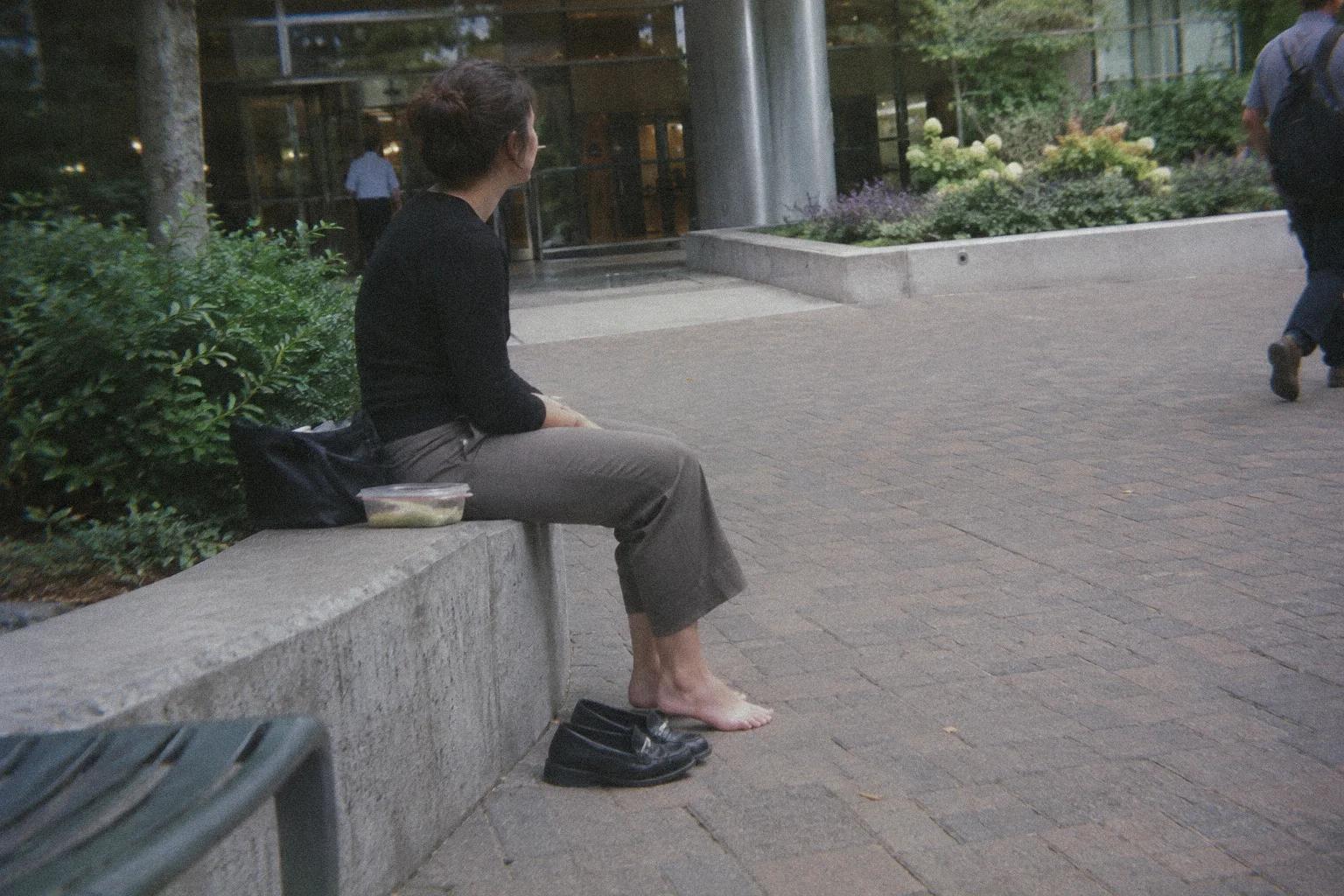
Tiles sit at the other end. Flat, hard and uniform, they teach the sole of the foot almost nothing, which makes them the least interesting surface for what concerns us here. Their real issue is thermal. A cold floor in winter can be plainly uncomfortable, especially for anyone whose extremities get cold easily.
Gravel and the stone slabs of a garden occupy a category of their own: highly informative, fairly uncomfortable, and perfectly safe as long as you watch where you put your feet. They make good learning surfaces over short distances.
Does it really strengthen your feet?
Yes, with one caveat about how to read it: the study that shows it best did not have its participants walk barefoot.
Ridge and colleagues published a trial in Medicine & Science in Sports & Exercise in 2019 that randomised 57 runners into three groups. The first walked in minimalist shoes, increasing the number of daily steps taken in them week by week. The second followed a foot strengthening programme at least five days a week. The third changed nothing. Muscle size was measured by ultrasound and strength by dynamometer, at week zero, week four and week eight.
The result is clear. Both active groups gained size and strength across every muscle measured, some of them by week four, while the control group did not move. The authors’ conclusion is an equivalence: walking in minimalist shoes is as effective as doing the exercises, with the practical advantage of adding nothing to your day.
What that trial measures is the removal of support, not skin against ground. So it is reasonable to think barefoot walking produces something of the same order, and unreasonable to treat it as proof. Two reservations point the same way: the participants were runners, so their feet were already working, and eight weeks of progressive walking looks nothing like ten minutes on the lawn on a Sunday.
The systematic review by Franklin and colleagues, published in Gait & Posture in 2015, adds a useful piece. Comparing barefoot and shod walking, it records differences in kinematics, in the forces involved and in muscle activity. Taking your shoes off does not remove a neutral layer: it changes the way you walk, and part of what people feel comes from that change of movement rather than from the contact itself. It is also why going back too fast has a cost, as with any walking you start doing differently.
Why walk barefoot on the earth? What the earthing theory is worth
This is the most typed question on the subject, and the answer that accompanies it in most articles is called earthing, or grounding. The idea: the surface of the planet carries a reserve of free electrons, our insulating shoe soles cut us off from it, and restoring contact would lower inflammation, pain and stress while improving sleep.
That hypothesis has one central source. The review by Chevalier, Sinatra, Oschman and the Sokal brothers, published in the Journal of Environmental and Public Health in 2012, is the text nearly all the others cite. It takes no precautions at all: its closing sentence announces a practice “of significant clinical importance”. And its conflict of interest statement notes that three of its authors are under contract with the company funding earthing research, in which they hold a small share of stock. That is no reason to dismiss it out of hand. It is a reason to read it with the caution anyone applies to work funded by the maker of what it evaluates.
So the problem is not that nobody has published anything. It is that the available work is sparse, run on small samples with heterogeneous protocols, and the available evidence does not allow anyone to claim that electrical contact with the ground changes sleep, pain or inflammation. There is a step between “measurements have been reported” and “the effect is established”, and earthing has not taken it.
It is worth saying what this criticism does not claim. It does not claim that walking barefoot outside does nothing. It says that if something happens, the electrical explanation is not the one that stands up best, while two simpler and better documented candidates exist: the sensory channel described above, and the plain fact of being outdoors.
That second candidate has measurements of its own. Hunter, Gillespie and Chen published an experiment in Frontiers in Psychology in 2019 in which participants took “nature pills” in ordinary life, at a place and time of their choosing, with salivary cortisol and alpha-amylase tracked throughout. Time outdoors came with a drop in those markers. It is not a study about feet, and that is precisely the point: the share of the effect credited to the ground could very well belong to the garden. The same caution applies to any practice taken outdoors, whose commercial versions often promise well beyond what the work shows.
Your own weight as a point of attention
There is one use of barefoot walking that asks for no belief at all and checks out in thirty seconds: it makes the body’s contact with the ground obvious. In shoes, weight is an abstraction. Unshod on an uneven surface, it becomes continuous information that shifts with every step.
Here is one way to use it, in five minutes, on a lawn or a terrace whose condition you know.
Stand still, feet hip width apart. Let the weight drop rather than trying to hold yourself well. For one minute, locate where it presses: more towards the heels, more towards the front, more along the outer edge. There is no right answer, only an observation.
Then shift the weight very slowly from one foot to the other for two minutes, following the exact moment when one foot loads and the other lightens. That crossing, not the position, is what carries the information.
Finish by walking for two minutes in slow motion, putting each foot down flat. Count textures rather than steps: a blade of grass, a stone, a damp hollow, a warm patch. When attention wanders, which it will, the next texture brings it back without effort.
The exercise asks for nothing beyond taking your shoes off, and it does what any seated practice does with the points where the body touches something. The difference is that here the support is rough and changing, so it is far harder to forget.
Who should not walk barefoot
This is the part most wellness articles put last and give three lines to. It deserves better, because it concerns a lot of people.
The clearest case is reduced sensation. When perception in the foot is impaired, by long-standing diabetes or by neuropathy, a cut, a splinter or a burn can go entirely unnoticed, and a wound that heals badly becomes a serious problem. The Footcare Advice page from My Diabetes My Way, an NHS Scotland service, lists avoiding barefoot walking among its recommendations, noting that going unshod risks injuring the feet on sharp objects. That is not a precaution of principle.
Then come the temporary situations: an open wound, a cracked heel, athlete’s foot, recent foot surgery. In all of them the skin is in no state to serve as a contact surface, and waiting costs nothing.
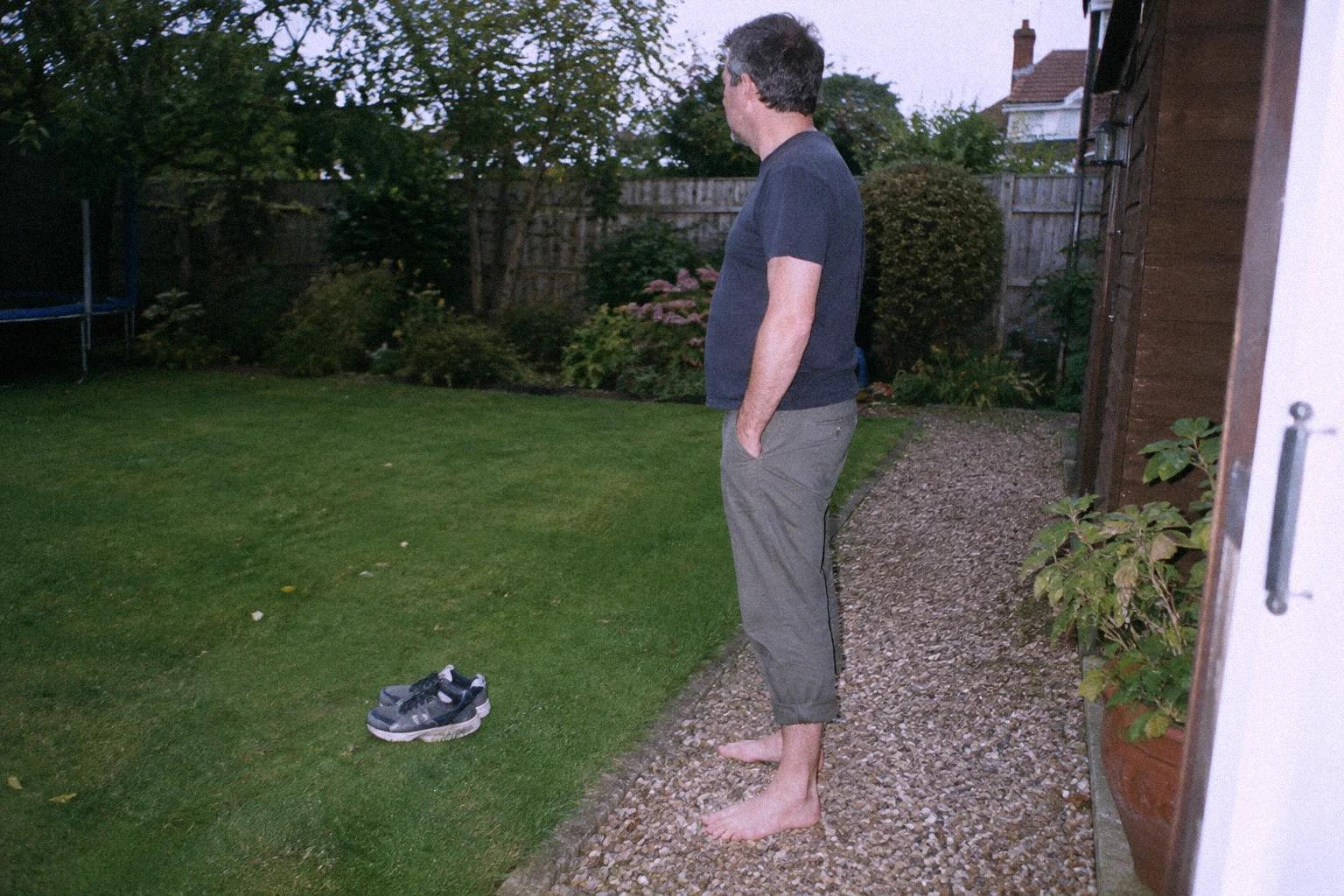
Finally there is the question of the ground, which applies to everyone. A public lawn, a roadside, a changing room or a poolside offer no guarantee about what they contain: glass, a staple, a needle, fungus. The rule is simple: you walk barefoot on ground whose condition you know, and nowhere else.
For the rest, caution fits in one sentence. Start short, on a soft surface, and build slowly: the sole of the foot, like any tissue, thickens and adapts provided it is given time. Pain in the heel or under the arch that settles in after several outings is not a stage of adaptation, it is the signal to cut back and, if it persists, to ask a podiatrist.
Frequently asked questions
- Is walking barefoot on grass in the morning especially good?
- Not for the reasons usually given. Cool damp grass hands the sole of the foot a lot of information, because it is uneven and changes temperature from one step to the next, which makes it a good support for attention. But nothing indicates that morning is a better moment than any other, and the benefits attributed to dew or to the hour belong to belief rather than to measurement.
- How long do you have to walk barefoot to feel anything?
- A few minutes is enough for the sensory part: the difference in perception shows up in the first steps on an uneven surface. For the muscular part, Ridge and colleagues measured their results over eight weeks of gradual daily exposure, with some muscles already larger at four weeks. These are two different timescales, and only the second one asks for consistency.
- Is walking barefoot at home on hard floors bad for you?
- Tiles and hard floors do no harm in themselves. They are simply the least informative surfaces: flat, hard and uniform, they give the sole of the foot almost nothing, so they do not deliver what people are looking for. The real issue indoors is temperature in winter: a cold floor can be plainly uncomfortable, especially for anyone whose extremities get cold easily.
- Do minimalist shoes replace barefoot walking?
- For the muscular work, they do the same job: that is exactly what Ridge and colleagues measured, finding the same gains in size and strength as a dedicated exercise programme. For the sensory part, they keep a sole between skin and ground, so they filter out some of the texture and relief. They are mostly a far safer way to reduce support without exposing the skin.
- Does walking barefoot improve your eyesight?
- No, and this claim circulates widely. The available evidence does not connect contact between the foot and the ground to visual acuity, and no plausible mechanism has been put forward. The idea probably comes from reflexology systems that map areas of the foot onto organs, a mapping research has not validated.
- Can you walk barefoot with plantar fasciitis?
- This is a case where a professional opinion matters more than an article. A painful plantar fascia often tolerates hard unpadded surfaces badly, and several treatment approaches rely instead on temporary arch support. Walking unshod on a soft surface can be comfortable for some people and painful for others: pain remains the signal to follow, and a podiatrist will settle it better than any general rule.
Sources
- The sensory role of the sole of the foot: Review and update on clinical perspectives — Viseux, 2020
- Barefoot vs common footwear: A systematic review of the kinematic, kinetic and muscle activity differences during walking — Franklin et al., 2015
- Walking in Minimalist Shoes Is Effective for Strengthening Foot Muscles — Ridge et al., 2019
- Earthing: Health Implications of Reconnecting the Human Body to the Earth’s Surface Electrons — Chevalier et al., 2012
- Urban Nature Experiences Reduce Stress in the Context of Daily Life Based on Salivary Biomarkers — Hunter et al., 2019
- Footcare Advice — My Diabetes My Way (NHS Scotland), 2026