Feeling guilty for doing nothing: Sofiane, 38, and the Sundays he spent catching up
Composite case: the first names, ages and situations in this story are drawn from several accounts and match no real person. No individual health outcome should be inferred from them.
I never managed to convince myself I had the right to stop. I just stopped putting it to the vote.
Feeling guilty for doing nothing: where the guilt comes from
This guilt comes from a lopsided burden of proof: an hour of work leaves a trace you can point to, an hour of rest leaves none. Rest therefore has to defend itself with no evidence, and it loses every time.
That is why arguing does not work. You tell yourself you have worked enough, that the body needs to recover, that nobody holds up seven days a week. The statements are true. They change nothing, because they are pleading a case before a court that never asked for a defence.
The word “guilt” is in fact a little too broad for what actually happens. What most people describe is not remorse, it is an alarm: a tension that rises the moment activity stops, along with the list of everything still outstanding. An alarm cannot be reasoned with. It has to be disarmed.
And it is disarmed by what it lacks. Give rest a nameable reason, a start time and an end, and you have handed it exactly what the task had and it did not. Nothing more. This is also why the problem is distinct from the one faced by people who cannot relax: there, relaxation is permitted and will not come; here, it would come easily if it were allowed.
Why do I feel guilty for doing nothing?
Because unjustified idleness is, for most people, genuinely unpleasant. That is not an impression: it is what two often-cited lines of research measure.
In 2014, Timothy Wilson’s team published eleven studies in Science in which participants were asked to sit alone for six to fifteen minutes, with no phone, nothing to read, and their own thoughts for company. Most found the exercise unenjoyable and struggled to concentrate. In one of those studies, participants could give themselves a mild electric shock they had all rated as unpleasant beforehand. A substantial share of them chose to hurt themselves rather than sit for fifteen minutes doing nothing. The study involved students in a lab room, not Sunday afternoons: worth remembering before generalising.
What it does establish holds, and it is the useful part here. The difficulty predates you. If doing nothing takes effort, that is not a sign of a damaged relationship with work, it is how an attention system looking for an object ordinarily behaves.
The second finding is more precise, and it is the one that yields the practical key. Hsee, Yang and Wang showed in 2010 that people prefer being busy to being idle, but above all that they need a reason to be busy: faced with a waiting period, they chose the option that made them walk pointlessly as soon as even a thin pretext justified it. The authors call this idleness aversion and the need for “justifiable busyness”.
Read it the other way round and you get the full mechanism of Sunday guilt. It is not idleness that is unbearable, it is unjustified idleness. The same hour spent sitting still becomes acceptable once it carries a label, which is precisely what someone does, without realising it, when they allow themselves a break “because they have a fever”. They have not changed their mind about rest. They have produced a receipt.
That leaves the question of whether the time is any use. A 2012 review by Immordino-Yang, Christodoulou and Singh argues that task-free periods are not dead time: they coincide with a brain mode turned towards emotional processing, autobiographical memory and meaning-making. This is theoretical work grounded in imaging, not a trial: it does not show that an hour on the sofa produces a measurable benefit. It does remove the last basis for the idea that the time is wasted.
Before: the Sundays Sofiane spent catching up
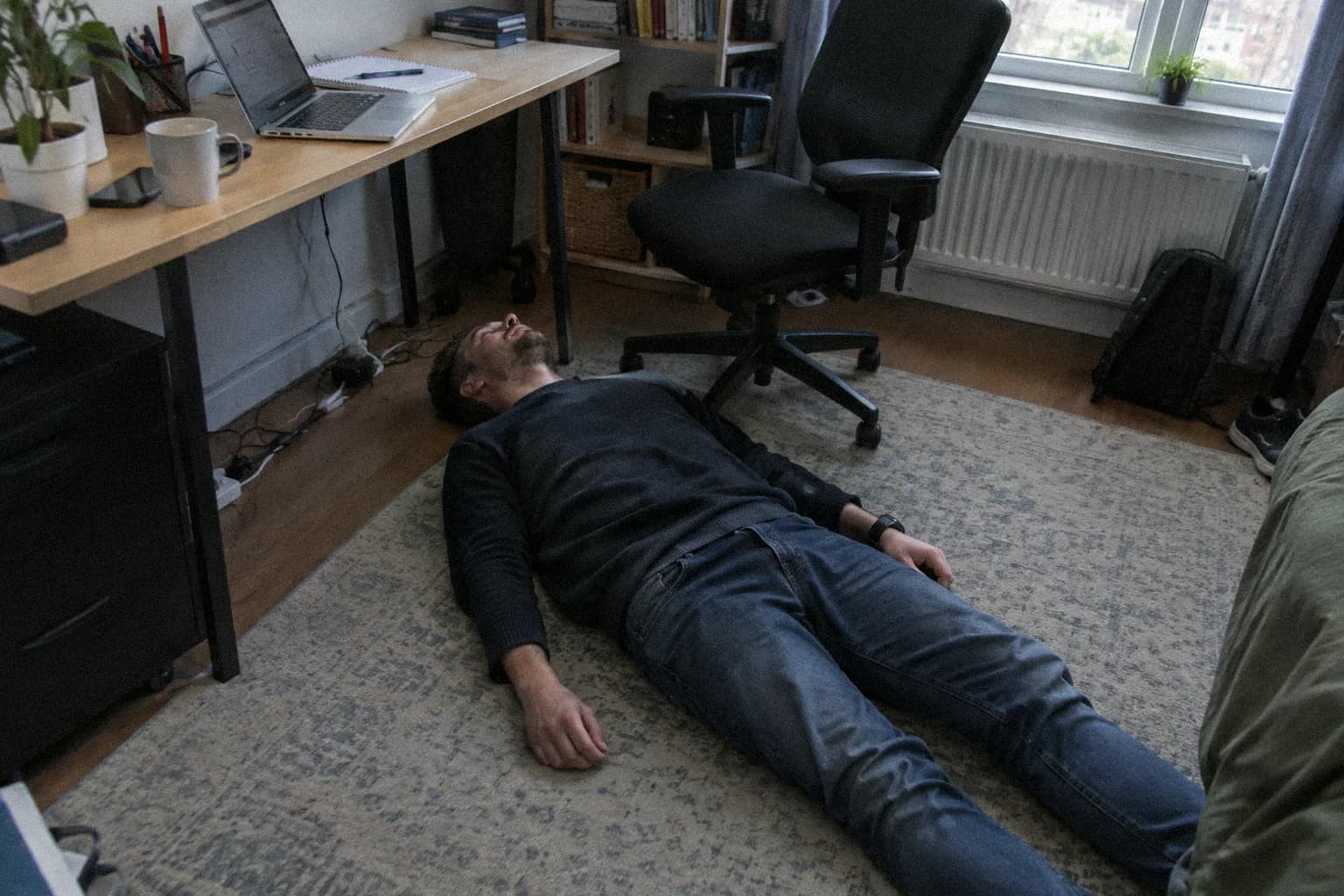
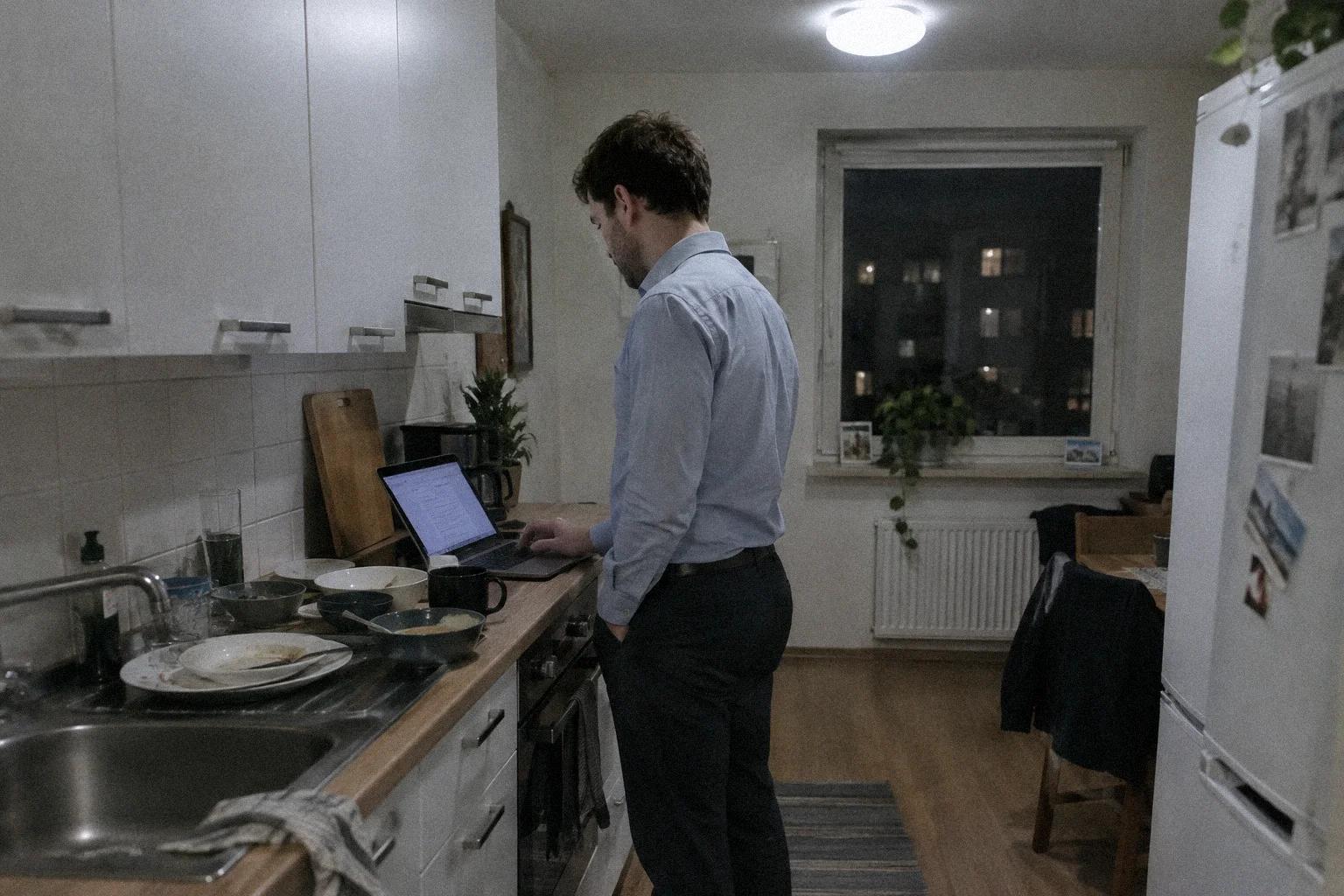
Sofiane is 38. He plans delivery rounds for a food distributor near Nantes, and it was his partner who eventually put words to what she was watching: he never sat down.
The symptom had been visible for years, in a form that looked like diligence. Saturday mornings went to shopping and paperwork. Saturday afternoons to work on the flat, which never really progressed. And Sundays, the day supposedly free, had become the catching-up day: whatever had not been done the day before, plus whatever could be pulled forward from the week ahead.
In February 2026, a weekend of flu put him in bed for two days. He later described it as the best rest he had had in a long time, and he heard himself say it. It had taken a fever of 39 °C (102 °F) for him to be granted permission to do nothing, and the permission came from nobody but himself.
What he had tried before amounted to a single repeated strategy: convincing himself. He knew sixty-hour weeks were not sustainable, he explained it well to other people, he had read the articles. None of it had ever produced a single hour of untroubled idleness. The rare times he sat down without a task, he got up again after ten minutes, and he called that “not being able to do it”.
That vocabulary does damage. It makes an ordinary mechanism into a personal defect, and adds another item to the case a person builds against themselves. Sofiane had arrived at a settled conviction: not only did he not rest, he had tried, so the problem was him. It is the same mechanism that drives people to put pressure on themselves over goals they never chose.
The shift: no longer asking for permission
The change came from something his partner said, and it was not remotely therapeutic. She pointed out that he managed to sit through two hours of a football match perfectly well, and had never felt guilty about it once.
He found the comparison unfair at first. Then accurate. A match has a start time, an end, a name, and nobody needs to defend it. So it was not stillness that was forbidden to him, it was stillness without a label.
What he changed comes down to a simple inversion. He stopped trying to deserve rest and started treating it as an appointment: a slot booked in advance, a stated duration, a name that is not “nothing”. The name did not need to be sincere to work, and that is the uncomfortable part.
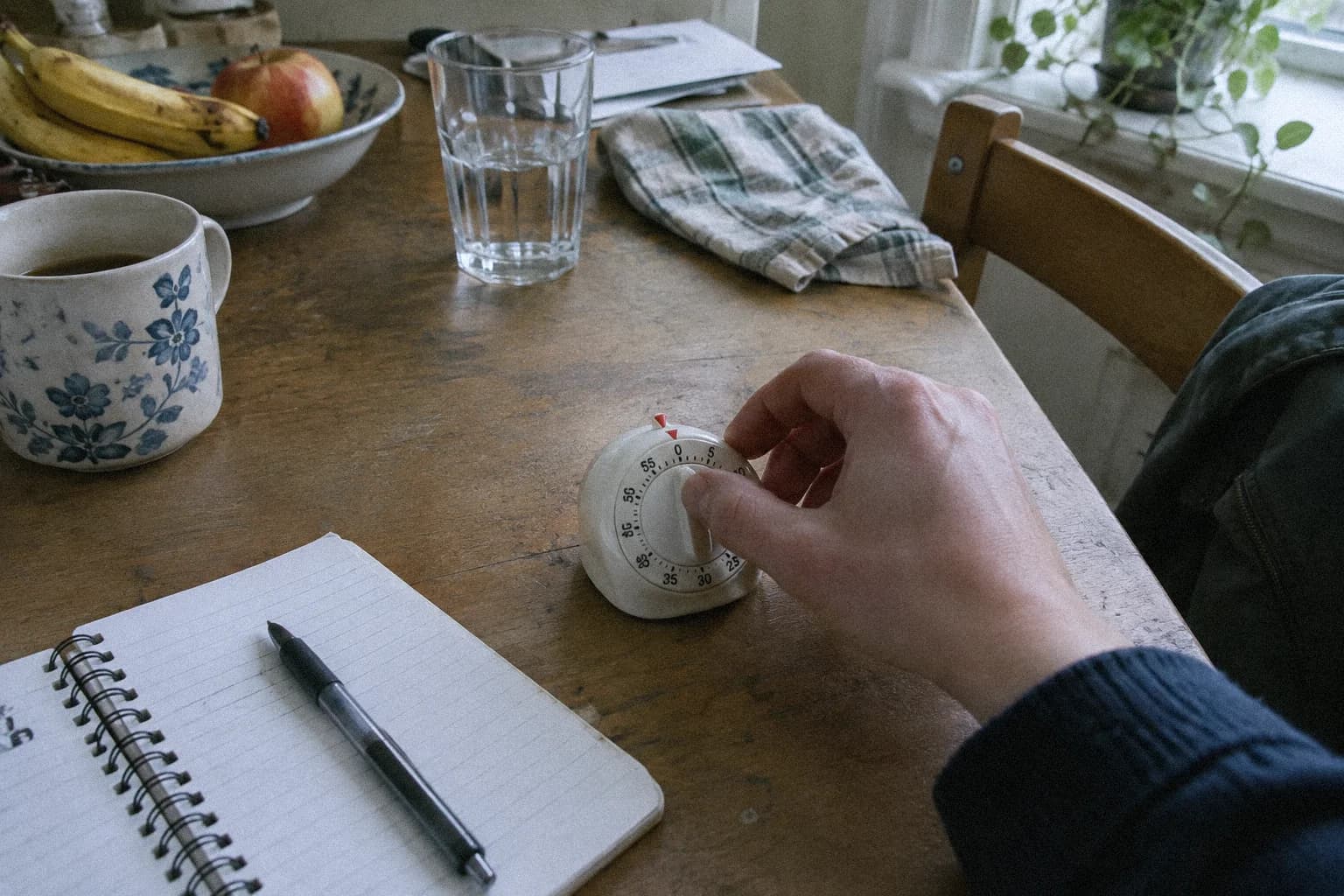
He also bought a mechanical kitchen timer, for a reason he had not anticipated: his phone could not do the job. A timer you wind up produces an audible commitment, and it offers nothing else to do while the time passes.
How to stop feeling guilty for doing nothing: exactly what he did
The protocol is deliberately bureaucratic. That is the point: it speaks the language of whatever triggers the guilt.
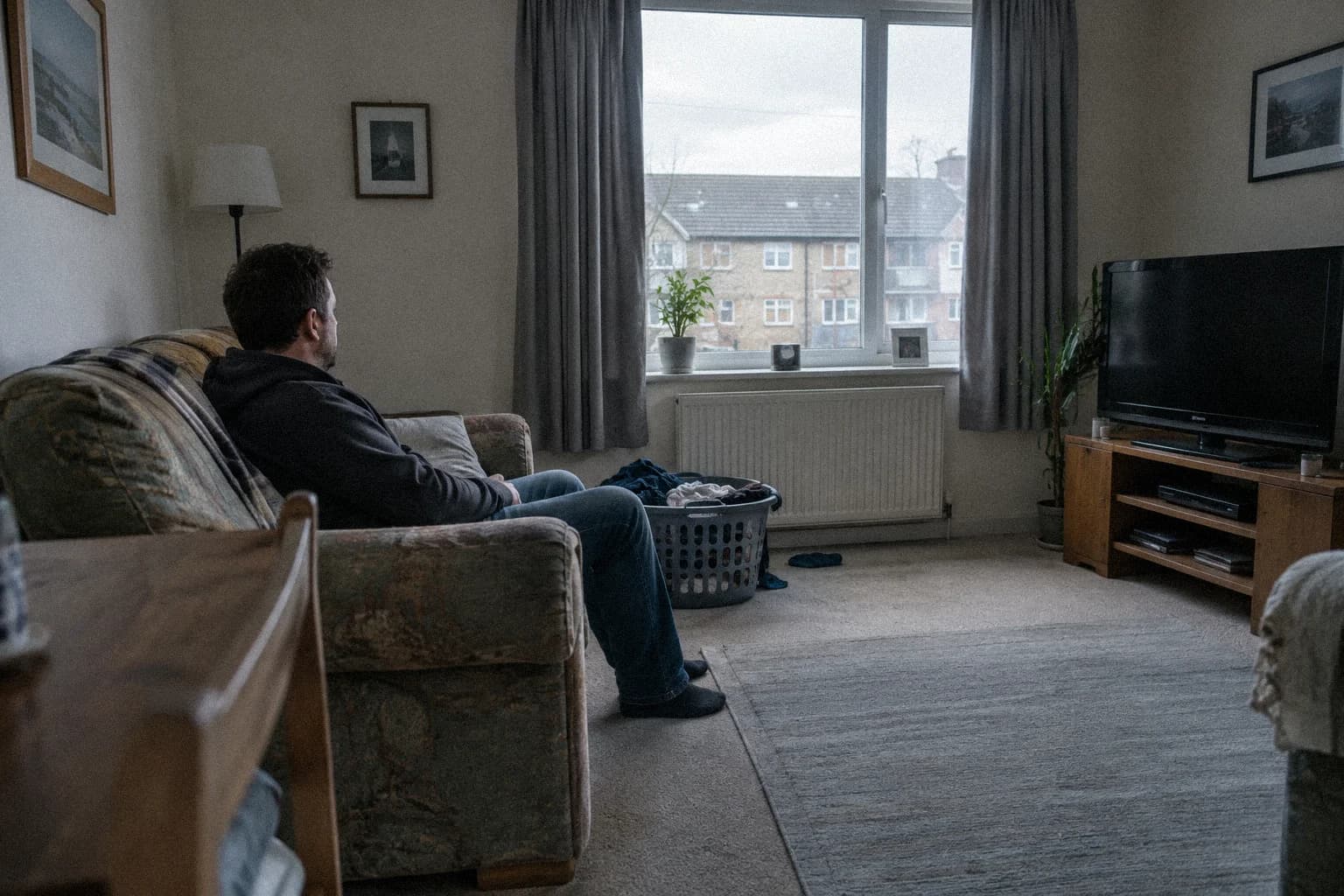
Every Sunday, Sofiane booked a single twenty-minute slot, written down the evening before in the same notebook as his tasks, with a title. Not “break”. Not “nothing”. Something like “recovery before the week”, or “twenty minutes at the window”. He wound the timer, put it out of reach, and stayed there.
A few rules, which he learned by getting them wrong first.
- Announce the end before the beginning. A closed window cannot be renegotiated, and it is the constant renegotiation that exhausts you, not the idleness.
- Give it a title that is not an absence. “Doing nothing” invites argument, “recovery before the week” far less so, and the difference is more than wordplay for a mind demanding a justification.
- Write the list before, not during. Tasks that surface go in the notebook the evening before; the ones that arrive anyway during the slot get written down afterwards, never live.
- Do not try to feel good. The goal is not a sense of relaxation, it is holding the window to the end. The first ten minutes are often frankly uncomfortable, and that does not mean it is not working.
- Stop at the timer, even if it was going well. A slot that stretches becomes open-ended time again, and therefore time to defend.
The choice of activity matters less than you would think, as long as it produces nothing. Looking out of the window, sitting outside, lying down without sleeping: what disqualifies a break is that it manufactures a result, not whether it is enjoyable. A slot spent sorting photographs is not a slot. It is the same line that separates resting without sleeping from insomnia: what decides it is not the position of the body, it is what you expect from the passing time.
What changed, and in what order
The sequence surprised Sofiane, and it is what makes the rest credible.
What moved first, after three Sundays, was not the guilt. It was how long it lasted. It still rose to the same intensity in the first few minutes, then dropped before the end of the slot instead of holding for twenty minutes. It took him several weeks to notice, because he was watching the wrong thing: he was waiting for it to disappear.
Then came a clearer shift, around the sixth week. He began booking the slot without having to justify it to himself as he wrote it down. The title stayed, but it had stopped being an argument and become an ordinary diary line.
Relaxation arrived last, and well after he had hoped. Not a sense of wellbeing. More the absence of what had been occupying the space: no more scrolling list, no more calculating what he could have got ahead on. Rest did not get added; it appeared once the monitoring left.
One side effect is worth flagging, because it is common and disconcerting. In the first few weeks his Sundays became more tiring, not less. Sitting still while discomfort rises asks more of you than folding washing does, and he nearly stopped for exactly that reason.
What it did not fix
His workload did not change by a single hour, and it was the workload that fed the catching-up Sundays. The slot made rest practicable; it removed none of the reasons that made it feel culpable. Sofiane stopped using Sunday to catch up on Saturday; he did not stop the long weeks.
The guilt comes back, too, in phases. Weeks when a project overruns, the return from a holiday, Sundays that follow an unproductive day. What changed is not that it disappeared, but that he recognises it early and knows what to do with it: book a shorter slot rather than give up the slot.
And this approach does not suit everyone. When stopping brings up not guilt but anxiety, with intrusive thoughts or difficult memories returning, sitting for twenty minutes with nothing to do can become counterproductive. In that case a rest that keeps some minimal activity for the attention is better, such as walking with no destination, and it is worth talking to someone rather than holding the window alone.
One note on diffuse guilt, finally, because the confusion is common. The guilt discussed here has a precise object: stopping. When the sense of doing things badly wanders without an anchor, from work to relationships, it belongs with constant guilt (in French), and the slot will do nothing for it.
When this guilt signals something else
There is a clear line between a learned relationship with rest and a state that needs care.
Seeing a doctor is warranted when the inability to stop comes with fatigue that no longer lifts after rest, even following several decent nights, and a gradual loss of interest in what used to matter. Together, those three can point to burnout, and no twenty-minute slot treats it. A general practitioner is enough for a first conversation.
The signal is more urgent if stopping brings on a sense of worthlessness, the feeling that nothing you do has any value, or dark thoughts. In the US and Canada, 988 answers free of charge, at any hour; in the UK and Ireland, 116 123. This is not a step beyond this article: it is a different door, and an equally legitimate one.
For everything else, which is by far the most common case, the good news is small but reliable. You do not need to be convinced that you deserve to stop. You need a slot with a name and an end, and the conviction, if it comes, will come afterwards.
Frequently asked questions
- Is doing nothing tiring?
- Doing nothing is not tiring in itself, but monitoring it is. A break spent checking every two minutes whether you are allowed to be there requires continuous mental activity, and that is what wears you out. People who come out of an empty afternoon more tired than they went in have rarely rested too much: they have been negotiating for three hours.
- Is it good to do nothing?
- The available evidence points that way, as long as you do not expect a measurable short-term effect. A 2012 review argues that task-free periods support emotional processing and meaning-making rather than being dead time. That is a theoretical argument grounded in brain imaging, not a clinical trial: it makes idleness defensible, it does not prescribe a dose.
- How long do you have to do nothing for it to count?
- There is no validated duration, and aiming high backfires when the guilt is strong. Twenty minutes with an announced start and end holds up better than a whole afternoon left open, because a closed window cannot be renegotiated continuously. Longer sessions come later, or they do not, and that is not a failure.
- I feel guilty doing nothing on holiday, is it the same thing?
- The mechanism is the same, amplified by the cost. A holiday carries an implicit expectation of return, and rest is supposed to produce something visible by the time you are back, which turns it into one more task. The guilt is often sharpest in the first two or three days, until the absence of tasks stops reading as a backlog.
- Does niksen actually work?
- Niksen, the Dutch idea of doing nothing without a purpose, describes this practice well, but its popularity goes far beyond what has been studied. To our knowledge, no trial has tested niksen as such. What is documented, and more useful, is the difficulty of unjustified idleness: that is the thing to address, and the name you give the practice matters little.
- Is guilt about resting a sign of burnout?
- It is a common sign, never a criterion on its own. What should raise concern is the combination: guilt that makes any stopping impossible, fatigue that no longer lifts after rest, and a gradual disengagement from what used to matter. Taken alone, this guilt mostly describes a learned relationship to work. Taken with the other two, it is worth raising with a doctor.
Sources
- Just think: The challenges of the disengaged mind — Wilson et al., 2014
- Idleness Aversion and the Need for Justifiable Busyness — Hsee, Yang & Wang, 2010
- Rest Is Not Idleness — Immordino-Yang, Christodoulou & Singh, 2012