How to rest without sleeping, and what separates rest from insomnia
What decides it is attention, not posture
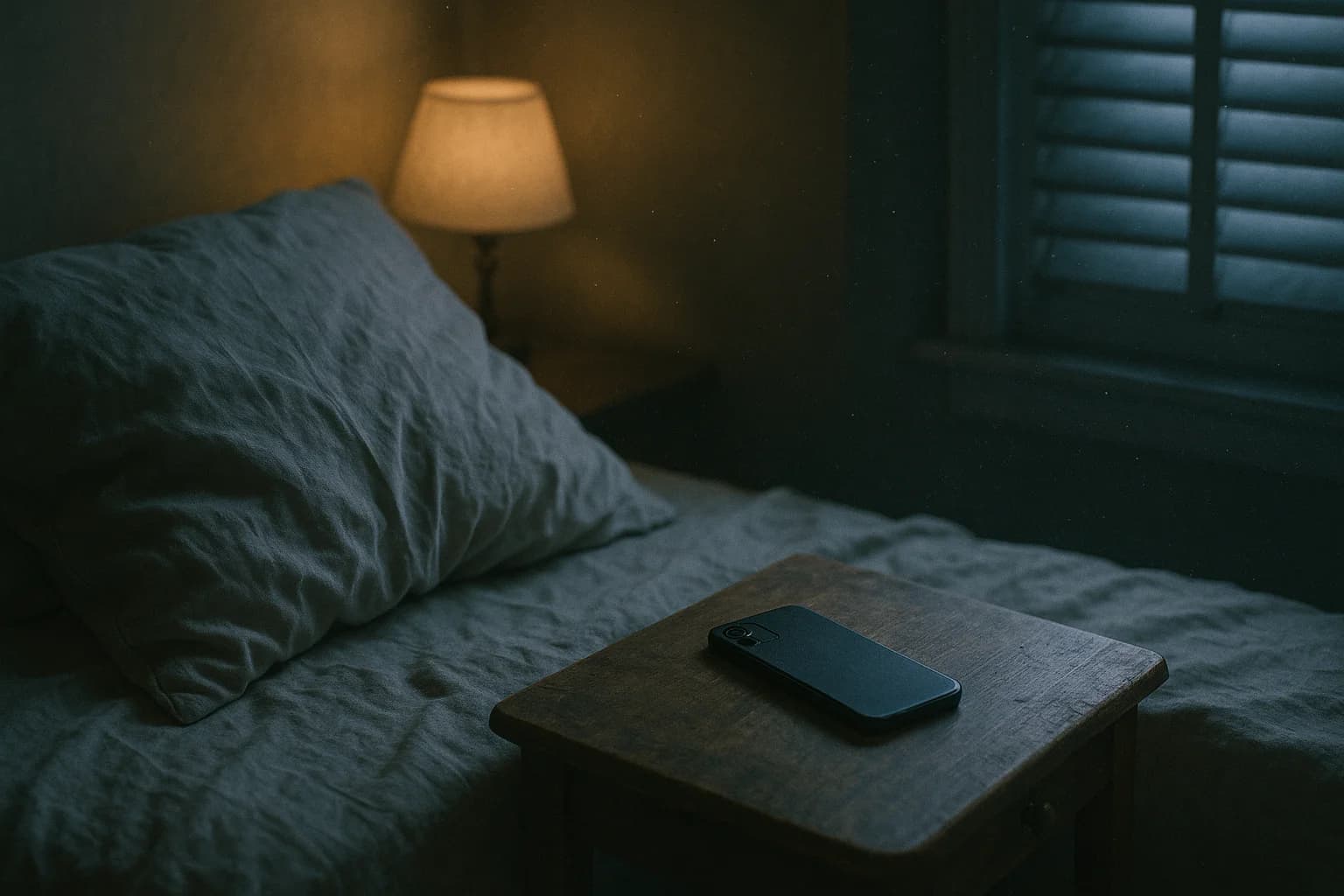
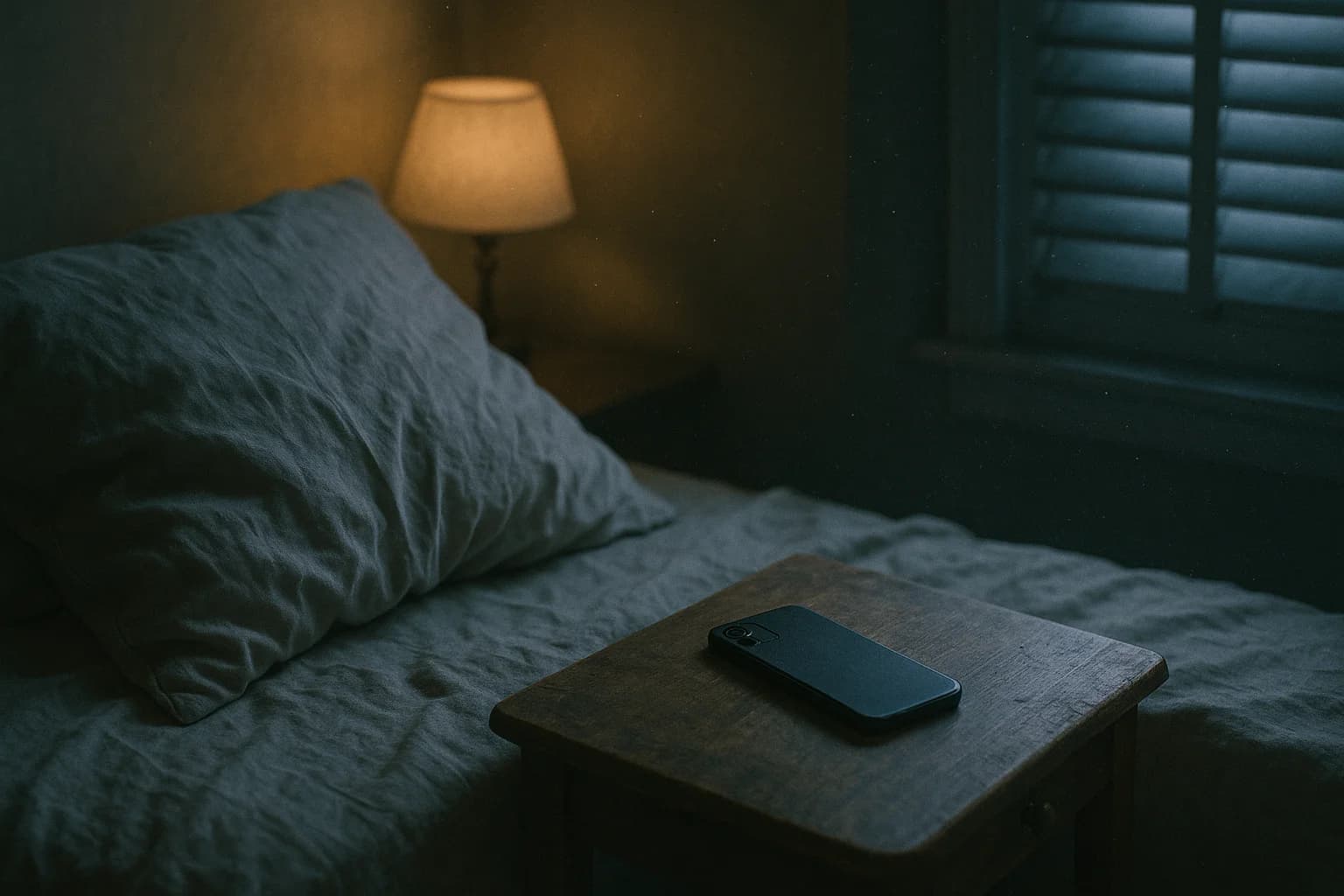
You can rest without sleeping, and the very same position can also wear you out: the difference is not in the body, it is in what the mind does with the time. Twenty minutes on the living room rug letting whatever comes go past is rest. Twenty minutes in bed at 3.40am working out how many hours are left before the alarm is the opposite of rest, and it is the same back on the same mattress.
That asymmetry explains why the pages answering this question contradict each other without ever meeting. Some sell a miracle technique for express recovery. Others point out, quite rightly, that lying in bed does not repair a sleepless night. Both camps describe the same posture and neither mentions the one variable that changes everything.
Sleep research has had a name for it for a long time. The hyperarousal model of insomnia describes the condition as an excess of arousal that persists day and night, maintained in part by learned associations around going to bed and by a tendency to worry. A motionless body is not an organism at rest. It can be an organism on maximum alert, perfectly still.
Which gives us a practical consequence that runs through everything below: waking rest works when you ask nothing of it. The moment it becomes an attempt to fall asleep, it becomes waiting, and waiting is what insomnia runs on.
Does closing your eyes without sleeping really rest you?
Yes, and more than people assume, provided you do not expect that pause to do a night’s work.
The first effect is mechanical and nobody disputes it. Lying down, the muscles holding up the head, back and pelvis stop working. Closed eyelids cut off a stream of information that accounts for a large share of what the brain processes continuously. Heart rate slows. Nothing spectacular, and already more than a sofa with a phone in hand delivers.
The second effect is more interesting, because it runs against intuition. In 2012 a team played participants two stories. One of the two was followed by ten minutes of quiet rest in a darkened room, the other by ten minutes of a spot the difference game. Seven days later, the stories followed by rest were remembered markedly better, and a second experiment found the same gap with no recall asked for in between.
What that experiment measures is not relaxation, it is consolidation. The brain needed a few minutes with no new task to file away what it had just received, and the puzzle game had denied it that. The authors do not claim rest replaces sleep. They show that what you do in the ten minutes after learning weighs on what survives a week later.
The lesson for anyone wanting to rest without sleeping fits in one line. The benefit comes not from stillness but from the absence of new information. An episode of a series with your eyes open produces none of it, and a news feed even less.
What waking rest never pays back
Sleep is not an absence of activity, it is a sequence of stages each doing a different job, and waking rest triggers none of them. No slow wave sleep, no REM, so none of what depends on either. After a four hour night, lying down makes the afternoon more workable; it does not buy the night back. You cannot slice a night into daytime portions, and the available data do not support any claim to the contrary.
A second limit is less visible and more awkward. Many people arrive at this question because they have stopped sleeping, and are looking for a substitute. That is understandable. It is also the wrong direction: a well executed backup rest makes insomnia more bearable, and therefore less treated. If the real difficulty is that sleep will not come or will not hold, daytime rest is not the subject, and we have covered it elsewhere, from exhaustion that still will not turn into sleep to the night waking that refuses to go back under (in French).
NSDR and yoga nidra: where the research actually stands
Since 2022 the acronym NSDR, for non sleep deep rest, has circulated widely: ten to thirty minutes lying down, guided by a voice. The name is new. The practice is not remotely new, it is yoga nidra, documented for decades, with progressive muscle relaxation as its western cousin.
Serious work exists. An Indian randomised controlled trial compared yoga nidra with standard cognitive behavioural therapy in 41 patients with chronic insomnia. Both groups improved on total sleep time and on perceived quality; the yoga nidra group additionally showed a marked improvement in slow wave sleep, measured on polysomnography in only those patients who volunteered for a second recording, alongside a statistically significant drop in salivary cortisol. That is an interesting result.
It is also a small trial. And this is where honesty costs something.
A systematic review with meta-analysis published in 2026 gathered what exists on the subject. Its verdict is sober: across the randomised trials, the effect on sleep quality does not reach significance, the certainty of the evidence is rated very low, the samples are small and the trials cluster in a single country. The authors describe their own conclusions as preliminary.
In other words: the practice is plausible, pleasant, low risk for most people, and unproven. Pages promising that twenty minutes equals several hours of sleep are quoting a figure nobody has measured. It is worth trying. It is not worth believing.
The cinema screen is a seat, not an instruction
Which leaves the hard question. How, in practice, do you get the mind to stop fighting without ordering it to be quiet?
The instruction to empty your mind fails for almost everyone, and it fails mechanically: it adds a task. Emptying your mind means constantly checking that it has stayed empty, which manufactures one more watcher. Three minutes in, you have two thoughts where there was one.
The image of a cinema offers something else, and its advantage is that it asks for nothing. Thoughts keep rolling past, like images projected on a screen. You are sitting in the room. The question is never how to switch the film off, it is whether you are watching from a seat or have climbed into it.
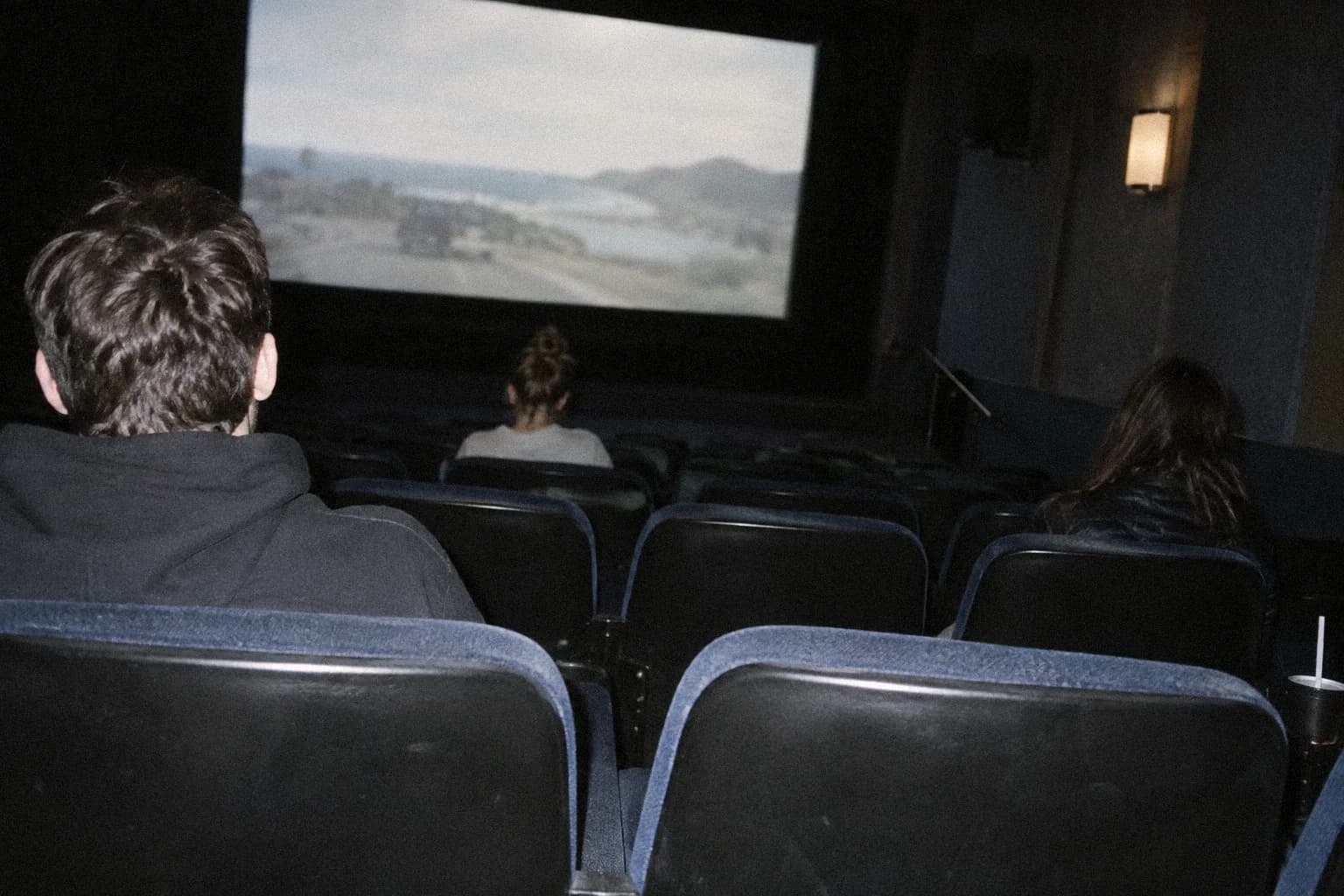
The distinction is anything but cosmetic when rest is the goal. Being inside the film means living each scene as an emergency: tomorrow’s meeting is happening now, and the body prepares for the meeting. Being in the room means watching a scene titled “tomorrow’s meeting” go by without leaving the seat. The content is identical. The physiological cost is not.
Stepping back from a thought rather than fighting it has a name in therapy, defusion, and it has been tested in the laboratory. A meta-analysis of 66 component studies found significant positive effects for procedures of this kind, and one detail of its results deserves attention here: effects were larger for conditions that went through a metaphor or an exercise than for those that merely explained the rationale.
Which means reading this paragraph is not enough. The image has to be played, lying down, while the thoughts arrive. We have set out several variants of that observer stance in our guide to detaching from your thoughts; the cinema one simply has the merit of being easy to find again in the dark.
And on the days when the image refuses to take, because there are such days, the fallback is the body rather than the mind. The weight of the heels on the floor, the temperature of the air at the nostrils.
Twenty minutes, and preferably not in your bed
The protocol comes down to three decisions, and the most important one is where.
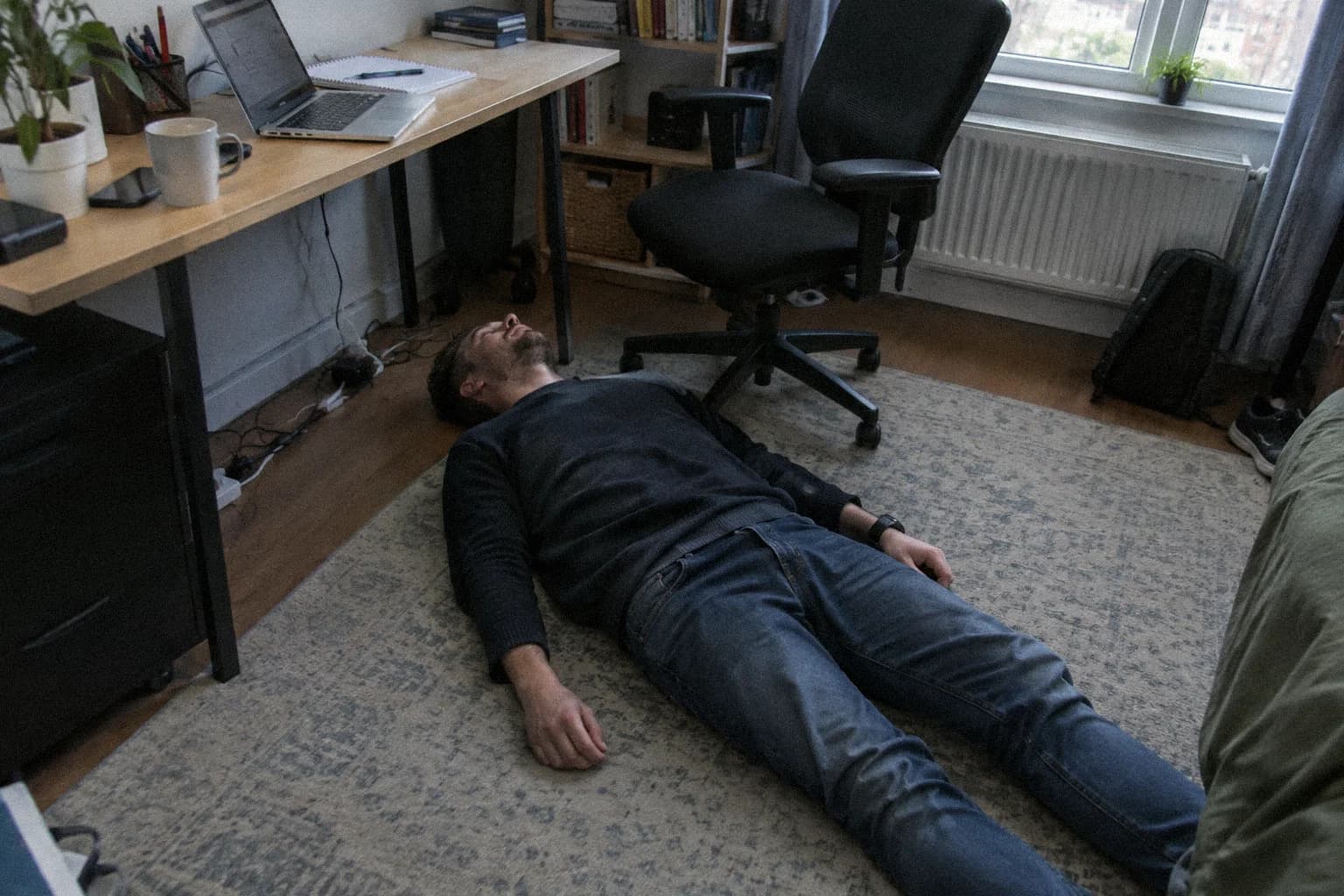
Pick somewhere that is not your bed. The living room rug, the office carpet, the back seat of a car in a car park, a bench. This is not fussiness: clinical guidance on chronic insomnia suggests stimulus control as a single component therapy, meaning you keep the bed for sleep and leave it when sleep does not come. A bed where you regularly spend waking time becomes a place of waiting, and that is a lesson you pay for at night.
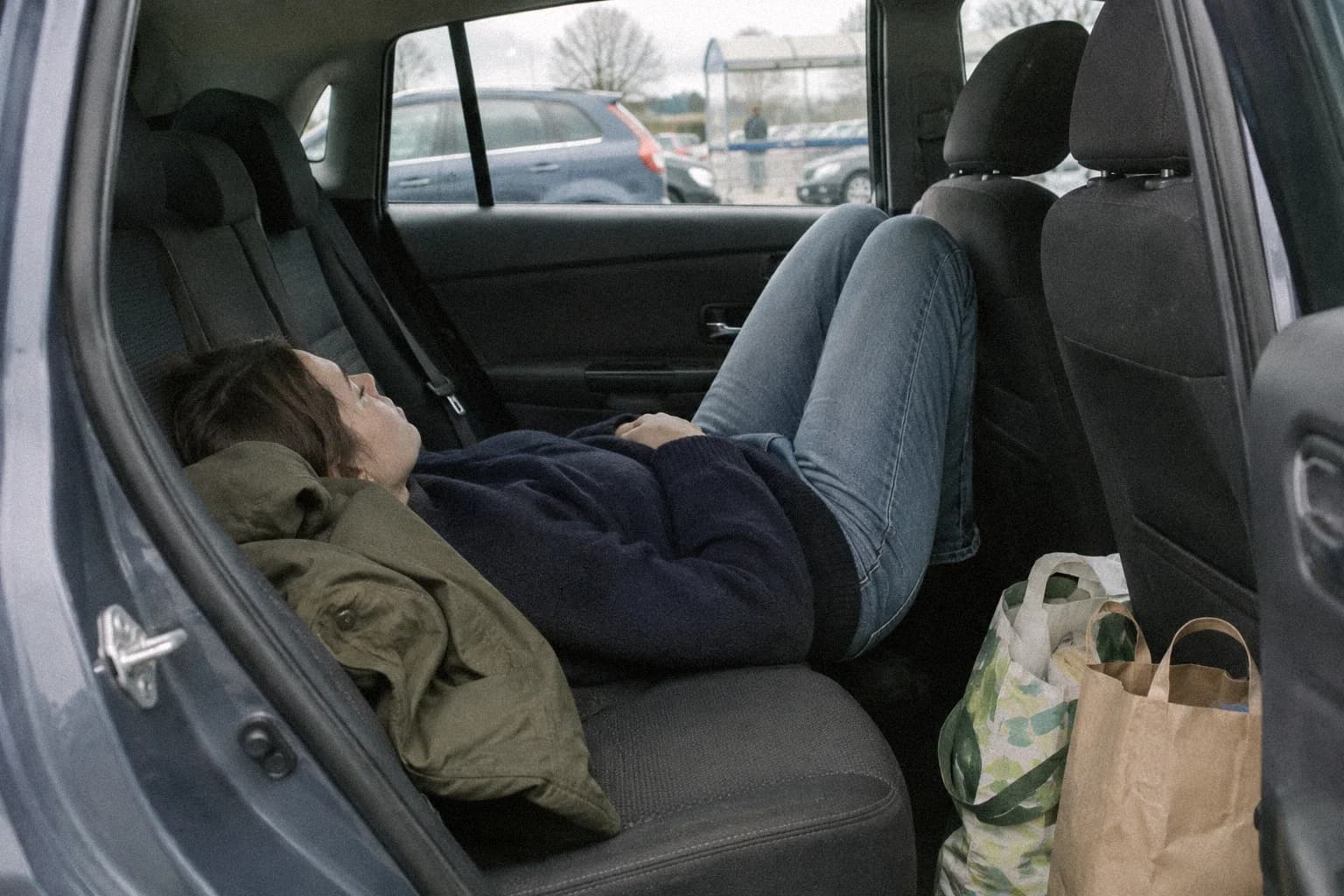
Then the duration. Ten minutes already does something. Twenty is a good format. Thirty is a ceiling: past that, the risk is not wasted time, it is falling asleep long enough to wake up groggier than before and to push the following night out of shape.
Finally the intention, which is the hardest of the three to hold. You are not lying down in order to fall asleep. You are lying down in order to do nothing for a quarter of an hour. If sleep comes, fine; if it does not, the exercise still happened, because the exercise was never sleeping. That is the only instruction that stops the session turning into an exam.
A few details matter more than they look. Set a timer, otherwise part of your attention will spend the session estimating the time. Keep the eyelids closed without squeezing them. Let the arms rest away from the body, palms up, which opens the shoulders at no cost. And accept that lying down changes what surfaces: the body lets go faster when horizontal, and the mind often talks louder for the first two minutes, which is one reason we wrote separately about why letting go refuses to happen for some people.
When waking rest is the wrong answer
An exercise that works deserves to have its edges named.
It suits highly anxious people badly, at least in its silent form. Lying still with nothing to do removes the supports that were keeping attention away from rumination, and some people find themselves alone with a flow they had been avoiding. The cinema fills up all at once. A practice guided by a voice holds better than bare silence, because it leaves a thread to follow; if nothing holds, a slow walk is better rest than stillness endured.
It is also no substitute for a diagnosis. Fatigue that persists despite decent nights, sleepiness that lands in the middle of the day, snoring with breathing pauses reported by someone else: those get examined. Sleep apnoea does not yield to a relaxation exercise, and good breathing intentions are exactly what delays the appointment. If the nights themselves are the problem rather than the days, our piece on what actually works in the evening is the better starting point.
Nor does it suit a case where fatigue has been the main symptom for several weeks, alongside low mood, loss of drive or dark thoughts. Rest is not what is missing there: something else is, and a professional will see it faster than you will.
For everyone else it remains an honest, modest tool. A quarter of an hour lying still, away from the bed, during which you ask nothing of anyone, not even of sleep. It is not much. It is a great deal more than most of us grant ourselves on a Tuesday afternoon.
Frequently asked questions
- Does lying down with your eyes closed actually help?
- Partly, yes. Closed eyes cut off the visual stream, lying down relieves the postural muscles of holding the body up, and heart rate slows. A well known experiment also showed that ten minutes of quiet wakefulness straight after learning improved memory of that material, still measurable a week later. What closed eyes do not do is trigger any stage of sleep, so none of the repairs that depend on those stages happen.
- How long should you rest without sleeping?
- Ten to twenty minutes is enough, and thirty is a sensible ceiling. Under ten minutes, arousal has barely started to come down. Beyond half an hour two things get worse: you risk slipping into sleep deep enough to wake up groggy, and you start spending a long stretch lying still while waiting for something, which is precisely the mechanism that keeps insomnia going.
- Is resting as good as sleeping?
- No. Waking rest produces neither slow wave sleep nor REM sleep, and those stages carry much of the brain’s overnight work. After a short night, a period of lying down can make the afternoon more bearable, but it does not pay the debt back. If short nights stack up over several weeks, that calls for a medical opinion rather than a relaxation exercise.
- Should you stay in bed when you cannot fall asleep?
- Clinical guidance leans the other way. Stimulus control, which the American Academy of Sleep Medicine suggests as a single component therapy for chronic insomnia in adults, means leaving the bed when sleep does not come and returning only when you feel sleepy. The point is to stop the bed becoming the place where you wait, because that association tends to maintain insomnia rather than relieve it.
- What is non sleep deep rest, or NSDR?
- It is a term popularised from 2022 onwards for guided lying down relaxation practices, with yoga nidra and progressive muscle relaxation as their direct ancestors. The protocol is simple: lying still with your eyes closed, you follow a voice that walks attention through the body for ten to thirty minutes. The label is recent, the practice is not, and the advertised benefits rest on a small number of studies.
- Does quiet wakefulness suit anxious or burnt out people?
- Not always, and not first. Lying still with nothing to occupy attention can amplify rumination in highly anxious people, who find themselves alone with their thoughts and no handrail. A practice guided by a voice works better than bare silence, and a slow walk sometimes works better than either. Where exhaustion is entrenched or dark thoughts are present, the exercise is no substitute for medical advice.
Sources
- Brief Wakeful Resting Boosts New Memories Over the Long Term — Dewar M, Alber J, Butler C, Cowan N, Della Sala S, 2012
- Yoga nidra practice shows improvement in sleep in patients with chronic insomnia: A randomized controlled trial — Datta K, Tripathi M, Verma M, Masiwal D, Mallick HN, 2021
- Effect of yoga Nidra (yogic sleep) in sleep disturbances and insomnia: systematic review and metanalysis — Singh S, Dhanlika D, Singh U, Haldar P, Sharma G, 2026
- The hyperarousal model of insomnia: A review of the concept and its evidence — Riemann D, Spiegelhalder K, Feige B, Voderholzer U, et al., 2010
- Behavioral and psychological treatments for chronic insomnia disorder in adults: an American Academy of Sleep Medicine clinical practice guideline — Edinger JD, Arnedt JT, Bertisch SM, Carney CE, et al., 2021
- The Impact of Treatment Components Suggested by the Psychological Flexibility Model: A Meta-Analysis of Laboratory-Based Component Studies — Levin ME, Hildebrandt MJ, Lillis J, Hayes SC, 2012