I can’t relax: why your body resists, and what to do
Why can’t I relax?
Because relaxing is not a decision. It is a state of the nervous system, and willpower does not set it: as long as the body reads the situation as uncertain, it keeps a baseline of vigilance in the muscles and in the breath. The order to relax is addressed precisely to the part of you that has no control over it.
That is bad news for willpower and good news for everything else: it means indirect levers exist, and that they are measurable.
It also explains why the standard evening fails. You sit down, you mute the notifications, you put on slow music, and ten minutes later you are exactly where you started, with the added irritation of having failed at something supposedly easy.
Anyone who takes time off knows the paradox. In August 2025, a reader wrote to us that she had waited for three weeks of holiday like a release, and that by the fourth day she was still waking at six with a clenched jaw and nothing to do all day. The context had changed. She had not.
The good news is that this is neither a discipline problem nor a character flaw. The less good news is that most available advice rests on the idea that wanting it is enough. Here is what the research actually says, including the part relaxation articles rarely quote: for a share of people, the relaxation exercise itself raises tension.
Why does my body stay tense even at rest?
Because the body does not measure rest, it measures safety. You can be motionless on a sofa, on holiday, with nothing urgent to handle, and still be on alert: the autonomic nervous system has no sensor for « I have nothing to do this afternoon ». It reads heart rate, breath, muscle state, how novel the surroundings are. It draws a conclusion, and it sticks to it.
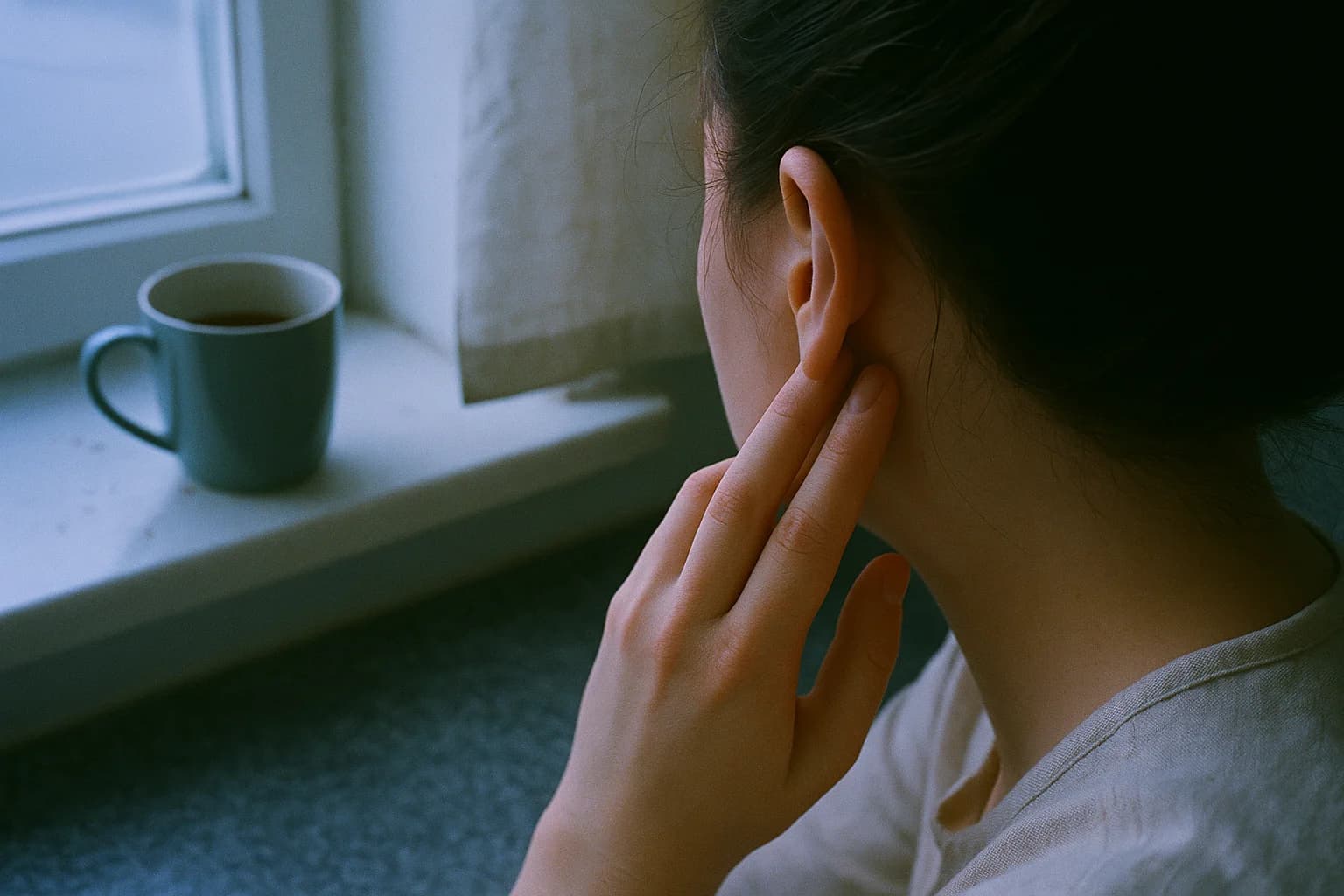
The signs are fairly consistent from one person to the next. Shoulders riding up towards the ears for no reason. A clenched jaw, usually discovered the moment someone mentions it. High, short breathing that stops at the chest. Being unable to sit still for more than a few minutes without reaching for the phone. And a tiredness that sleep does not fix.
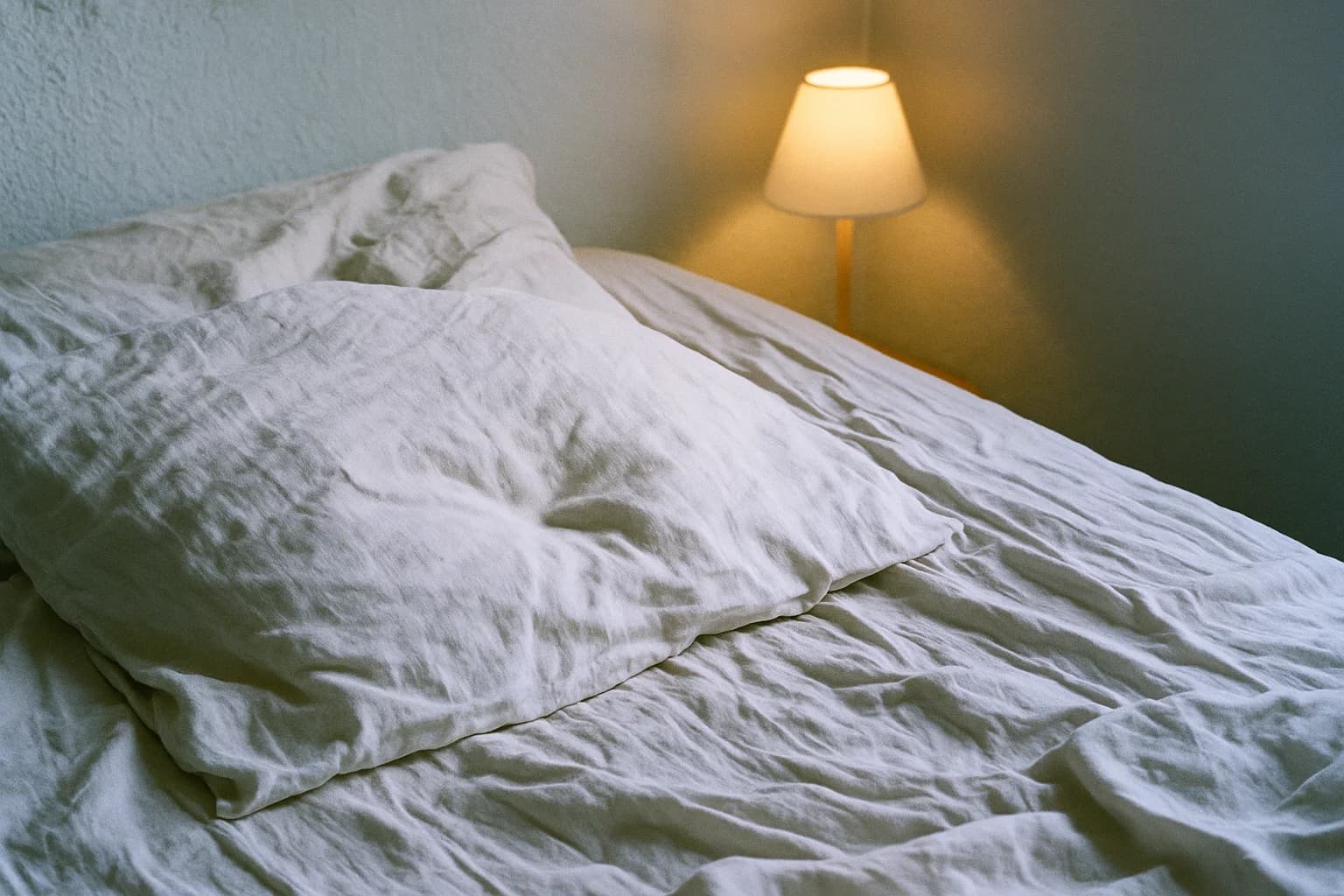
That last point deserves a pause. Plenty of people sleep their seven or eight hours and get up as tense as they went to bed. Time spent lying down is not the same thing as rest: if muscle tone stays high all night, the night only half repairs. A night of normal length can perfectly well be a night without recovery.
This vigilance serves a purpose, and that is what makes it hard to shift. A nervous system that stayed on alert through six months of heavy work has learned something: dropping your guard is expensive. It is not making a calculation error, it is applying a rule that worked. The problem is not the rule, it is that the rule keeps running long after the situation that produced it has ended.
The jaw is the most reliable witness to that state, because it is the last area vigilance lets go of. It is also one of the few you can check without equipment: we covered that link between a clenched jaw and mental noise (in French) in a separate article.
Trying to relax can raise the tension
This is the point relaxation guides leave out, and probably the most useful one to know.
In 1983, Frederick Heide and Thomas Borkovec published a counter-intuitive observation in the Journal of Consulting and Clinical Psychology. They trained 14 tense people in progressive muscle relaxation and mantra meditation. Four of them showed a clear anxiety reaction during the practice period. Not before. During. The phenomenon would get a name: relaxation-induced anxiety.
The finding is surprising, and it has been confirmed since. In 2019, Hanjoo Kim and Michelle Newman revisited the question with 96 participants, including 32 with generalised anxiety disorder and 34 with major depressive disorder. Their explanation fits in one idea: what bothers people is not the calm itself, it is the contrast. Highly anxious people tolerate abrupt shifts in emotional state badly. Staying tense all the time means never falling. Keeping the guard up becomes a strategy, not an accident.
The model’s reasoning fits in one sentence: someone who stays worried all the time never takes the hit of a calm state broken by bad news, because they are never calm. The peak is already occupied. Vigilance is expensive, but it removes the fall.
In other words, some of the people who cannot relax are not failing an exercise. They are protecting something. That changes how to approach the question: the aim is no longer to force the descent, it is to make it gradual enough that it is not experienced as losing your guard.
Contrary to what you might think, this sensitivity does not only concern people with a diagnosis. The effect showed up, more weakly, in the study’s depressed group as well, and anyone who has been through a long stretch of stress can recognise it. If you have ever tried to meditate and finished more irritated than you started, you know the feeling. It is a common reason to give up, and we treated it separately in I can’t meditate.
Replace the order to calm down with a measurable act
« Relax » is an instruction with no object: it does not say what to do with the body. The best supported remedy is to target something concrete and observable, with relaxation as a consequence rather than the stated goal.
That something is the length of the exhale.
The systematic review published in 2018 by Andrea Zaccaro and colleagues in Frontiers in Human Neuroscience gathered the available work on slow breathing, defined as fewer than ten cycles per minute. The picture is consistent: heart rate down, heart rate variability up, changes in cortical activity, and subjectively less reported anxiety and more comfort. The body is not receiving an order, it is receiving information: slow breathing is incompatible with the alert state, so the alert eases.
In practice, the only thing to watch is the ratio between the two phases. An exhale clearly longer than the inhale, no breath-holding, no counting out loud, no trying to do it « well ». Four counts in, six or eight out, and above all: do not fill the lungs to capacity. Air hunger is the surest way to switch back on exactly what you were trying to switch off.
Two minutes are enough to notice a change. That is not a promise of calm, it is a test. If nothing moves, that information is useful too: it tells you the body needs something else that day. A longer guided practice, such as a ten-minute visualization, sometimes takes over better than an isolated breathing drill.
One detail matters, because it explains a lot of failures: slow breathing does not work like a switch, it works like a climate. The effects measured in the studies come from repeated practice, not from a single sequence pulled out mid-crisis. Saving slow breathing for the evenings when everything is falling apart means testing it in the worst possible conditions and concluding it does not work.
Two minutes every day beats twenty minutes once a week. That is a dull thing to say. It is also the only difference between the people for whom this eventually works and everyone else.
The inner smile: relaxation that asks for no effort
Then there are the evenings when even two minutes of breathing feel like one more chore. That is where the kindness route becomes interesting, because it asks for no release at all.
The principle is simple: you move through the body, and at each area you offer something closer to a welcome. Not an instruction to relax. Warm attention, with no expected result. The jaw is still clenched? You ask nothing of it, you look at it the way you would look at someone who is tired. You move on to the shoulder. Then the belly. The practice is called the inner smile, and the name is slightly misleading: it is not about smiling.
The distinction matters. The deliberate smile, the one you paste on your face hoping the mood will follow, has a far shakier literature than people assume: we took that piece of received wisdom apart in does forcing a smile really make you happy (in French). Here, nothing is pasted onto the face. The object of the exercise is the quality of the attention, not the position of the muscles.
What the research documents, on the other hand, is solid. In 2019, Hans Kirschner and his team split 135 participants between two short self-compassion exercises and three control conditions (rumination, neutral, positive excitement). After the self-compassion exercises they observed lower heart rate, lower skin conductance, and higher heart rate variability. Translated: the threat signal comes down and the parasympathetic brake comes back online. Kindness towards yourself produces a physiological profile of safety, not one of forced release.
That is exactly what makes it workable when classic relaxation fails. There is nothing to succeed at. You are not asking the body to come down, you are removing the pressure to come down, and the dreaded contrast does not happen all at once. A reader wrote to us in February 2026 that after three weeks of this practice her jaw was still clenched in the evening, but she had stopped holding it against herself. That is a modest result. It is also, often, the one through which everything else becomes possible.
We told the story elsewhere of Marine, who practised this silent smile for six weeks (in French) without her insomnia going away, but with different nights.
When the tension never eases
An honest limit: none of the above fits if the tension is permanent, indifferent to context, and has been there for months without variation. A body that never lets go, including on holiday, including around people you love, does not have a breathing technique problem.
The possible causes are numerous and none of them is a do-it-yourself matter: chronic pain, hyperthyroidism, side effects of certain treatments, the aftermath of traumatic events, an established anxiety disorder. Relaxation-induced anxiety is, in Kim and Newman’s data, markedly more frequent among people with generalised anxiety disorder. The very people who most need to come down are the ones who tolerate the descent least well, and for them structured support beats an app.
A simple marker: if the tension varies at all, from day to day and situation to situation, there is room to work with and the exercises above make sense. If it has been perfectly flat for a long time, talk to a doctor or a psychologist before adding one more discipline to an already long list. This is not a failure. It is triage.
For everything else, the one thing worth keeping fits in a sentence: stop aiming at relaxation. Aim at a slightly longer exhale, slightly gentler attention, and let the body set the pace at which it lets go. It always ends up doing it once you stop asking. If it is the mind that keeps spinning after the light goes out, how to stop thinking so you can sleep (in French) deals with that part specifically.
Frequently asked questions
- Why does trying to relax make me more anxious?
- This is a documented effect called relaxation-induced anxiety, first described by Heide and Borkovec in 1983, when 4 of 14 trained participants showed a clear anxiety reaction during the practice itself. The 2019 study by Kim and Newman ties it to sensitivity to emotional contrast: what bothers you is not the calm, it is the drop in vigilance it forces. The answer is to make the descent gradual rather than forcing it.
- How should you breathe to calm the nervous system?
- Aim below ten breathing cycles per minute, with an exhale clearly longer than the inhale: four counts in, six or eight out, no breath-holding. Above all, do not fill the lungs to capacity, since air hunger switches back on exactly what you were trying to switch off. Two minutes are enough to notice whether anything moves that day.
- How often do you need to practise slow breathing for it to work?
- Daily, even briefly. Slow breathing does not work like a switch, it works like a climate: the effects measured in the research come from repeated practice, not from a single sequence pulled out mid-crisis. Two minutes every day beats twenty minutes once a week.
- Can you sleep a full night and still wake up tense?
- Yes. Time spent lying down is not the same thing as rest: if muscle tone stays high all night, the night only half repairs, and plenty of people sleep seven or eight hours and get up as tense as they went to bed. The tiredness that sleep does not fix is one of the consistent signs of a nervous system on alert.
- What is the inner smile practice?
- You move attention through the body and offer each area warm attention with no expected result, asking nothing of it, not even to relax. Despite the name, it is not about smiling: the object is the quality of the attention, not the position of the muscles. In a 2019 study with 135 participants, short self-compassion exercises of this kind lowered heart rate and skin conductance and raised heart rate variability.
- When should constant tension be seen by a doctor?
- When it is permanent, indifferent to context and has been there for months without variation, including on holiday and around people you love. That pattern points to causes that are not a do-it-yourself matter, such as chronic pain, thyroid issues, treatment side effects, trauma sequelae or an anxiety disorder. If the tension varies at all from day to day, there is room to work with the exercises.
Sources
- Relaxation-induced anxiety: Paradoxical anxiety enhancement due to relaxation training — Heide & Borkovec, 1983
- The paradox of relaxation training: Relaxation induced anxiety and mediation effects of negative contrast sensitivity in generalized anxiety disorder and major depressive disorder — Kim & Newman, 2019
- How Breath-Control Can Change Your Life: A Systematic Review on Psycho-Physiological Correlates of Slow Breathing — Zaccaro et al., 2018
- Soothing Your Heart and Feeling Connected: A New Experimental Paradigm to Study the Benefits of Self-Compassion — Kirschner et al., 2019