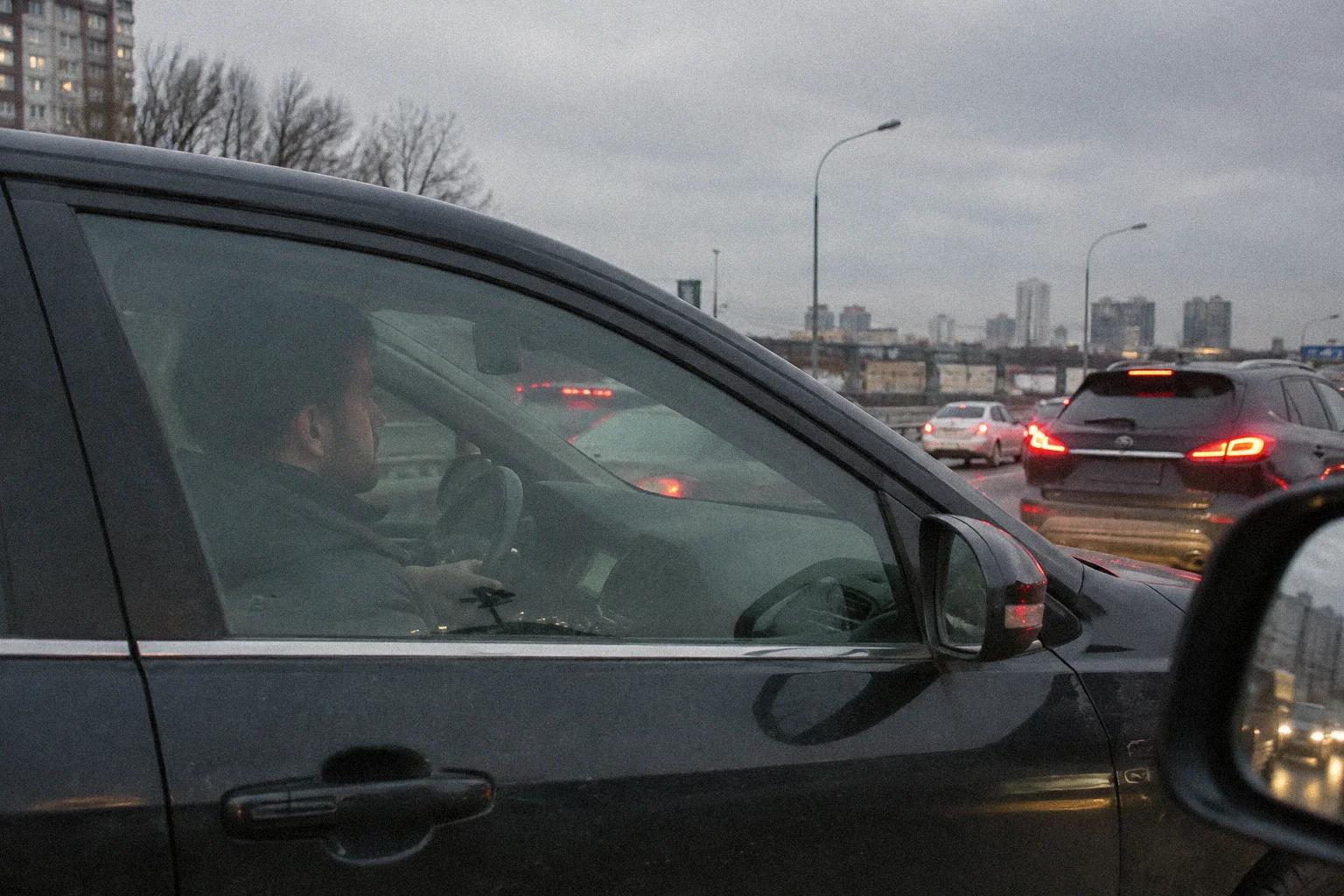
How to Stay Calm While Driving: 5 Moves That Hold in Traffic
How do you stay calm while driving?
Calm at the wheel is recovered during the drive, not before it: it comes down to a few seconds of physical release, repeated every time the tension climbs again. Hands first, breath second, then nothing imposed on your breathing at all.
This is the gap almost every page on the subject leaves open. They tell you to set off earlier, plan your route, adjust your seat before you start the engine. All of that is sound, and all of it becomes useless the second you are already stuck, which is precisely the moment you start looking for something to do.
One Tuesday in September 2026, city ring road, 6.40pm. Thirty-five minutes to cover two exits. The reflex everybody has had: one big deliberate breath in, held, released, on the assumption it should help. It does not help much, for a fairly plain reason. While you were holding it, your hands had not moved a millimetre and your shoulders were still up around your ears. You worked on about ten per cent of the problem.
The five moves below take it from the other end. They are ordered by what driving actually allows, not by what would be ideal on a yoga mat.
Why do I get angry so fast behind the wheel?
A car gathers three conditions you rarely meet together elsewhere, and all three push the same way.
There is time pressure you do not control. There is the impossibility of acting: you can see the problem, you can do nothing about it, and your body prepares anyway for an action that will not happen. And there is anonymity, which strips other drivers of everything that would earn them the benefit of the doubt anywhere else. Someone who cuts across you in a corridor apologises with a gesture. In a car, there is only bodywork.
A fourth thing is less obvious: you are seated, belted, still. The arousal rises and finds no motor outlet. So it settles where it can, which means the jaw, the shoulders and the hands.
This is not a character trait surfacing at the wheel, it is a situation that produces the same state in people who are calm elsewhere. That changes what follows: there is nothing in you to fix, there is a physical state to bring down, several times per drive if that is what it takes. The same mechanism runs when someone loses their temper in front of you and you can neither leave nor answer back.
Step 1: Loosen your hands before touching your breath
Look at your hands. In stopped traffic, most drivers hold the wheel with a force that would suit a gravel corner.
Let go down to the lightest pressure that keeps you in control of the car. Fingers resting, thumbs free, wrists no longer pushing. Then the elbows, which drop an inch or so without you having to think about them any further.
This comes first for a mechanical reason: a gripped wheel keeps feeding the very tension your breathing is trying to bring down. Starting with the breath while your hands stay clenched is emptying a bath without closing the tap. The order matters more than the quality of each move.
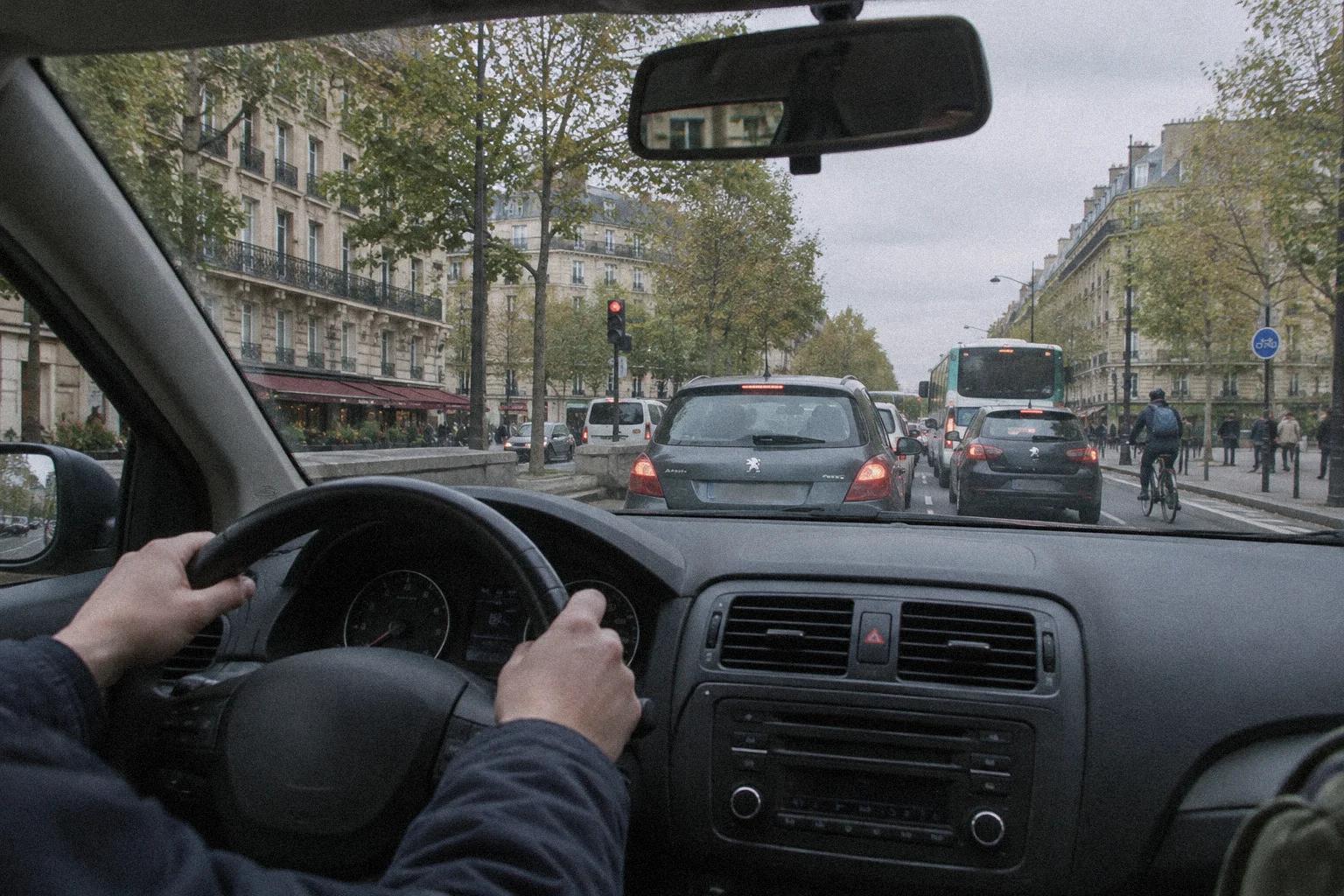
Takes ten seconds. Do it again without keeping score, because your hands close by themselves the moment the queue moves and stops again.
Step 2: Let one breath leave as a sigh
A full breath in through the nose, without forcing the volume. Then you release the air through your mouth and you do not push it: the breath falls out under its own weight, a little audibly, exactly like the sigh that escapes you when you sit down after a long day.
Hold nothing in between. Breath holding is the one item on this list that is genuinely inadvisable while driving.
Your body already does this without you. The rate of spontaneous sighs rises both during a task that holds attention for a long stretch and under stressful mental load, which has been measured in the lab in both conditions (Vlemincx et al., 2010): driving in a jam has something of each. The best documented account is the resetter hypothesis, where the sigh puts variability back into breathing that has locked into a pattern too regular.
A word of honesty about what is known. The relief felt after a sigh is not fully explained by the mechanics of breathing, and the psychological share carries weight (Vlemincx et al., 2016). Beyond that, none of the studies cited in this article was run at the wheel: they describe a respiratory mechanism, not a road safety intervention. What carries over is the move and the fact that it costs nothing, not a promise of a measured result.
Step 3: Impose nothing on the breaths that follow
This is the step nearly everyone skips, and the one that matters most.
After the sigh, you do not take the controls back. You do not count, you do not try to make the out-breath longer than the in-breath, you aim for no particular slowness. You let three, four, five breaths happen as they come, and a second sigh leaves when it wants to. Alternating ordinary breaths with sighing out-breaths, letting your body pick the tempo, is plenty.
Why not carry on with a chosen rhythm, given that slow breathing has good results? Because at the wheel, holding a rhythm is one more task. You already have the road, the mirrors, the car in front. A count adds mental load at the exact moment you are trying to shed some, and it turns a release into an exercise you can fail. In a car, the right way to breathe is the one that asks for no attention at all.
This is where the trial by Balban et al. (2023) deserves to be cited with its limits attached: five daily minutes of cyclic sighing over a month improved participants' mood and lowered their breathing rate, more than a meditation practice of the same length. The study used a seated, daily practice, off the road. It justifies rehearsing the move at home with the engine off, and that is all it justifies. If you want the mechanism itself, our piece on why you sigh so much goes into it.
Step 4: At a red light: shoulders, neck, tongue
A red light most often lasts between thirty seconds and two minutes. It is the only window in an urban drive where you can release something other than your hands.
Three places, in this order. The shoulders, which you let drop rather than roll. The neck, by lengthening the back of the skull very slightly upwards without moving your chin. Then the tongue, which in almost every traffic jam is pressed to the roof of the mouth or against the teeth: you lay it flat, and the jaw unclenches by itself.
Shoulders are the costliest post of tense driving and the quickest to tighten again. If you routinely arrive with a stiff neck, the longer look at shoulder tension from stress goes further than these few seconds.
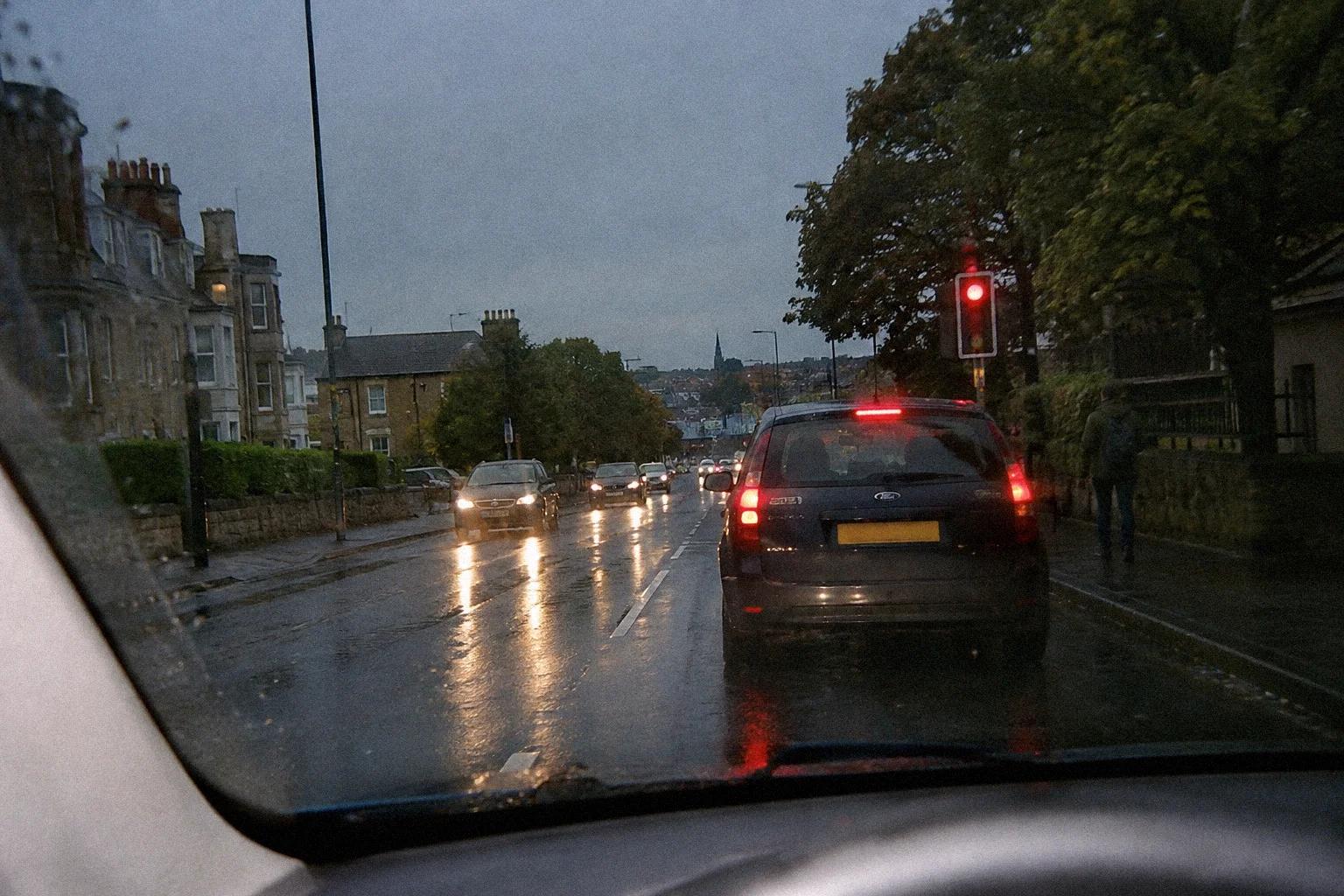
Eyes stay open. Always.
Step 5: Come back to your own driving
The first four moves work on the body. This one works on attention, and it holds for the rest of the drive.
Tension at the wheel feeds almost entirely on what other people do: the one who will not move, the one who cuts in, the one who undertakes on the inside. Bring your attention back inside the perimeter where you have any power, meaning your following distance, your speed, your line. Driving instructors say it constantly and they are right, but they make it a moral instruction when it is an energy saving.
A concrete marker: when you catch yourself narrating another driver's behaviour in your head, that is the cue for move number two. Not a reason to be hard on yourself, just a reliable sign the tension has climbed back.
What these five moves do not do: they do not get you there any earlier. They get you there in a different state, which is the only variable still available inside a traffic jam. And they work anywhere you can neither stand up nor speak, in a meeting or an open plan office for instance.
How long before the tension comes down?
Two timescales, better not confused.
The immediate release plays out over a few seconds, and it does not hold: your hands close again at the next pull away, your shoulders rise at the next horn. That is not the move failing, that is how it works. You do it again, ten times in a drive if needed, without keeping count.
The other timescale is measured in weeks. For the sigh to become a reflex rather than a decision, you have to have repeated it somewhere other than a car: a gesture practised only while irritated stays attached to irritation. A few minutes a day, sitting down, is enough. The same logic applies to the slow breathing practices people reach for to calm the nervous system, which do little if they are first attempted on the day they are needed.
When these moves are not enough
They do not fit once anger has settled in. From the moment it changes how you drive, you tailgate, you overtake out of irritation, you cannot recall the last few miles, the only reliable option is to stop for two minutes in a lay-by or a car park. A three-second move does not undo an hour of accumulated tension.
They are also not enough if fear of driving makes you avoid trips you used to take, or if intense physical symptoms appear at the wheel: dizziness, blurring vision, a racing heart with no exertion. That calls for seeing someone, not for breathing better. A family doctor is the right first stop.
One last caveat about the irritation itself: if you flare up just as easily away from the car, the traffic jam is only the most regular occasion for it. The question then sits somewhere slightly different, and it is worth asking separately.
Frequently asked questions
- Can you really do breathing exercises while driving?
- Some of them, not all. Anything that asks you to count, close your eyes, hold your breath or monitor your belly pulls attention that belongs on the road, and breath holding is best avoided at the wheel entirely. A sigh escapes those constraints: one full breath in, one breath that falls out on its own, eyes on the traffic. Structured patterns such as box breathing or coherent breathing belong to a parked car.
- Why do I get angry driving when I am calm the rest of the time?
- Because a car gathers conditions you rarely meet together anywhere else: time pressure you do not control, no action available to you, and anonymous counterparts whose faces and reasons you cannot see. Your body gears up for an action that never comes. This is not a character trait showing itself at the wheel, it is a situation that produces the same state in people who are calm everywhere else.
- Should you pull over when anger builds while driving?
- Yes, as soon as the anger changes how you drive: you tailgate, you overtake out of irritation, you cannot recall the last two miles. A breathing move brings down a spike of tension, not an anger that has settled in. Stopping for two minutes in a lay-by or a car park is the only reliable option at that stage, and the safest one.
- Does music help you stay calm while driving?
- Often, though the available evidence does not let anyone name one genre as more calming than another, and playlists marketed as stress relief are mostly marketing. What you can check yourself: high volume and a fast tempo sit badly with a traffic jam, and rolling news radio adds urgency to a situation that has plenty already.
- How long does it take for driving stress to actually drop?
- The immediate release takes a few seconds and can be repeated as often as a drive requires. For the move to become a reflex rather than a decision, count on a few weeks of drives, and practise it with the engine off as well: a gesture you only ever use while irritated stays tied to irritation.
- When should you see someone about driving stress?
- When fear of driving makes you avoid trips you used to take, when intense physical symptoms show up at the wheel (dizziness, blurring vision, a racing heart with no exertion), or when irritation turns into aggression towards other drivers. A family doctor is the right first stop, and work with a psychologist can help once driving anxiety has settled in.
Sources
- Respiratory variability preceding and following sighs: A resetter hypothesis — Vlemincx, Van Diest, Lehrer, Aubert, Van den Bergh, 2010
- A sigh of relief or a sigh to relieve: The psychological and physiological relief effect of deep breaths — Vlemincx, Van Diest, Van den Bergh, 2016
- Sigh rate and respiratory variability during mental load and sustained attention — Vlemincx, Taelman, De Peuter, Van Diest, Van den Bergh, 2010
- Brief structured respiration practices enhance mood and reduce physiological arousal — Balban, Neri, Kogon, Weed, Nouriani, Jo, Holl, Zeitzer, Spiegel, Huberman, 2023