Waking up with a knot in your stomach: what fires before your first coffee
Why do I wake up with a knot in my stomach
Because waking is, physiologically, a stress event. Between thirty and forty-five minutes after your eyes open, cortisol in a healthy person rises by half, sometimes more: it is the signal that brings blood pressure, blood sugar and alertness up to the level of a day spent upright. The phenomenon has a name, it was measured as early as the 1990s, and it was described in 2010 by Angela Clow and colleagues as the cortisol awakening response. Everyone has it. Including people who get up in a good mood.
What differs from one person to the next, and from one week to the next in the same person, is not whether the peak happens. It is what an already busy brain does with it. Under sustained strain, the hormonal rise does not land in a system at rest: it lands in a system that is scanning. The same signal, read as an alarm, recruits the gut.
Which explains the very particular feel of that kind of waking: the rise begins the moment you wake, before you have formulated anything at all, so the sensation is already in place by the time consciousness arrives. You had no time to dread anything.
What your stomach does while you are still asleep
The gut has its own network of neurons, dense enough to run without instructions from the skull, and it talks to the brain constantly in both directions. Emeran Mayer summarised the state of that conversation in 2011: a large share of the traffic travels up from the gut to the brain, not the other way round. An abdominal clench is therefore not the translation of a thought. It is often the opening message.
In practice, sympathetic activation slows gastric emptying and tightens smooth muscle. At the same time, the threshold at which you notice your own viscera drops. The sensation is not imaginary, and it is not a “sick” stomach either: it is a tense muscle that you feel more sharply than usual.

That double mechanism explains a detail many people report without knowing what to make of it: the knot can be located. You can put a hand on it. It has a shape, a rough diameter, sometimes an edge. This is not a vague impression you eventually give a name to: there is a muscle underneath the sensation.
Where it sits and how strong it is vary from one person to the next, and in the same person from one morning to the next. The work cited here does not describe a typical path, and there is no cause for concern if yours does not match someone else’s. The same state of alert, which lowers detection thresholds generally, also makes jumping at every little noise sharper in the same stretches.
Why is my stomach in knots for no reason
You did not find one because you looked at the wrong point in the sequence. The usual order, the one we assume, runs from worry to body: I think about the meeting, my stomach tightens. On waking, the order reverses. The body goes first, on an internal hormonal cue, and the brain receives a sense of danger with no context attached.
A brain dislikes a sensation without context. So it will manufacture one, and it will take whatever is lying around: the overdue task, yesterday’s conversation, a deadline still vague. The thought that shows up at 6.45 is not the cause of the knot, it is the first available explanation. Which does not make it untrue, incidentally. Just not first.
That inversion has a useful practical consequence. Interrogating the content leads nowhere at that hour: you are auditing a justification, not a motive. What does shift is the body’s setting, and that is within reach. Morning rumination runs on the same spring as the tendency to imagine the worst, which also feeds on a bodily alarm in search of a subject.
The stomach tightened first. The reason, you went looking for afterwards.
Knot in your stomach in the morning: what to do in the first ten minutes
Three moves, in this order, because the last one does not work if the first two are skipped.
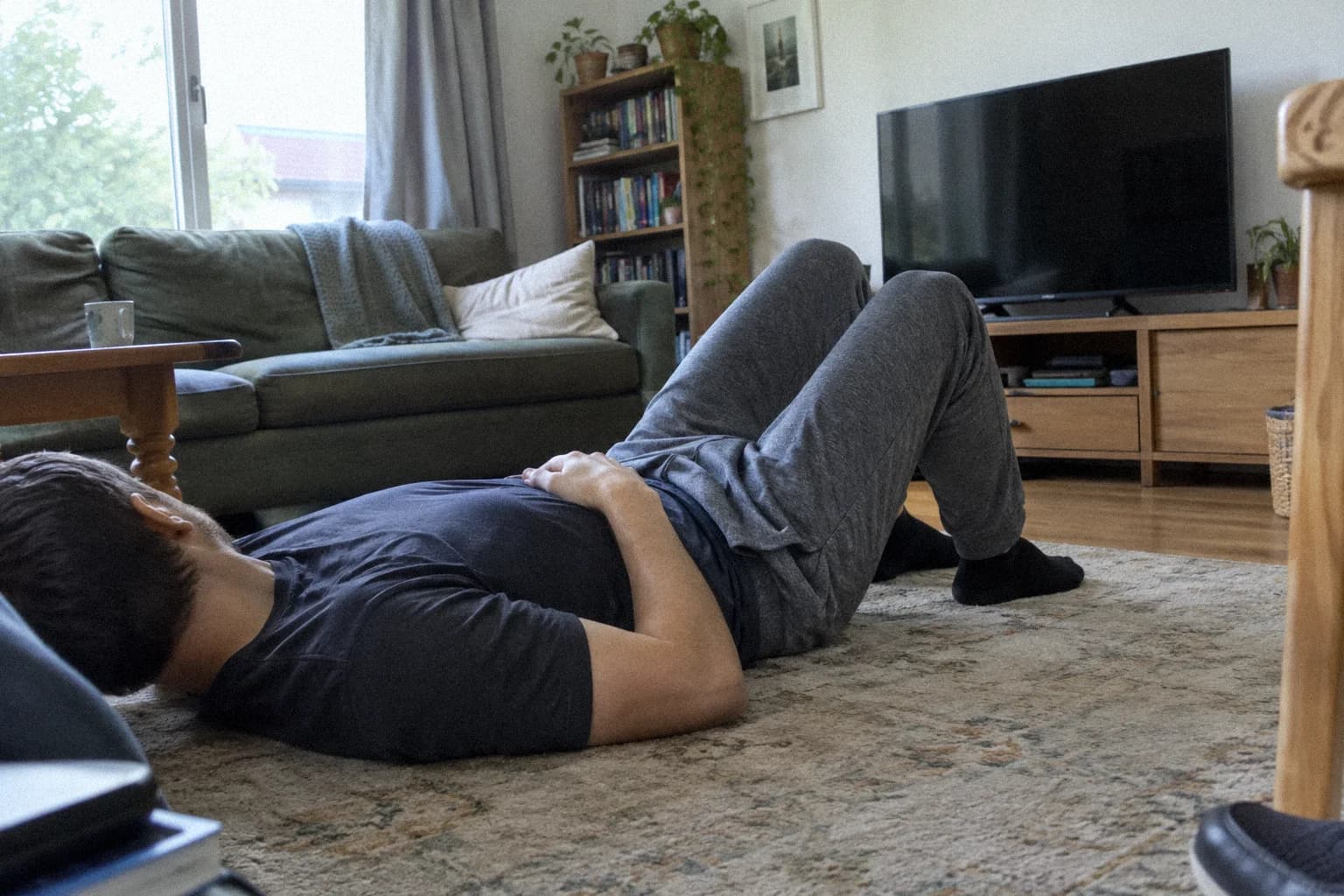
Stay lying down and lengthen the out-breath (3 minutes)
The most direct lever on a nervous system in alarm is the length of the exhale, not the size of the inhale. The systematic review by Zaccaro and colleagues links slow breathing, around six cycles a minute, to a measurable shift towards parasympathetic activity. In practice: breathe in for four seconds, out for six, without forcing the volume. Twenty cycles is enough. If counting irritates you, belly breathing pushes in the same direction without the arithmetic.
Do not pick up the phone (the full ten minutes)
A screen on waking hands your brain exactly what it is asking for: a context for the sensation. One email, one notification, one headline, and the knot now has a subject, and therefore a reason to stay. This is not a question of discipline, it is a question of order. Ten minutes later you will have felt the tension ease on its own, and the same email no longer lands on a body busy looking for a reason to be alarmed.
Name the sensation, not the situation (30 seconds)
“My stomach is tight” and “today is going to be awful” do not produce the same morning. The first sentence describes what is measurable right now. The second is a forecast, and it has just been written by an organ that has not finished waking up. Describing the sensation without commenting on it often shortens it, because you stop feeding it narrative material.
These three moves fit inside the window where the rise is still under way. After that they keep some value, but not the same kind: you are then working on the memory of waking, which is a different matter.
The night before counts for more than the morning itself
The cortisol awakening response is sensitive to the night that precedes it. Elder and colleagues reviewed in 2014 what sleep medicine knows about it: sleep quality, rise time and waking early through anxiety all change the size of the peak. A 5.20 am jolt awake before an alarm set for 6.30 does not produce the same morning as a night carried to term.
Which moves the window of action. If the knot comes back every morning, the highest-yield lever is not a morning one: it is bedtime, the time spent ruminating before sleep, the regularity of your rise time at weekends. The two ends hold each other, and the evening is the end you have most grip on. People who recognise themselves in “exhausted but I cannot fall asleep” very often meet the same knot twelve hours later.
One detail matters too, and it surprises people: the weekend does not automatically help. Getting up three hours later on Saturday shifts the body clock, and Monday restarts on a short night dressed up as a normal one.
What ten minutes of breathing will not fix
This approach does not suit you if the knot is not an awakening response but the symptom of something else. Three signs should point you to a doctor rather than a technique: genuine abdominal pain and not merely tension, digestive trouble that has been settled in for several weeks, or a sensation that no longer lets go at all between mornings.
It is also worth distinguishing this tense waking from a panic attack, which builds within minutes with palpitations, shortness of breath and a sense of losing control, and which calls for different care. The available data do not allow us to claim that slow breathing is enough in that case.
Finally, a knot that fires only on working days and never on holiday is telling you something about the work, not about cortisol. No breathing exercise will answer in its place. The technique makes the morning workable; it does not settle the question the morning is asking.
If the thought of the day ahead regularly becomes unbearable, or you wake with the sense that nothing is worth it, speak to a professional, or call 988 in the US and Canada, or 116 123 in the UK and Ireland. That is not a hard morning, and it is not something to go through alone.
Frequently asked questions
- How do I get rid of a knot of anxiety in my stomach?
- Lengthen the exhale rather than the inhale: four seconds in, six seconds out, for around twenty cycles. Breathing at about six cycles a minute shifts the nervous system towards its recovery mode, and the abdominal tension follows. Avoid screens for the ten minutes that follow, or your brain will give the sensation a subject and it will last longer.
- Why do I wake up with a knot in my stomach for no reason?
- Because the sensation comes before the thought instead of after it. The cortisol peak on waking triggers an abdominal clench before any mental content, and only then does your brain look for a plausible cause among whatever is lying around. So there is often no reason to find at the moment you go looking for one.
- Is waking up with a knot in your stomach dangerous?
- In itself, no: it is a muscular contraction driven by the nervous system, not an injury. What does deserve medical advice is real pain rather than tension, digestive trouble settled in for several weeks, or a continuous sensation that no longer lets go between mornings. In those three cases, see a doctor rather than adding another technique.
- How long does it take to go away?
- The hormonal peak on waking usually subsides within the hour, and the sensation with it. Over several weeks, the cause is what decides: an episode tied to a tense period loosens when the period ends. If the knot has returned every morning for more than a month with no improvement, the work to do is upstream, not at waking.
- How do I wake up without anxiety?
- Mostly by acting the evening before. The cortisol awakening response is sensitive to sleep duration, to how regular your rise time is, and to rumination at bedtime. Getting up at the same hour seven days a week, weekends included, smooths mornings more than any morning ritual you could add.
- Is it normal to feel it only on weekdays?
- It is common, and it is useful information. A sensation that disappears on holiday and returns on Sunday evening points to the anticipation of a specific situation as the trigger, rather than the mechanics of waking. Breathing will make the morning workable, but the question raised is about the situation itself.
Sources
- The cortisol awakening response: More than a measure of HPA axis function — Clow et al., 2010
- The cortisol awakening response: Applications and implications for sleep medicine — Elder et al., 2014
- Gut feelings: the emerging biology of gut-brain communication — Mayer, 2011
- How Breath-Control Can Change Your Life: A Systematic Review on Psycho-Physiological Correlates of Slow Breathing — Zaccaro et al., 2018