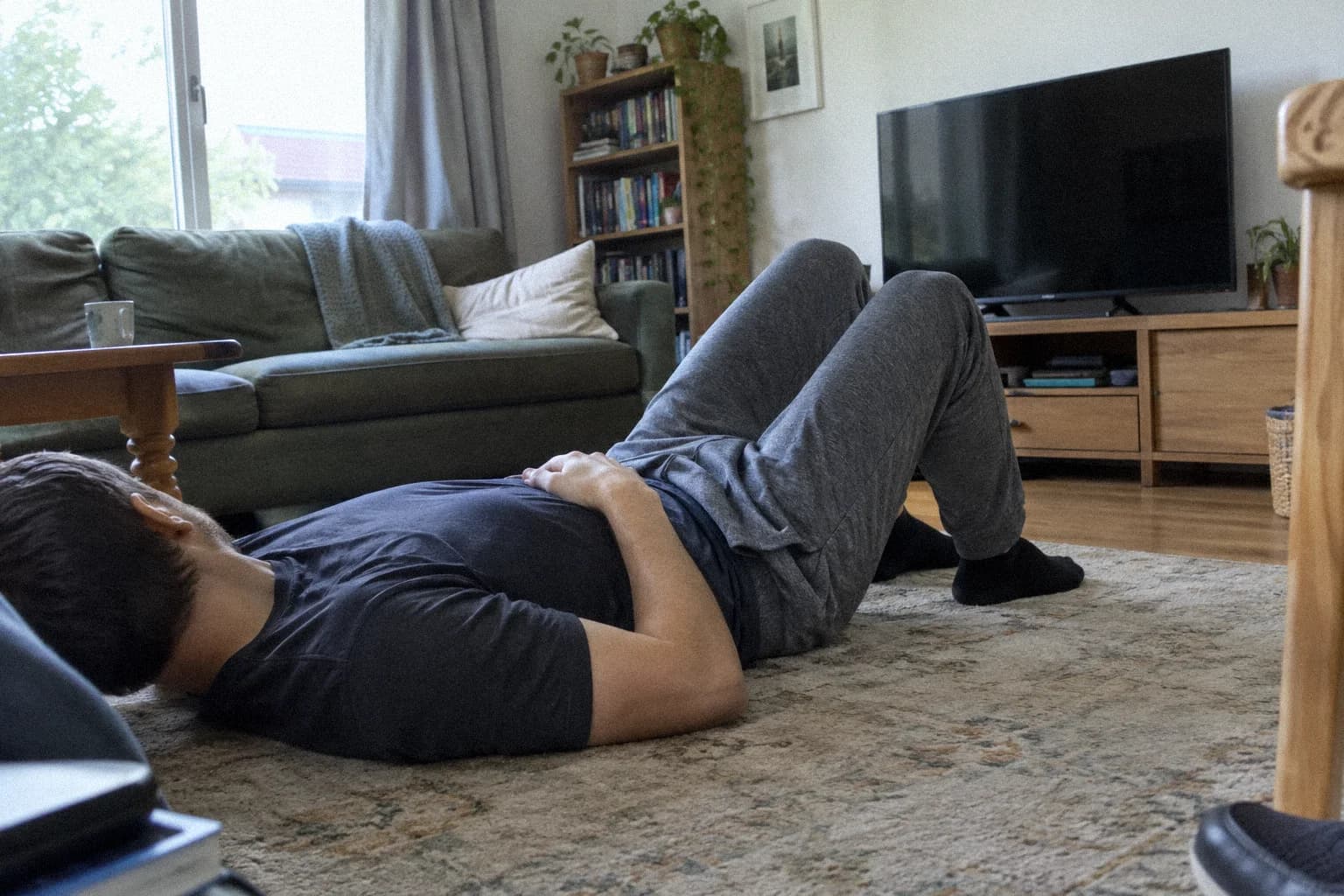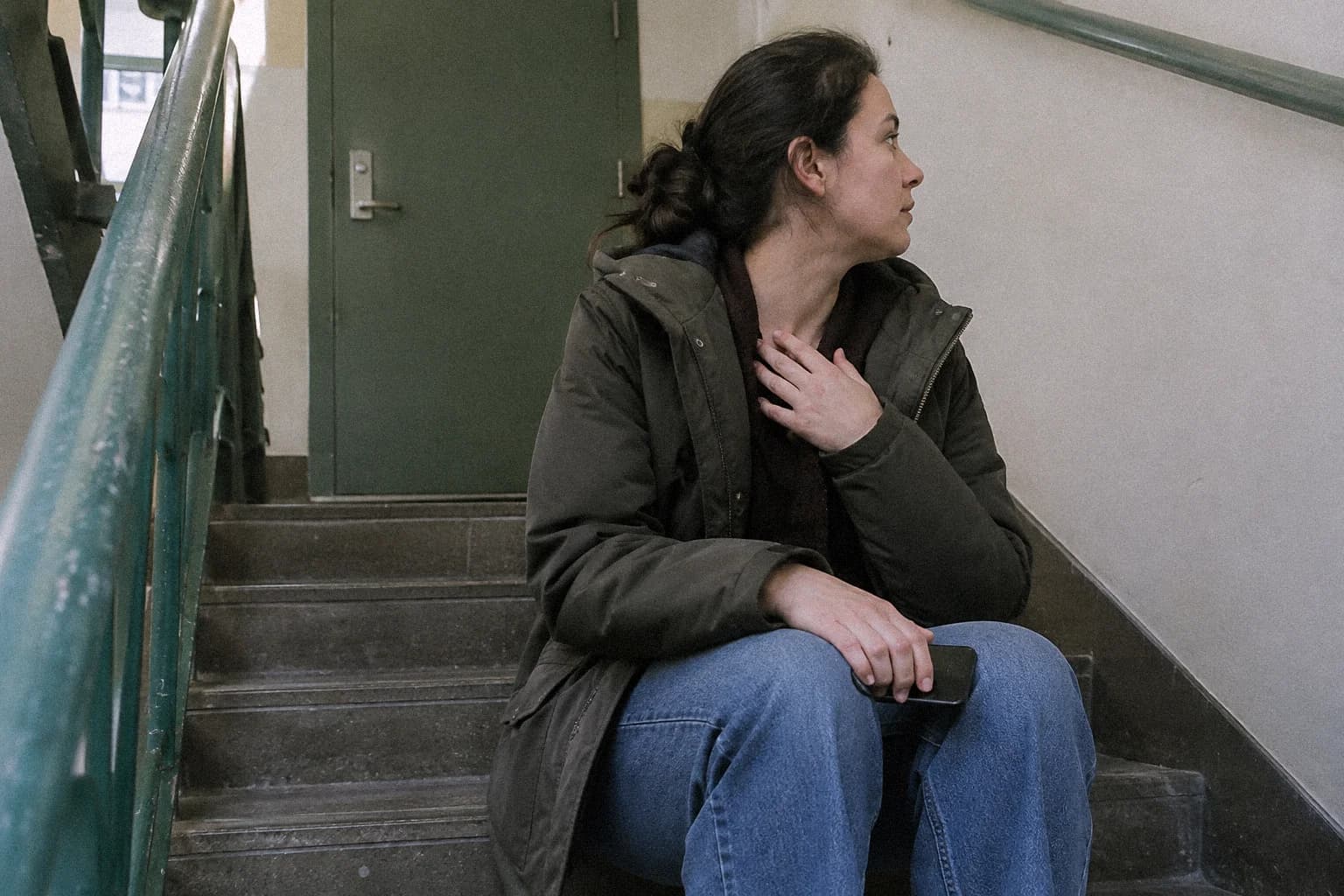
I can’t take a deep breath: it isn’t air that you’re missing
Why can’t I take a deep breath?
Because the sense that an inhale has landed does not come from the volume of air taken in. It comes from the match between the command your brain sends to the breathing muscles and the feedback it gets back from the lungs and the ribs. When that match fails, an inhale can be large and still feel unfinished.
This is not a metaphor. The American Thoracic Society, in its statement on the mechanisms of breathing discomfort, separates three sensations that do not blend into one another: effort, tightness, and air hunger, which it also calls unsatisfied inspiration. Its intensity tracks the imbalance between inspiratory drive, the actual activation of the muscles, and the information coming back from receptors throughout the respiratory system.
In other words: the feeling is a mismatch signal, not a fuel gauge.
For someone feeling it at a desk, with no exertion and no cough, the reflex is to go looking for air. The body is not asking for air: it is reporting that the movement it got does not match the movement it expected. The three beliefs below are what keeps that gap open.
People say you just need to take one big breath
It is everyone’s first move, and the advice anyone nearby will give. Breathe in deep. Fill right up.
So you pull on the top of your chest, the shoulders rise, and you go looking for the point where the inhale would finally be complete. It does not arrive. You try again, harder. Five or six attempts later the discomfort has not shifted and your attention is locked entirely onto your breathing, which is the condition that sustains it.
What is missing is movement, not air
A maximal inhale probably does not close a mismatch signal, and it may amplify one. The bigger the command sent out, the more likely the sensory feedback falls short of it, and that interval is what manufactures the sense of incompleteness. You raise the demand on the part of the rib cage that is already near the end of its travel, and leave untouched the part where movement was still available.
The mechanics are visible by hand. Under tension, breathing migrates towards the upper chest: the top ribs lift, the neck and trapezius muscles join in, the diaphragm contributes less. This is the breathing of shoulders that stay up all day. Upper ribs have a short range, and they are already engaged. Lower ribs open sideways and backwards, and that is where the room is left.
One single sigh, on the other hand, genuinely helps, and that is worth saying plainly because it is the exception. Vlemincx and colleagues measured in 2010 that a sigh, arriving spontaneously or prompted, produces measurable respiratory relief. A second study by the same team describes what it puts back, and it is not what you would guess: across the breaths leading up to a sigh, variability rises in a disordered way; after the sigh, it is structured variability that returns. So a sigh does not make breathing more irregular, it gives its regularity some give again. So what fails is not the isolated big breath: it is the series. One sigh resets the system, ten maximal inhales in a row tire the neck muscles and install breath-watching.
The physiological sigh (in French), two stacked inhales followed by a long exhale, is the deliberate version of that move. Once, not on a loop.
Why is it hard to breathe when you are anxious?
Because alarm reorganises breathing before any conscious decision. The rate climbs, the amplitude drops, breathing moves up into the chest, and neck muscles take over part of the work the diaphragm was handling alone. None of this is pathological: it is the configuration that prepares an effort, and it earns its keep when an effort follows.
The trouble starts when no effort follows. In a queue, in front of a screen, in a conversation that drags on, the configuration stays in place with nothing to spend it on. Shallow breathing becomes the baseline, and attention eventually notices it. From that point a second mechanism starts up, costlier than the first: watching your breathing makes it irregular, and the irregularity confirms the worry that triggered the watching.
It is also why the feeling often sharpens in the evening, when activity drops and nothing is diverting attention away from the body. Not because breathing has got worse: because it has become audible.
Common misconception: you are hyperventilating, so breathe less
This is the explanation most pages on the subject serve up, and it has the elegance of a good story. Breathe too much, blow off too much carbon dioxide, shift the chemistry of the blood, and the suffocating and dizzy sensations follow. Conclusion: breathing should be retrained downwards, breathe less, breathe slower. The paper bag from the movies belongs to the same family of ideas.
The research is less confident than the articles
A randomised controlled trial put the two theories in direct competition. In 2012, Kim, Wollburg and Roth assigned seventy-four patients with panic disorder to three groups: the first trained to raise their end-tidal carbon dioxide using feedback from a handheld capnometer, the second to lower it, the third on a waiting list. If hyperventilation were the engine of the problem, only the first group should have improved.
Both improved. Both training methods, pointing in opposite directions, reduced the severity of panic disorder one month after treatment ended, with the effect maintained at six, and physiological measurements confirmed each group had indeed learned to shift its level in the direction it was taught. The authors note themselves that the evidence for the theory behind downward retraining is thin.
What this does not establish: that breathing is beside the point. What it does establish, usefully, is that the benefit probably does not come from the direction in which you correct blood chemistry. It more likely comes from what both trainings had in common: attention turned towards the breath regularly and without resistance, and the repeated demonstration that the sensation can be passed through without anything happening.
The physiology of slow breathing, for its part, is documented for what it is: a review by Russo, Santarelli and O’Rourke surveys its effects on diaphragm activity, ventilation efficiency and autonomic balance in healthy subjects. That is a solid base. It is not proof that a breathing exercise treats breathing discomfort, and the distinction is worth holding: a protocol that does nothing for someone is not that person’s fault.
Giving the lower ribs room, in three minutes
The aim is not to breathe more. It is to breathe elsewhere, where movement is still available, so that sensory feedback catches up with the command. Sitting or standing, no equipment, and nobody around you needs to see it.
Put the backs of your hands on your lower ribs, at waist height, thumbs forward and fingers pointing back, where the last ribs sink into the muscles of the back. Let your shoulders drop. Then inhale with no particular size to it, through the nose, with one instruction only: push your fingers outwards and backwards. Not to inflate the chest, not to push the belly out: to widen the belt of the ribs behind you, as if the back were opening.
The first attempt usually gives almost nothing. Two or three millimetres under the fingers, sometimes less. That is normal, and it is the sign the area was out of circuit: it does not reopen on command, it gets reminded. Carry on for six to eight cycles, letting each exhale leave without being pushed and last a little longer than the inhale. Do not count. Counting reintroduces exactly the performance you are trying to remove.
Three markers that it is working, and none of them is the discomfort disappearing. The fingers move a little more on the fifth cycle than on the first. The neck stops joining in. And the urge to take a checking breath comes further apart. The feeling of an unfinished inhale is usually the last to go, often after you have stopped monitoring it.
This move is the rear cousin of belly breathing, where the belly is released rather than pushed out. Same principle, other direction: you remove a constraint, you do not add an effort.
When it is not stress
Everything above assumes discomfort arriving at rest, familiar to the person, with no other signs, and easing when attention moves elsewhere. That assumption is not a given, and it is not something reading can verify.
Sudden discomfort with chest pain, faintness, or blue lips or fingertips is a call to emergency services, right away. Discomfort that started recently, shows up on exertion, wakes you at night, comes with fever, a cough or wheezing, or settles in across several days, is a consultation: asthma, anaemia, a rhythm disorder, the thyroid, the aftermath of an infection cannot be told apart by feel, and several treat well once named. An anxious origin for breathing discomfort is a diagnosis made after the others have been ruled out, never instead of them.
And if it returns several times a week with a sense of losing control, this is not a breathing technique problem. Panic attacks and panic disorder respond to treatment, through approaches with established evidence behind them, and a general practitioner is the right first door. A three-minute exercise makes the day more bearable. It does not replace that door.
Frequently asked questions
- Am I short of oxygen when I can’t take a deep breath?
- Almost never. The feeling of an unfinished inhale and the oxygen level in your blood are two separate things: you can feel the first with a perfectly normal saturation, and that is the usual case when the problem shows up at rest, without exertion and without a cough. That does not remove the need for medical advice if the problem is new or keeps coming back, but it does explain why breathing bigger changes nothing about something that was already sufficient.
- Why do I hold my breath without noticing?
- Because holding your breath is part of the alarm reflex, in the same family as clenching your jaw. In front of a difficult email, while lifting something, during a tense conversation, breathing suspends for a second or two with no conscious decision behind it. The suspension itself is ordinary; what matters is how it adds up across a day. Each restart begins a little higher in the chest, and background breathing turns shallow without any single moment to blame.
- Should I sigh when my breathing feels stuck?
- Yes, and your body already does it on its own. Vlemincx and colleagues measured in 2010 that a sigh, whether spontaneous or prompted by instruction, brings measurable respiratory relief, and that it restores structure to the variability of breathing. The nuance is in the count: one sigh helps, ten maximal inhales in a row tire the neck muscles and feed the attention you are paying to your breath. Take one, then let breathing resume by itself.
- How long before the feeling passes?
- When it follows a surge of tension, it usually fades within a few minutes once the exhale lengthens and the shoulders drop. When it settles in over days or weeks, it is no longer an episode but a baseline, and a baseline needs looking into: fatigue, prolonged load, anaemia, asthma and a diagnosed anxiety disorder cannot be told apart by feel. Breathing discomfort that lasts beyond a few days gets seen, without waiting for it to worsen.
- Does slow paced breathing help in this situation?
- It helps the baseline, not the moment. A six-breaths-per-minute pace assumes you can already hold a steady inhale, which is exactly what is missing when breathing feels stuck: the instruction becomes one more demand. The order that works is the other way round. You give the movement room first, let the exhale run without counting, and the steady rhythm comes later, once it is no longer an effort.
- When should I see a doctor about breathing problems?
- Immediately, by calling your local emergency number, if the problem is sudden and comes with chest pain, faintness, or blue lips or fingertips. Without emergency but without delay either: if it started recently, if it shows up on exertion, if it wakes you at night, if there is fever, a cough or wheezing, or if it settles in. An anxious origin for breathing discomfort is a conclusion reached after ruling the others out, and that happens in a consultation, not while reading an article.
Sources
- An official American Thoracic Society statement: update on the mechanisms, assessment, and management of dyspnea — Parshall MB, Schwartzstein RM, Adams L, Banzett RB, et al., 2012
- Opposing breathing therapies for panic disorder: a randomized controlled trial of lowering vs raising end-tidal PCO2 — Kim S, Wollburg E, Roth WT, 2012
- Take a deep breath: The relief effect of spontaneous and instructed sighs — Vlemincx E, Taelman J, Van Diest I, Van den Bergh O, 2010
- Respiratory variability preceding and following sighs: a resetter hypothesis — Vlemincx E, Van Diest I, Lehrer PM, Aubert AE, Van den Bergh O, 2010
- The physiological effects of slow breathing in the healthy human — Russo MA, Santarelli DM, O’Rourke D, 2017