Belly breathing: how to do it when your stomach will not move
Breathing into your belly means letting the belly go
There is no air in your stomach, and that is where the misunderstanding sits. The diaphragm, the domed muscle separating chest from abdomen, drops as you breathe in and pushes everything below it gently forward. What moves under your hand is your abdominal content, displaced by a few millimetres. The lungs stay exactly where they are.
This sounds like a technicality. It decides whether the exercise works: a stomach you push forward is a stomach under tension, and a tense wall is precisely what stops the diaphragm from descending. The instruction everybody repeats therefore asks you, word for word, to block the movement it wants.
Hence the reversal the rest of this article runs on. You do not manufacture the movement, you remove what is blocking it.
Why can I not feel my belly move when I breathe?
Because the half of the instruction people remember is the wrong half. Across the English guides checked for this question on 4 October 2026, the sentence that recurs everywhere is some version of six words: one hand on the belly, make it rise. One of them is blunter still and tells you to feel the stomach push out against your hand. At least one of them does give the correction, and gives it late: picture the breath moving down rather than pushing the belly out. The right instruction exists. It is just never where you would read it first.
There is a first, and it is the whole move. Release the abdominal wall deliberately, then breathe in. In that order. Inhale first and hope the stomach follows, and it will not: it is already busy holding you upright, and that holding is so habitual you no longer feel it at all.
Hence the second cause, which is postural. Sitting on a chair, the abdominal wall stabilises the trunk continuously. The stomach is not available. That is why every step below starts on the floor, and not on the cushion where you may already meditate.
Then come the dumb obstacles, and they matter: a tight belt, high-waisted jeans, a large meal still being digested, an abdominal workout the day before. Each one is enough to cancel the exercise, and none of them appear in the guides. The test is immediate. Undo the button of your trousers and start again. If the movement appears, you never had a breathing problem, you had a clothing problem.
There is also the expectation itself. Many people are looking for a sense of filling, of the chest expanding, of air travelling down to the lower abdomen. None of that happens. The correct movement is small, discreet, almost disappointing the first time, and it is recognised by one thing: the lower hand moves while the upper one does not.
Then there is the heavier case. Some people have breathed high in the chest for so long that the pattern has become their default way of taking air, at rest as much as under effort. The respiratory literature calls this dysfunctional breathing and acknowledges that no reference test exists to diagnose it, which means two things: your difficulty can be real and documented, and nobody will hand you a number for it. In that case a few sessions will not be enough, and a physiotherapist trained in breathing retraining will do more for you than an article.
Step 1: Start lying on your back, knees bent
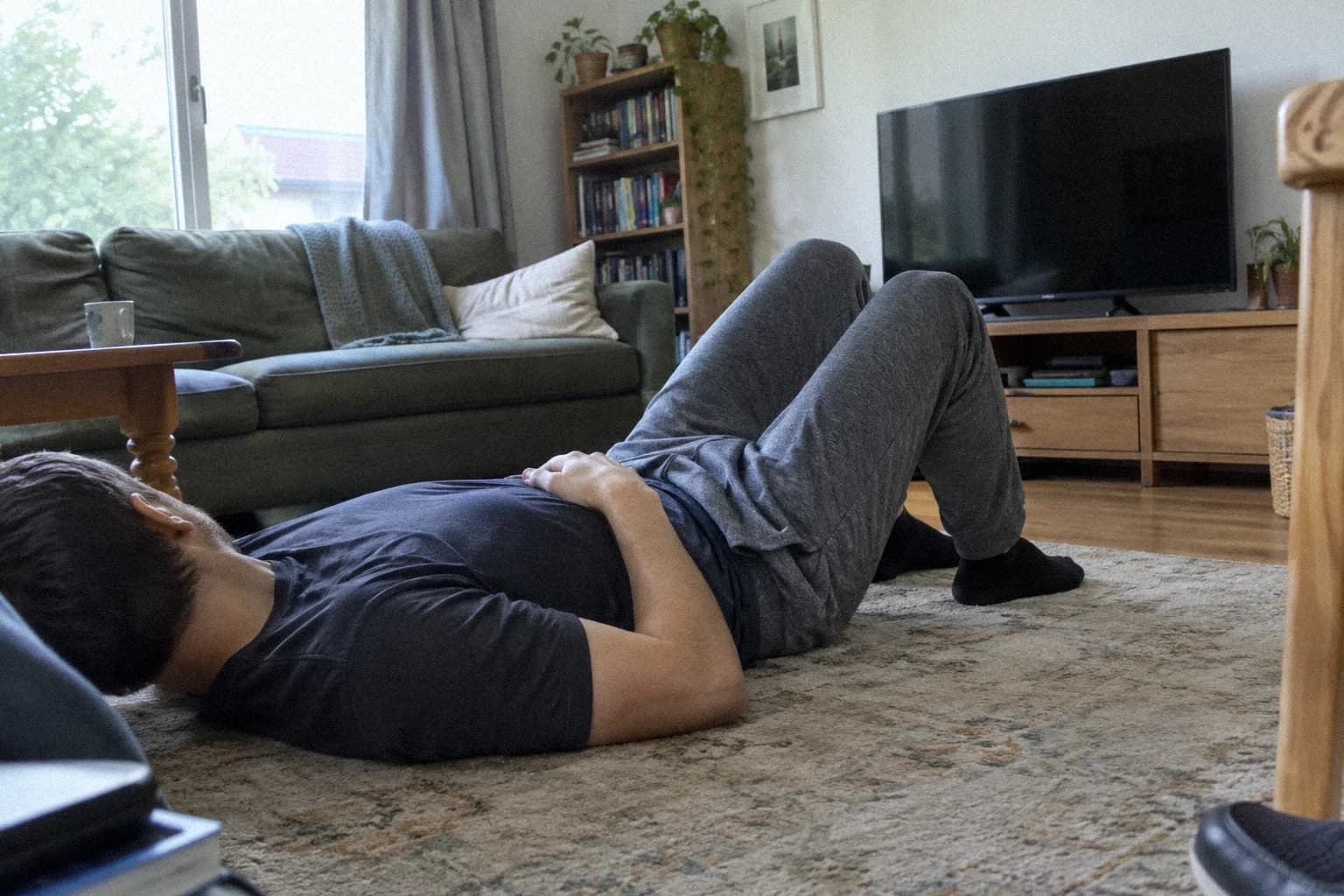
On the floor rather than in bed, if you can: a soft mattress absorbs the very movement you are trying to feel. A rug, a folded towel, the living room floorboards.
Bend your knees and put your feet flat, hip width apart. This tilts the pelvis slightly, the lower back settles down, and the abdominal wall no longer has a lumbar curve to hold. It stops working. You have just solved half the problem by doing nothing.

One hand below the navel, the other on the breastbone. The second hand is not decoration: it will tell you, better than any sensation, whether the upper chest is leading.
And if that position gives you nothing, try your side. Curled up, hand on the flank rather than on the stomach, you can feel the lower ribs widen sideways as you breathe in, and that movement is far harder to fake on purpose. Some people recognise it on the first try after weeks of failing flat on their back.
Step 2: Let the stomach go before you inhale, not during
Here is the move almost no guide names. Before the first inhale, let the stomach drop forward, as though you had nobody left to impress. Not a polite release: a real surrender of the lower abdomen, the kind you allow yourself alone in a closed room.
Only then, breathe in through the nose. Slowly, without trying to fill up. Do not judge this by how far the hand travels. The useful sign is not amplitude, it is which hand moves: the lower one rises, the one on the breastbone stays more or less still. A large movement on both hands at once is the one to watch, because that is the chest joining in.
That is all. If you feel that asymmetry between your two hands, you have the exercise.
If your jaw clenches while you try, it is telling you something: you are forcing. Tension in the upper body comes back quickly as soon as an exercise turns into a performance, and we have gathered what to do about it separately in our exercises to relax your jaw.
Step 3: Let the air out for longer than it came in
Flip the priority. The inhale is the step everybody concentrates on, and it is the less useful of the two: the exhale is what makes the room the next inhale needs.
So let the air leave on its own, mouth barely open, without pushing and without emptying all the way. Aim for roughly twice the length of the inhale, without counting precisely for now. A lengthened exhale slows the heart, and that slowing is one of the routes by which slow breathing acts on the autonomic nervous system.
If the exhale turns into a sigh by itself, let it. That is a release mechanism the body knows better than we do, and it has its own instructions in our article on the physiological sigh (in French). If what you notice is that you sigh constantly rather than deliberately, that is a different question, and we answered it in why do I sigh so much.
Step 4: Five minutes a day, and count in weeks
Five to ten minutes is enough. What matters is not the length of the session but the fact of coming back, because what you are relearning is a motor pattern, not a trick.
The order of magnitude deserves to be stated plainly, because it rarely is. The most cited study on diaphragmatic breathing had its participants practise twenty times across eight weeks before measuring effects on sustained attention, mood and salivary cortisol. Eight weeks, not eight minutes. A later systematic review points the same way on stress reduction, while noting that the quality of the evidence remains limited: useful, and not a medicine.
A fixed slot helps more than good intentions. On the floor in the evening, before going up to bed, works well for a mundane reason: the rug is already there, and you are already slowing down.
Step 5: Move to sitting, then standing, expecting less
After a week or two, try it sitting, back against a wall, pelvis tipped slightly back. The movement will be smaller. That is mechanical and not a regression: the abdominal wall goes back to holding you as soon as the trunk is no longer supported.
So do not wait to find standing the range you have on the floor, you will not find it, and that is fine. In a queue, at the sink, in a corridor before a meeting, aim for three things only: loosen the belt a notch, let the lower stomach go by about a third, lengthen the exhale. Nobody will see anything, much like the other small manoeuvres we have collected for calming down discreetly at work.
Once the move is yours: give it a rhythm
While you are still hunting for the sensation, do not count. Counting adds a task to a hand that does not yet know what it is feeling, and the two instructions get in each other's way. One thing at a time.
Once the movement is settled, though, pace becomes the interesting lever. Around six breaths a minute, the slowing of the breath and the natural oscillations of blood pressure fall into step: this is the resonance zone that coherent breathing protocols aim at explicitly. The detail of the rhythm and its timer is in our guide to coherent breathing in 5-5 (in French).
And if you have already tried that kind of protocol and felt nothing, the pace may not be the problem: it is often the stomach that was never released underneath. We listed the other reasons in why coherent breathing does not work for everyone.
What belly breathing does not fix
An exercise that works deserves to have its edges named.
It is not for the middle of a panic attack, and this is the most common misreading. In those moments the reflex is already to take in a lot of air; asking for a large inhale adds volume to a body that has too much. Dizziness, tingling in the hands or around the mouth, a growing sense of breathlessness: stop the exercise. Those are signs of hyperventilation. Short, nasal breaths with a slow exhale suit that moment better, and the fuller breath is trained later, when nothing is happening.
It does not replace medical advice. Breathlessness at rest or on mild effort, pain on breathing, a cough that lasts, tightness in the chest: those get examined, not retrained on a rug. The feeling of needing more air is a symptom in its own right, and it has causes that no exercise corrects. Poorly controlled asthma is one of them, and it is exactly the case where respiratory good will delays the appointment. The rule of thumb is unglamorous: if your breath worries you when you are not thinking about your breath, that is a question for a clinician, not for a rug.
It is not felt at the same pace by everyone either. After abdominal surgery, during pregnancy, with reflux, letting the stomach go can be uncomfortable or simply impossible in some positions. The side-lying version is then the better starting point, and a physiotherapist's opinion beats stubbornness.
Finally, it does not address the mind, and it is honest to say so: it changes the state of the body, which sometimes makes the mind easier to settle and sometimes does not. On days when thinking runs faster than breathing, working through sensation holds better than working through air, and we wrote about the sensation of weight (in French) for exactly those days.
Frequently asked questions
- How do you do belly breathing as a beginner?
- Lie on your back, knees bent, feet flat, one hand below your navel. Let the stomach go completely slack before you breathe in, then inhale through the nose without trying to fill up. The lower hand should rise by a few millimetres, and that is enough. Then let the air leave on its own, for longer than it came in. Five minutes a day, lying down, for one or two weeks before you try it sitting.
- Why can I not feel my belly move when I breathe?
- Usually because you are pushing it instead of letting it go. Pushing the stomach forward tightens the abdominal wall, which then blocks the diaphragm from descending: the movement you feel comes from muscle, not from breath. Two other common causes: sitting, where the abdominal wall holds the trunk continuously, and tight clothing at the waist. A breathing pattern set over years can also take longer than a few sessions.
- How long should you practise belly breathing each day?
- Five to ten minutes is enough, as long as it is regular. The most cited study on the subject had its participants practise twenty times across eight weeks before measuring effects on attention and salivary cortisol, which gives an honest order of magnitude: this is counted in weeks, not in sessions. A single session still calms you in the moment, and that is already worth something.
- Belly breathing or chest breathing: which one is correct?
- Both exist and both have a job. Breathing high in the chest is normal during effort, while speaking, or whenever the body needs a lot of air quickly. The problem is not the chest, it is the chest all the time, including at rest. The goal is not to suppress one mechanism but to get a second one back, available when there is nothing to run from.
- Can you do belly breathing standing up or at work?
- Yes, but later. Standing and sitting, the abdominal wall takes part in holding the trunk, so a full release is neither possible nor desirable. Aim for a reduced version: loosen your belt a notch, let the lower stomach go by about a third, and lengthen the exhale. The movement will be smaller than on the living room floor, and that is expected.
- Does belly breathing help you sleep?
- Often, yes, for a mechanical reason as much as a mental one: lying down is exactly the position where the stomach releases best, and a longer exhale slows the heart. The available evidence does not allow us to claim it treats established insomnia. If falling asleep is the real question, a counted protocol usually works better than a free exercise.
Sources
- The Effect of Diaphragmatic Breathing on Attention, Negative Affect and Stress in Healthy Adults — Ma X, Yue ZQ, Gong ZQ, et al., 2017
- Effectiveness of diaphragmatic breathing for reducing physiological and psychological stress in adults: a quantitative systematic review — Hopper SI, Murray SL, Ferrara LR, Singleton JK, 2019
- The physiological effects of slow breathing in the healthy human — Russo MA, Santarelli DM, O’Rourke D, 2017
- Dysfunctional breathing: what do we know? — Vidotto LS, Carvalho CRF, Harvey A, Jones M, 2019
- Heart rate variability and slow-paced breathing: when coherence meets resonance — Sevoz-Couche C, Laborde S, 2022