Safe place visualization: building a refuge that holds
What the safe place exercise actually does
The exercise installs a state, not a picture. You hold in mind a place where you know you are safe, you make it precise enough for the body to react, and that physical reaction is the result: shoulders dropping a notch, the jaw letting go, the out-breath lengthening without being asked. The scenery is only the road there.
That settles a stubborn misunderstanding. Plenty of people give up after two attempts, explaining that they see badly, that their beach is pale, that the forest will not stay still. Sharpness of scenery was never the test.
The exercise has a precise origin: the preparation phase of EMDR therapy, where a resource is installed before difficult memories are approached. It has travelled a long way out of it. You will find it in hypnotherapy as the safe place, in antenatal preparation, in compassion-focused therapy under the name calm place, and on the stress management handouts given to hospital staff.
It circulates under three names for the same thing: safe place, calm place, resource place. That variation is not sloppy vocabulary. Clinicians let the person choose the word, because safe can ring hollow, even hostile, for someone who has never felt safe anywhere. When a word jars, you change it before concluding the exercise is useless.
One last point before the protocol itself: the safe place is not escapism, whatever it looks like. You do not leave the room, you do not tell yourself a story, and the aim is not to forget what weighs on you. You give the nervous system a scene to respond to, long enough for the current reaction to come down a notch. What was waiting is still waiting afterwards, with the same difficulty in front of you and slightly less tension to look at it with.
Why a picture calms faster than an argument
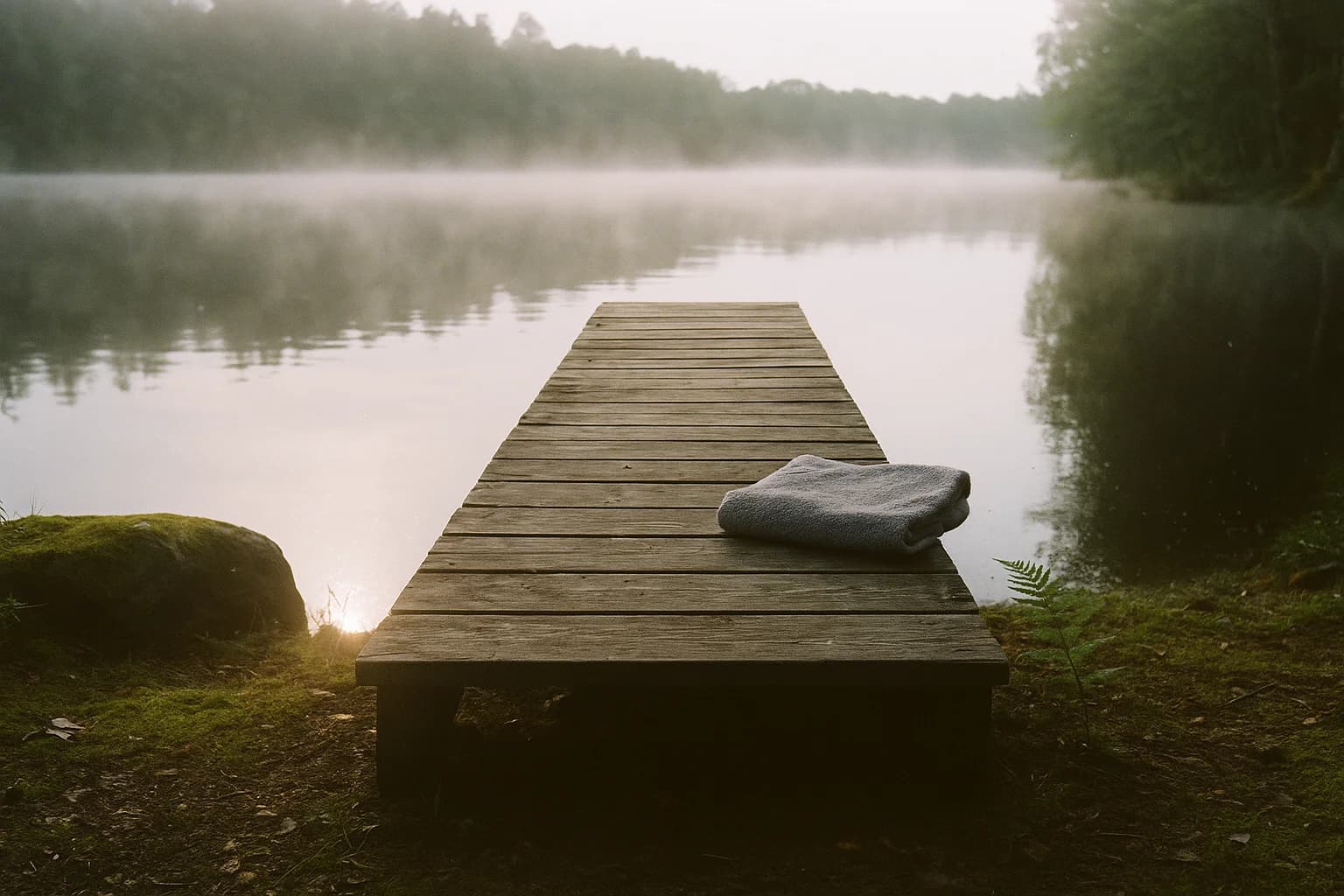
Telling yourself to calm down does almost nothing. Picturing the edge of a lake at six in the morning does something measurable, and the difference is not a matter of willpower.
The review by Emily Holmes and Andrew Mathews, published in 2010 in Clinical Psychology Review, gathers the studies comparing the two formats. Their conclusion holds from one experiment to the next: the same information has a markedly stronger effect on emotion when it is held as an image than when it is put into words. That is what makes intrusive images so punishing in anxiety and post-traumatic stress, and it is the same lever turned to your advantage here.
The mechanism rests on mental imagery recruiting part of the machinery of actual perception. The body does not draw the line as cleanly as we assume: a detailed enough scene triggers the beginnings of what the lived scene would have triggered. Hence the insistence, in every protocol, on all five senses rather than sight alone, which is the natural reflex and the poorest of the five.
How to build your safe place, step by step
The protocol has four steps. Sit down, close your eyes if that is more comfortable, take a few breaths with no particular instruction. Allow five to six minutes the first time.
1. Choose the place, and rule out two categories
A beach, a clearing, a bright room, a mountain path, a grandmother's kitchen, somewhere invented from scratch. The place can be real or imaginary, past or present, it makes no difference: the only test is that it evokes calm and safety.
Two exclusions, though, and they are rarely mentioned in general-audience articles. The relaxation handout given to hospital staff at Besançon University Hospital in spring 2020, during the first wave of Covid, states them plainly: the place must be neither an enclosed space nor somewhere people have died. A closed space can flip into a feeling of confinement as tension rises, and a place of grief brings back exactly what you were trying to step away from.
2. Fill it through all five senses
This is the step everyone rushes. Look around the place until the picture is as precise as you can get it, then leave sight behind: what can you hear, what does it smell of, how warm is the air, what is the skin touching, the wood of a jetty, sand, a blanket.
Precision matters more than beauty. One small, very sharp detail, the flaking paint on a shutter, the clink of a boat chain, anchors better than a postcard panorama. If picturing anything stays hard, this piece on not being able to visualize during meditation takes that problem head-on.
3. Notice where the ease settles
Third question, the most useful and the most often skipped: where in the body does this register? The belly loosening, the back of the neck, the weight of the hands on the thighs. It is that bodily marker, not the image, that will make the place recallable later, including on a day when the mind is too busy to construct anything at all.
4. Add an anchoring gesture
Before you leave the place, tie it to something simple and repeatable: two fingers pressed together, a hand on the breastbone, a pebble kept in a pocket.
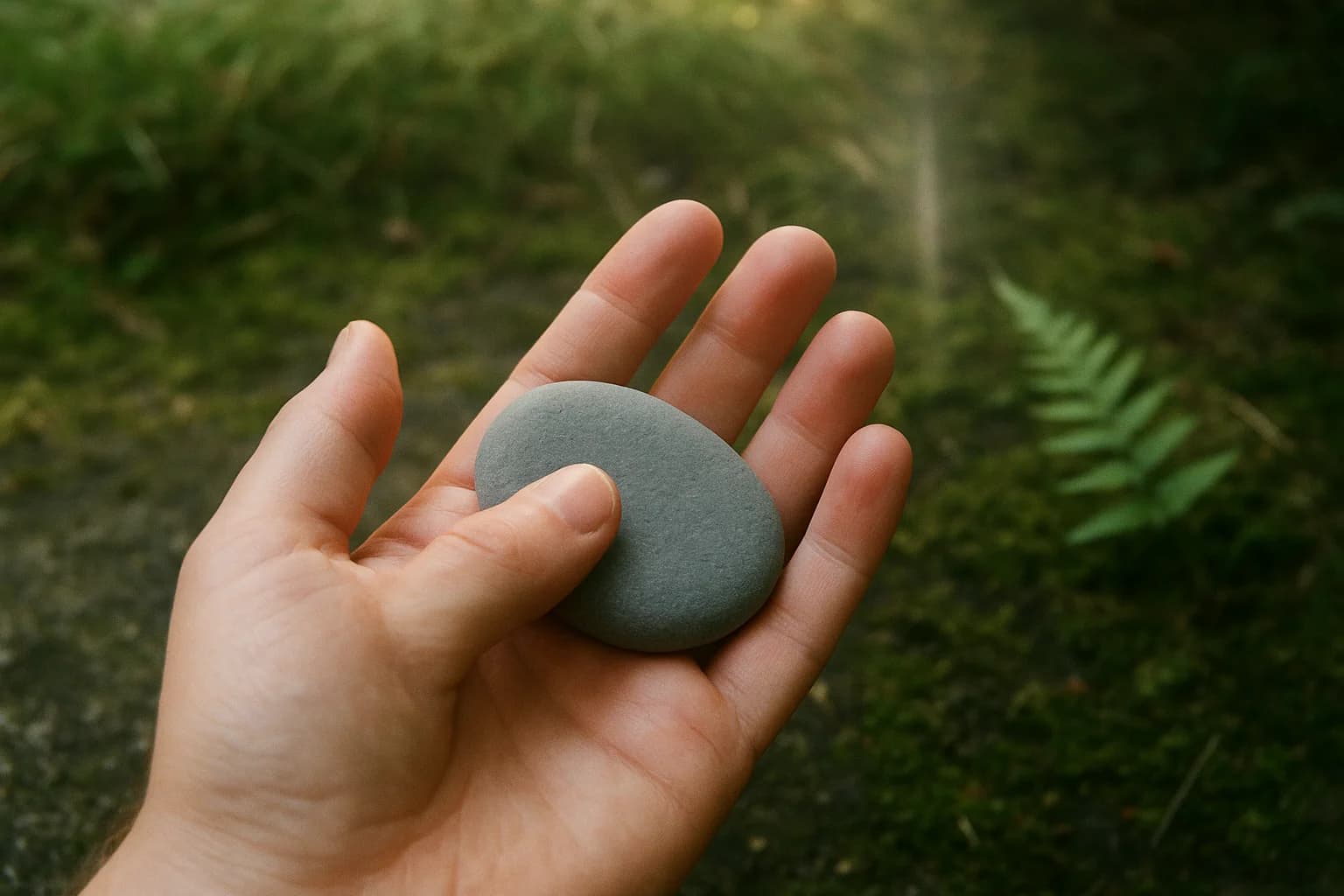
This is the principle of resource installation in EMDR, where the association is strengthened with alternating left-right stimulation. Outside a therapeutic setting, a gesture is enough. The point is practical: in a waiting room or on a train you do not have six minutes with your eyes shut, but you always have your fingers.
Should the place be real or invented?
Both work, and neither is more serious than the other.
A real place starts with an advantage: memory supplies the detail at no cost, the smell of woodland after rain does not have to be manufactured. Its drawback is that it carries its context along too, and a holiday memory can drag in the person you were there with, which is not always welcome.
An invented place asks for more work the first time and often proves sturdier afterwards, because it belongs to nobody else. Some people assemble one from pieces: the light of one spot, the sounds of another. Nothing obliges an inner place to be geographically coherent. For anyone who would rather start from scenery they already know, practising outdoors supplies raw material that imagination then only has to replay.
What the exercise really does, and what it does not replace
The published data on calming imagery is encouraging and fragile, and that order matters. The samples are tiny.
An Indian study by Kumari and Patil, published in 2023 in the Industrial Psychiatry Journal, had patients with generalised anxiety run ten sessions of guided imagery built on nature scenes. Anxiety scores in the treated group fell considerably further than in the control group. The sample was twenty people, ten per group: a signal, not a demonstration. On the EMDR side, the work of Korn and Leeds, published in 2002 in the Journal of Clinical Psychology, also covered a handful of patients and presented itself explicitly as preliminary evidence.
A third result deserves to be known, because it cuts against intuition. In 2020, Matthew Browning's team compared six minutes spent in a real forest, six minutes of the same forest as a 360-degree video, and six minutes facing a blank wall. Positive affect rose among those who were outdoors; it did not move among those watching the simulated forest. Negative affect, for its part, fell in all three conditions, blank wall included: sitting still for six minutes was enough. The forest on video was not the equal of the wall either, since positive affect dropped sharply among those left facing the wall while the video held its own. Reconstituted nature does part of the work, then, not all of it.
The three findings hold together, provided each is given its proper weight. Imagery works, with short protocols and no equipment, which explains why it settled into hospital wards well before large trials stood behind it. And nobody has shown that an imagined scene is worth the lived one.
The practical conclusion is modest and fits in one sentence: a well-installed safe place is a good short-term regulation tool, it does not treat an anxiety disorder, and it is no substitute for going outside for a walk.
When the safe place does not work
Three cases keep coming up, and each calls for a different answer.
The image will not form at all. The prevalence study by Carla Dance, Alberta Ipser and Julia Simner, published in 2022 in Consciousness and Cognition, puts at 3.9 per cent the share of people whose mental imagery is absent or very weak, of whom 0.8 per cent form no image at all. This is aphantasia, described and named seven years earlier by Adam Zeman and colleagues in Cortex, in a series of twenty-one cases. These people are not failing, they are simply not using the right channel. The place can be built from sensations and sounds rather than pictures, or replaced by a tactile anchor, as in this visualization exercise adapted for poor visualizers.
The place gets contaminated. A soothing setting can turn, sometimes months later, because a memory attached itself in the meantime. You do not try to repair it: you pick another one. Protocols insist on a simple check at the end of a session, making sure the person feels well afterwards, and that check applies just as much when practising alone.
The exercise arrives at the wrong moment. In the middle of a panic attack, imagery is generally out of reach and insisting adds failure to distress. The safe place is a tool for prevention and for coming back down, not for the peak. That is also why it is so often practised at night, where it meets the visualizations used to fall asleep (in French).
There is a fourth case, more ordinary and more common than the other three: the place was built once and never revisited. On the day it is needed it does not come, and the method gets written off. Repetition is what makes the difference, and every protocol mentions it without anybody paying attention. A few minutes a day for two weeks is enough to make the scenery familiar; without that, you are asking an image seen once to stand up to a rising wave of anxiety.
One last marker, to close. If the exercise regularly drags up painful memories, images that impose themselves or a feeling of distress, it is touching material that calls for support. In its original setting this is not a wellbeing exercise: it is the preparation for work done with someone.
Frequently asked questions
- How long does it take to install a safe place?
- The first installation takes five to ten minutes, the time needed to choose the place and fill it with detail. Later visits are much shorter, often one or two minutes, because the scenery is already there and you are only returning to it. The relaxation sheet issued by Besançon University Hospital allows five to six minutes for the full exercise. What actually takes time is regularity: expect two to three weeks of daily practice before the image comes back on its own in a tense moment.
- Can you do the safe place exercise on your own?
- Yes for everyday use, as a way to settle before an exam, after a hard day, or at bedtime. That is exactly the form hospital handouts circulate. The answer changes as soon as trauma is involved: in EMDR, the safe place belongs to a preparation phase that precedes work done with a trained clinician, and practising it alone does not replace that work. If difficult memories surface during the exercise, that is the signal to talk to someone rather than push on.
- Does the safe place have to be a real place?
- No. A precise memory, somewhere seen once on holiday, an entirely invented setting or even a place from fiction all work, as long as it evokes calm and safety. The criterion is not whether the place exists but what it triggers. Two categories are best avoided: enclosed spaces, and places tied to the death of someone close, two exclusions the Besançon hospital handout states plainly, because they can turn the exercise against the person doing it.
- What if my safe place turns unpleasant?
- Stop the exercise, open your eyes, and reconnect with the real room: feet on the floor, sounds around you, an object you name quietly. Nothing needs forcing and nothing needs repairing on the spot. A place can get contaminated, for instance because a memory attached itself to it later on, and the answer is to pick another one rather than try to clean that one up. If the image flips often or brings back painful scenes, support helps more than a change of scenery.
- Can you use a safe place during a panic attack?
- At the peak of an attack, mental imagery is usually out of reach: attention is taken up by physical sensations and the picture will not form. Immediate sensory anchors work better at that moment, such as naming five visible things or holding something cold. The safe place belongs before and after: as prevention when you feel the tension climbing, and to come back down once the peak has passed. Building it while calm is precisely what makes it available later.
- Safe place, calm place, resource place: what is the difference?
- They are three names for the same exercise, and the choice of word is not trivial. Clinicians let the person pick the one that fits, because safe can ring false for someone who has never felt safe anywhere, and then produce the opposite of the intended effect. Calm place, quiet spot or resource place say the same thing with less at stake. If a word jars, change it before concluding that the exercise does not work.
Sources
- Mental imagery in emotion and emotional disorders — Holmes & Mathews, Clinical Psychology Review, 2010
- Preliminary evidence of efficacy for EMDR resource development and installation in the stabilization phase of treatment of complex posttraumatic stress disorder — Korn & Leeds, Journal of Clinical Psychology, 2002
- Guided imagery for anxiety disorder: Therapeutic efficacy and changes in quality of life — Kumari & Patil, Industrial Psychiatry Journal, 2023
- Can Simulated Nature Support Mental Health? Comparing Short, Single-Doses of 360-Degree Nature Videos in Virtual Reality With the Outdoors — Browning et al., Frontiers in Psychology, 2020
- Lives without imagery: congenital aphantasia — Zeman, Dewar & Della Sala, Cortex, 2015
- The prevalence of aphantasia (imagery weakness) in the general population — Dance, Ipser & Simner, Consciousness and Cognition, 2022
- Relaxation and stress management handout: the safe place — Besançon University Hospital, 2020