How to unblock the solar plexus chakra: what is actually there
Unblocking the solar plexus chakra, concretely
Nothing unblocks, in the sense of a valve reopening. Where tradition places Manipura, between the navel and the lower sternum, there is a very real nerve crossroads. What feels like a blockage is a contraction: a tight diaphragm, digestion slowed down. Slow, low breathing loosens it within a few minutes.
Less pretty than a wheel spinning again. More useful, though. You can do something about a contracted diaphragm; there is nothing to do about a wheel.
The question deserves better than a shrug. Thousands of people type “blocked solar plexus chakra” into a search bar every month, and they are not after metaphysics: they want to know what to do with the ball that settles under the ribs before a meeting, a phone call, a conversation postponed three times. The sensation is accurate even when the words for it are not.
This article takes the symbolic map seriously, then looks at what sits underneath it.
Where the solar plexus chakra sits, and what is actually there
In the tantric tradition, Manipura is the third centre counting up from the pelvis. It is placed between the navel and the base of the sternum, and it carries will, self-assertion, the capacity to hold your ground. The name translates as “city of jewels”.
Now the anatomy of the same spot.
Just behind the stomach, around the artery feeding the liver, spleen and stomach, sit the celiac ganglia. The reference chapter StatPearls devotes to those ganglia places them at the T12 to L1 spinal level, medial to the adrenal glands and just in front of the crura of the diaphragm. Together they form what anatomists call the celiac plexus, and what everyday language calls the solar plexus. The authors go as far as calling it a “little brain”, because it regulates the digestive tract at an intermediate level, neither fully central nor purely local.
A map drawn more than a thousand years ago, without dissection, puts a centre of confidence exactly where the main nerve relay of the belly runs. There is no miracle in that: the map was drawn from what people felt, and what they felt came from that relay. The symbol does not prove the anatomy, but it aims at the right place.
The same logic drives the five-zone vertical scan (in French), which climbs from pelvis to skull leaning on bodily maps of emotion rather than on traditional colours.
How do you know if your solar plexus chakra is blocked?
The lists in circulation all look alike: low confidence, trouble saying no, a knotted stomach, temperamental digestion, a feeling of being swamped. Then, a few lines further down, the same page adds that the imbalance can also show up as overcontrol, perfectionism, irritability, a need to run everything.
Look at what that produces. Too much drive, not enough drive, and every shade in between. No human experience falls outside the net. A grid that no observation can contradict diagnoses nothing; it merely describes being alive on a weekday.
What can actually be read is the timing of the sensation.
Keeping a note on a phone for three weeks is worth more than any list: every time the area under the sternum tightens, write down the hour and what had just happened. The pattern that usually emerges is unambiguous. Most entries fall within forty minutes of speaking up, sending a delicate email, or making a call that kept being pushed back. A few follow a coffee drunk too fast. A handful stay unexplained.
Such a note says more than any symptom list, because it ties the sensation to specific situations instead of tying it to a permanent state. A stomach that tightens before an interview is not an energy centre out of order. It is a body getting ready, a little too hard, a little too early.
One caveat, and it is not decorative. Stomach pain lasting weeks, waking you at night, coming with heartburn, vomiting or weight loss is not treated by paying attention to your breath. It is shown to a doctor. The celiac plexus is also the junction through which pancreatic and gastric pain travels, which has nothing symbolic about it.
Why the stomach tightens when confidence drops
The neurons leaving the celiac ganglia are postganglionic sympathetic neurons. In plain terms: they carry the alarm order to the viscera. When that order goes through, the StatPearls chapter describes what follows: sphincters contract, stomach and gut motility drops, pancreatic secretion falls, the liver releases glucose.
So the knot is not a figure of speech. It is a fairly literal description of what this network does when the body braces for something: it shuts down digestion, which can wait, and sends fuel elsewhere.
Traffic does not run one way, though. The neurogastroenterologist Emeran Mayer, in a 2011 review that has become a classic, describes the gut-brain axis as a bidirectional system shaping affect, motivation and even intuitive decision making. The gut receives the alarm, and it sends back a reading that weighs on what you decide next.
Hence that familiar impression, for anyone who has ever given up on speaking in a meeting, that the body ruled before you did. The sensation arrives first, the argument justifying it arrives afterwards. English fixed this in its idioms long ago: gut feeling, no stomach for it, a knot in the stomach.
None of which means the sensation is right. A tight belly signals mobilisation, not proven danger. That distinction is the whole subject.
What slow breathing changes, and what it does not
The diaphragm is the muscle separating chest from abdomen, and its crura come down just behind the ganglia discussed above. Breathing low means mechanically mobilising that area with every cycle. Nothing esoteric: the muscle moves, and what sits just in front of it moves along.
The systematic review by Zaccaro and colleagues (2018), which compiled the literature on slow breathing in healthy adults, finds a consistent coupling: below ten cycles per minute, heart rate variability rises, vagal activity takes over, and participants report calm paired with rested alertness. The authors point out that protocols vary enormously between studies, which makes comparisons delicate and rules out announcing a universal dose.
None of that work is about chakras. It is about breath, measured, in volunteers wired to sensors. What it documents is a change in autonomic state, not the reopening of an energy centre. If someone sells you one while citing the other, the citation is borrowed.
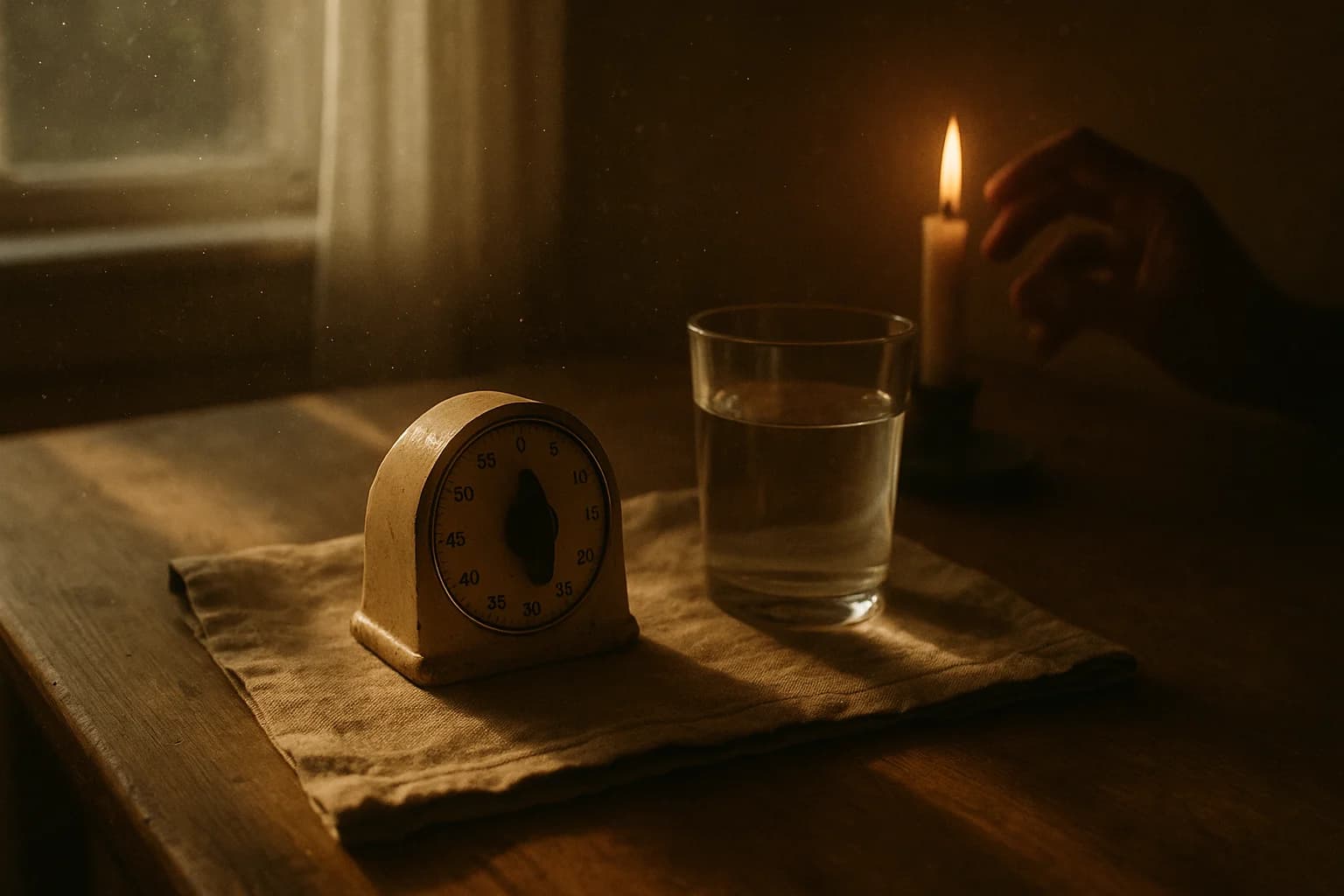
In practice, aiming at six cycles per minute means five seconds in and five seconds out. Cardiac coherence at 5-5 (in French) does nothing else, with a timer on top.
One remark that sometimes lands badly: the effect is real and it is modest. It acts on the state of the moment, not on temperament. Five minutes of slow breath will not make someone able to say no to their manager; they make the body slightly less mobilised while that person says it. Which is already a lot, and it is all.
A six-minute scan, from pelvis to sternum
Order matters. Here is a version stripped of colours and mantras, kept for what it brings: a stable route that stops attention from circling the area that grips. Five stops on the way up, a quick way back down, six minutes in all.
Seated, back free. One hand flat under the sternum if that helps you find the spot.
- The pelvis, forty-five seconds. Weight on the chair, contact points, feet. Question to ask: am I being held, right now? Quality attached: stability.
- The lower belly, forty-five seconds. The area that moves when breathing really goes down. Quality attached: drive, whatever wants to go somewhere.
- The plexus, ninety seconds. Under the sternum, above the navel. You do not try to relax it: you describe what is there, tight, warm, hard or absent, then take three slow breaths and describe it again. Quality attached: assertion.
- The chest, forty-five seconds. The amplitude, ribs spreading sideways as much as forward. Quality attached: openness to others.
- The throat, thirty seconds. Often the last lock before speech. Quality attached: saying things.
- Then back down, the other way around, twice as fast. Ending at the top leaves a lot of people with a buzzing head.
If you feel nothing at one floor, do not go hunting. Absence of sensation is data like any other, and it moves from session to session. Anyone who practises the classic body scan, from feet to head (in French), knows those mute zones that end up speaking after a few weeks.
The hand matters more than you would think. A warm palm on the belly gives the breath a target, and provides tactile feedback that makes the area easier to follow. Same mechanism, applied lower, as a hand placed on the heart (in French).
When this frame gets in the way
For some people, placing attention on the belly does not calm anything: it amplifies.
Martin Paulus and Murray Stein, in a reference review on interoception in anxiety and depression, describe those conditions as altered interoceptive states: internal signals arrive amplified and noisy, and the brain predicts poorly what they announce. The sensation is loud and its meaning stays uncertain. Shining a spotlight on it can, for these people, feed the loop rather than cut it.
The practical cue is simple. If after two minutes of attention on the plexus the sensation has grown and the urge to move becomes pressing, change anchor: hands, feet, the sounds in the room. Grounding does not have to happen where it grips.
The other risk sits in the vocabulary. “My solar plexus chakra is blocked” quickly turns into a self-explanation, then into a verdict: I lack confidence because something in me is out of order. That is exactly the machinery described in the piece on the inner critic and self-deprecation (in French), with an energetic wrapper added.
The map of centres is not dangerous. It becomes cumbersome the day it is used to explain a whole life instead of describing three minutes of sensation.
What remains, once the colours and the stones are taken away: a spot in the body where alarm shows very early, a muscle just above it that answers to breath, and six minutes that make the dreaded conversation slightly less physical. The rest is decoration, and everyone keeps the kind they like.
Frequently asked questions
- What is physically located where the solar plexus chakra is placed?
- A real nerve crossroads: the celiac ganglia, which sit just behind the stomach at the T12 to L1 spinal level, just in front of the crura of the diaphragm. Together they form the celiac plexus, what everyday language calls the solar plexus. Anatomists describe it as a little brain, because it regulates the digestive tract at an intermediate level.
- How do you breathe to release the solar plexus area?
- Slowly and low, aiming at around six cycles per minute: five seconds in, five seconds out. Breathing low mechanically mobilises the diaphragm, whose crura come down just behind the celiac ganglia, so the area moves with every cycle. A few minutes are usually enough to feel the contraction ease.
- How long does it take to feel a difference in the solar plexus?
- Slow, low breathing loosens the area within a few minutes, and the six-minute scan from pelvis to sternum gives it a stable route. Keep expectations honest: the effect is real and modest, acting on the state of the moment rather than on temperament. Five minutes of slow breath make the body slightly less mobilised during a hard conversation, they do not change who you are.
- Are lists of blocked solar plexus chakra symptoms reliable?
- Not really: they cover a thing and its opposite, from lack of drive to overcontrol and perfectionism, so no human experience falls outside the net. A grid that no observation can contradict diagnoses nothing. Tracking when the area tightens, and what happened just before, tells you far more than any symptom list.
- Can focusing on the belly make anxiety worse?
- For some people, yes. In anxiety and depression, internal signals can arrive amplified and noisy, and putting a spotlight on them feeds the loop rather than cutting it. If after two minutes of attention on the plexus the sensation has grown, change anchor: the hands, the feet, or the sounds in the room. Grounding does not have to happen where it grips.
- When should stomach tension be seen by a doctor?
- When the pain lasts for weeks, wakes you at night, or comes with heartburn, vomiting or weight loss. The celiac plexus is also the junction through which pancreatic and gastric pain travels, so persistent symptoms are a medical question, not something to address with breathing or an energy practice.
Sources
- Anatomy, Abdomen and Pelvis: Celiac Ganglia (StatPearls) — Candal, Reddy & Samra, 2023
- Gut feelings: the emerging biology of gut-brain communication — Mayer EA, 2011
- How Breath-Control Can Change Your Life: A Systematic Review on Psycho-Physiological Correlates of Slow Breathing — Zaccaro et al., 2018
- Interoception in anxiety and depression — Paulus & Stein, 2010