Can’t visualize during meditation: why it happens, and what to do instead
What is really happening when no image shows up
When a guided meditation asks you to walk down a staircase, follow a path or open a door and nothing appears, the likeliest cause is not your concentration: your visual imagery is naturally faint, or absent altogether. This capacity varies between people to a degree most of us never suspect, because nobody ever compares the inside of their head with the neighbour’s.
That is where the misunderstanding starts. Everyone assumes “picture a beach” means the same thing for everyone. In a group class, the question almost always arrives at the very end, quietly, in the tone of a confession: someone admits to having “cheated” through visualizations for years by nodding along. They were not cheating. They were doing something else, and that something else worked.
One clarification before going further: none of what follows assumes a diagnosis. There is no clean split between people who visualize and people who do not, but a continuous gradient on which everyone sits somewhere, usually without knowing it.
What follows will not try to make you see. The aim is more useful: understand what the research actually measures, then find the door that opens when the visual one stays shut. If you want the brain side of guided narrative first, our deep dive on what neuroscience says about meditative storytelling (in French) covers that ground.
Mental imagery is a scale, not a switch
The reference instrument dates from 1973. David Marks asks you to call up specific scenes, a relative’s face, a familiar landscape, then rate how clear each one is on five levels. That Vividness of Visual Imagery Questionnaire is still the standard fifty years later, and the spread of answers is genuinely wide: some people describe something close to a photograph, others a vague sense of presence, others nothing.
In 2015, Adam Zeman’s team put a name on the low end of that scale. Aphantasia describes a lasting inability to produce voluntary mental images in people whose vision, memory and reasoning are otherwise intact. Many of them dream in pictures. Many recognise a face perfectly well. They simply cannot summon it as an image on request.
How many people are we talking about? A team at the University of Sussex asked the question across two independent samples of 502 people, one of students and one recruited online. The result: 4.2% and 3.6%, meaning 3.9% across more than a thousand participants, with no difference between men and women. In a room of thirty, that is one or two people for whom “visualize this” is structurally unusable.
And just above that floor sit everyone whose imagery exists but stays pale, unstable, unable to hold for two seconds. They recognise themselves in no label at all. They assume they are distractible.
Why the word “picture” sets you up to fail
A guided meditation script is nearly always written by someone who visualizes well. The vocabulary gives it away: you see, you look, you watch the light on the water. The channel is imposed before the practice even starts.
Yet mental imagery is not only visual. It can be auditory, tactile, olfactory, motor. Someone who cannot see the beach may well hear the surf, feel warm sand under the arch of the foot, register the small imbalance of a step on a slope. Guidance is not really asking for a picture: it is asking for a simulated experience, and the picture is only one of its carriers.
The script adds its own pressure. A voice stating “you now see the light filtering through the leaves” leaves no room for doubt: it describes what is supposed to be happening, in the present tense, as fact. Anyone seeing nothing reasonably concludes they are failing. Phrased differently, “let whatever comes, come, image or not”, the same people get through entire sessions without a shred of that feeling. The practice has not changed, only the implicit promise.
There is an effort trap too. Looking for an image means turning back on yourself to check whether it is there. That checking uses exactly the attention the session is trying to place elsewhere. The harder you push, the less happens, and frustration ends up filling the room.
Can you meditate without visualizing?
Yes, and without losing anything essential. The best documented forms of meditation do not rely on imagery at all: breath attention, body scanning, listening to sound, watching thoughts. Guided imagery is a late and popular subset, not the foundation of the practice.
The confusion probably comes from the market: a session with a story sells better than a ten-word instruction repeated for twelve minutes. The story is pleasant, it occupies, it reassures beginners. It is not compulsory.
If images are your sticking point, there are two roads. The first is to choose practices that ask for none, and there are many: our piece on what actually blocks you when you cannot relax lays out several body-led entries usable without a single mental landscape. The second is to keep the narrative guidance but translate every visual cue into the channel that answers in you. That is what comes next.
One word on the classic exercises first. Safe place protocols and any visualization exercise to relax stay perfectly usable: replace “see the place” with “know that you are there, and find one sensation in it”. The difference looks tiny. In practice it changes everything, because it removes the constant checking.
Four doors that replace the image
These are the substitutions that work best in session, from the most accessible to the most abstract. None of them requires seeing anything.
- Contact sensation. When the voice says “you are sitting by the water”, go and find the real weight of your sit bones on the seat, the temperature of the air on your forearms, the exact spot where fabric touches the back of your neck. The body supplies material that imagination does not have to invent.
- Sound. The guide’s voice is already a legitimate object of attention: its grain, its pace, the silences between sentences. Following the voice rather than what it describes is a complete practice, not a consolation prize.
- Movement and support. “Walk down the staircase” becomes a shift of weight from one foot to the other, a small controlled fall at each step. Plenty of people who produce no visual images describe an intact sense of movement, and this door suits narratives of travel particularly well.
- Knowing without picturing. You can know there is a forest around you, with its proportions, its coolness, its quiet, without seeing a single tree. That abstract knowledge of the place is enough to orient attention and colour the mood. It is the least intuitive channel, and often the most effective after a few attempts.
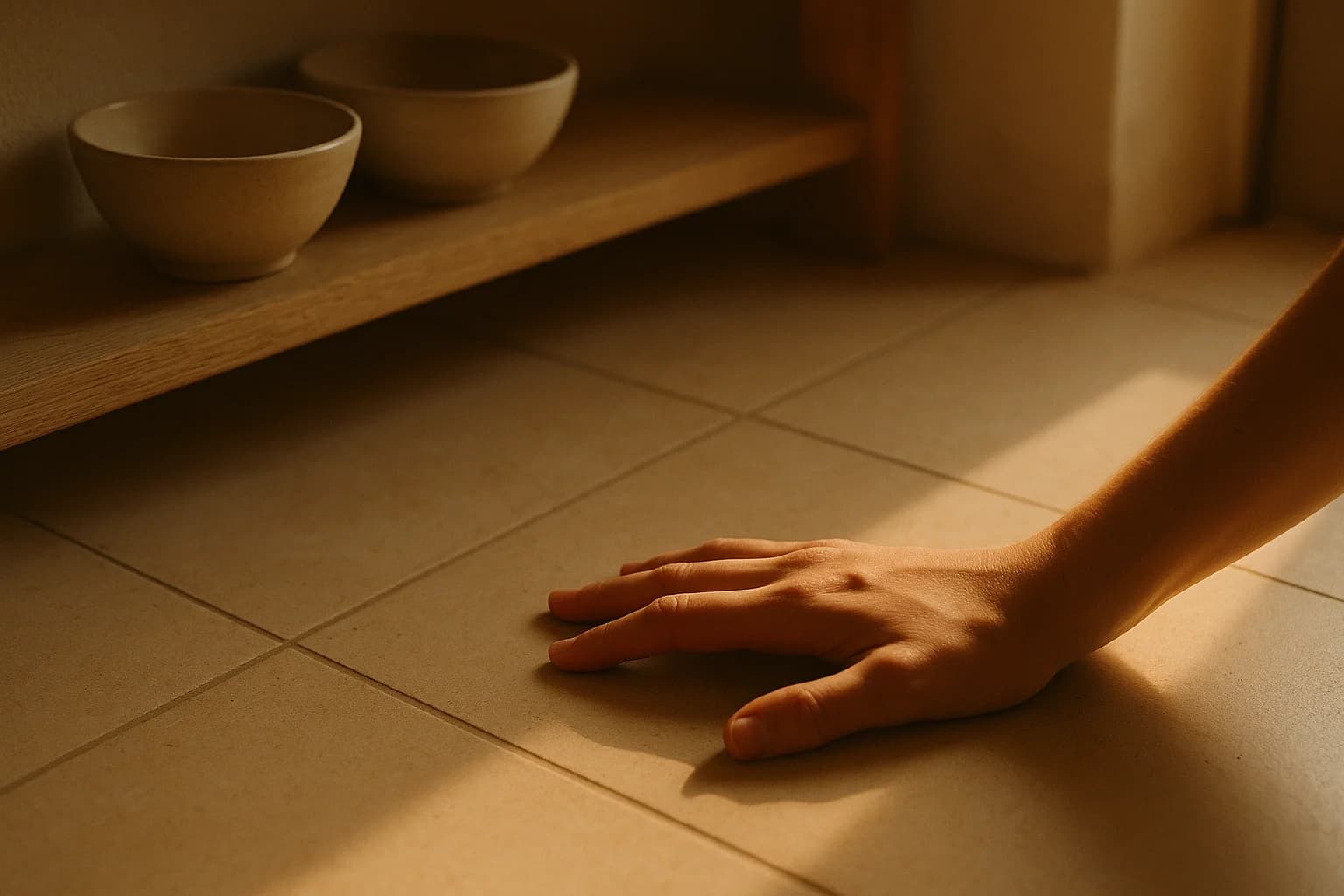
A quick test to find your starting point: put a hand flat on a cold surface, tile, table, window, and hold your attention there for fifteen seconds. If the experience is sharp, your channel is tactile, and that is how to enter any guided session. The mountain meditation (in French) makes a good testing ground, because its central instruction, stability, is felt in the pelvis as much as it is pictured.
One last thing, and it runs against instinct. Many people do better with eyes half open, gaze resting on the floor without fixing on anything. Closing your eyes to summon an image that will not come sets up a face-off with emptiness. A lowered gaze gives real visual support, and attention stops searching.
What the absence of images really changes
There is a difference, and it is measurable. In 2021, a team at the University of New South Wales read frightening stories to participants while recording skin conductance, an index of autonomic arousal. In the general population, the response climbed. In aphantasic participants, it stayed flat. The second half of the experiment is the decisive one: shown frightening photographs, both groups reacted the same way.
The authors’ reading is straightforward: mental imagery amplifies emotion, it does not manufacture it. A text describing a distressing scene moves you only insofar as it is simulated through the senses.
For a meditation practice, that cuts both ways. On one hand, a guided session built on a soothing scene will likely move you less than it moves the person next to you: the amplifying mechanism is missing. On the other, intrusive imagery, the catastrophic loops that run before sleep, reaches you less forcefully too. Several aphantasic people describe an anticipatory anxiety that is markedly less visual and less sticky than what those around them report.
None of this disqualifies guided imagery practices. A systematic review published in 2025 in oncology patients finds a favourable effect of guided imagery on anxiety and quality of life, with the usual caveats of that literature: heterogeneous trials, modest sample sizes, uneven risk of bias. Those results concern specific clinical populations and do not transfer mechanically to an evening session at home.
When to persist, and when to move on
Training your visualization makes sense if your images exist but keep slipping. The protocol that works best is not inventing landscapes: you look at an everyday object for half a minute, a mug, a key, then close your eyes and try to reconstruct its shape and colour. Then you look again to correct yourself. It is dull, and it is the part that improves.
This training does not suit you if you have never seen anything behind your eyelids. In that case the available evidence does not allow us to claim that repeated practice produces vivid imagery, and pushing mostly manufactures a sense of failure where there is only an ordinary variation. Adapt the material rather than the person.
One caution, though. Imagery that has been lost by someone who used to visualize well, particularly alongside recent forgetfulness, trouble finding your way, or a change in mood, is not a meditation matter. It goes to a doctor. Lifelong aphantasia is neither a disorder nor a gap to fill: it is a way of having a mind, and the people who live with it read novels, love faces and remember their holidays like everyone else.
Which leaves tomorrow morning. Take the next guided session you would have given up on, and listen to it having decided in advance to follow nothing but the body’s points of support. You will see, so to speak, that the thread holds without a single image.
Frequently asked questions
- Can you meditate without visualizing at all?
- Yes. Breath awareness, sound, body scanning and attention to points of contact require no mental images whatsoever. These are also the oldest and most heavily researched forms of practice. Imagery-based sessions such as the safe place or the mountain are a subset, not the foundation.
- Can visualization be learned?
- Partly. Many people sharpen and stabilise their images by practising on familiar objects rather than invented landscapes. But the available evidence does not allow us to claim that training turns an aphantasic person into a vivid visualizer. Aim for precision of attention rather than quality of picture.
- How do I know whether I have aphantasia?
- The reference tool in research is Marks’ Vividness of Visual Imagery Questionnaire, where you rate how clear requested images are, for instance a close relative’s face. A floor score suggests aphantasia. It is not a medical diagnosis, and congenital aphantasia is not an illness: it is a variation found in roughly 4% of people.
- Why do I see images falling asleep but not on demand?
- Hypnagogic images are involuntary and do not travel the same route as deliberate imagery. Plenty of aphantasic people report dreaming in pictures while being unable to summon one awake. Forcing it mid-session rarely works: the images come with release, or not at all.
- Is a guided narrative session worth anything if I see nothing?
- Yes, provided you follow something other than the picture. The voice sets a pace, the breathing cues slow you down, and the storyline occupies a mind that would otherwise wander. You lose the emotional amplification imagery provides, not the settling.
Sources
- Lives without imagery: congenital aphantasia — Zeman, Dewar & Della Sala, 2015
- The prevalence of aphantasia (imagery weakness) in the general population — Dance, Ipser & Simner, 2022
- The critical role of mental imagery in human emotion: insights from fear-based imagery and aphantasia — Wicken, Keogh & Pearson, 2021
- The effectiveness of guided imagery on psychological outcomes and quality of life in cancer patients: a systematic review and meta-analysis — Bozkurt-Duman et al., 2025