Feeling drained but not tired: what sleep does not recharge
Why you feel drained but not tired, even after a full night
What is missing, in most cases, is not another hour of sleep: it is a switch-off that never took place. For twenty years, work psychology has separated two things your calendar treats as one: the time spent away from the job, and the fact of having mentally left it. A whole evening on the sofa re-running a meeting counts as rest on a schedule. For your head, it is the working day in extra time.
Sonnentag and Bayer named that gap in 2005: psychological detachment, the act of no longer representing the demands of work to yourself once you have walked away from them. Their finding is counterintuitive: it is having detached, more than the time spent out of the office, that goes with a less exhausted evening.
Which is why the question “am I sleeping enough” misses the target so often. You may well be sleeping enough. You simply never stopped. And if the night itself is what leaves you flat on waking, that is a separate thread, covered in what makes sleep non-restorative.
Recovery is not rest: what the research actually measured
Two years after the detachment study, Sonnentag and Fritz went after a more precise question: what exactly is a restorative evening made of? Their 2007 questionnaire isolates four distinct ingredients, and the important part is that you can have one without the others.
- Detachment: no longer thinking about work. The hardest one, and the most predictive.
- Relaxation: a low-activation bodily state, with no demand to perform.
- Mastery: doing something that asks for a bit of learning, a language, an instrument, a recipe you have ruined twice.
- Control: deciding for yourself what the time is spent on, rather than having it decided for you.
Four ingredients, and an ordinary evening often contains one. Watching a series ticks relaxation, sometimes detachment, rarely mastery, and almost never control once episodes start playing themselves. An obligatory family dinner can tick detachment and nothing else. That explains something everyone has noticed without putting words to it: two evenings of identical length do not give back the same thing the following morning.
It is worth saying what this literature does not establish. In their 2017 review, Sonnentag, Venz and Casper point out that most results in the field rest on self-report measures and follow-ups of a few days, and that causality remains hard to pin down. We know detachment and next-day energy move together. We cannot demonstrate, study after study, which one pulls the other. It is a working basis, not a law.
It does yield a usable instruction all the same. If recovery breaks down, it can be built: you can deliberately add the missing ingredient to your week instead of extending free time that already gives nothing back. In practice that is a small audit rather than a resolution. Look at last week, name the ingredient each evening contained, and you will usually find the same one missing every time. That is precisely the point of end-of-day rituals once the commute has gone and nothing marks the border any more.
What drains you without being counted: switches, not hours
There is a gap almost everyone notices without knowing what to do with it: short, lightly loaded days sometimes leave you flatter than long ones. So duration does not explain everything, and neither does the volume of work. Eight hours on a building site and six hours arbitrating urgent messages do not produce the same fatigue, and it is not a matter of physical strain. It is a matter of what got used.
What costs is the number of times attention has to be reinstalled somewhere else. A morning on a single file is tiring, but it is the tiredness of effort: you know what you did. A morning made of twelve interruptions, three parallel subjects and a message thread skimmed sideways is tiring differently, and it also leaves the unpleasant sense of having produced nothing, which closes the door on feeling you earned your evening.
A second cost goes just as unnoticed: micro-decisions. Answer now or later, chase or wait, rephrase because the tone could land badly. Each one is tiny. There are two hundred of them. Not one is worth remembering, and that is exactly the trouble: you keep no record of the effort, so you do not credit it with the evening’s fatigue. You credit your character, or your age, or the season.
And a third, the quietest of all: the share of the day spent holding an attitude. Staying available while irritated, keeping a neutral voice in a meeting, smiling down the phone. None of it is dishonest, and none of it is free either. That work appears in no report, and it explains why a day “where nothing happened” can drain as much as any other. If that invisible load rings true, it has a territory of its own: lightening your mental load starts with making it visible.
False rest: what fills the time without giving anything back
A Saturday in November, three in the afternoon. You sit down on the edge of the bed because you have had enough, phone face down on the duvet so you will not cave. Twenty minutes later you get up, and nothing has shifted.
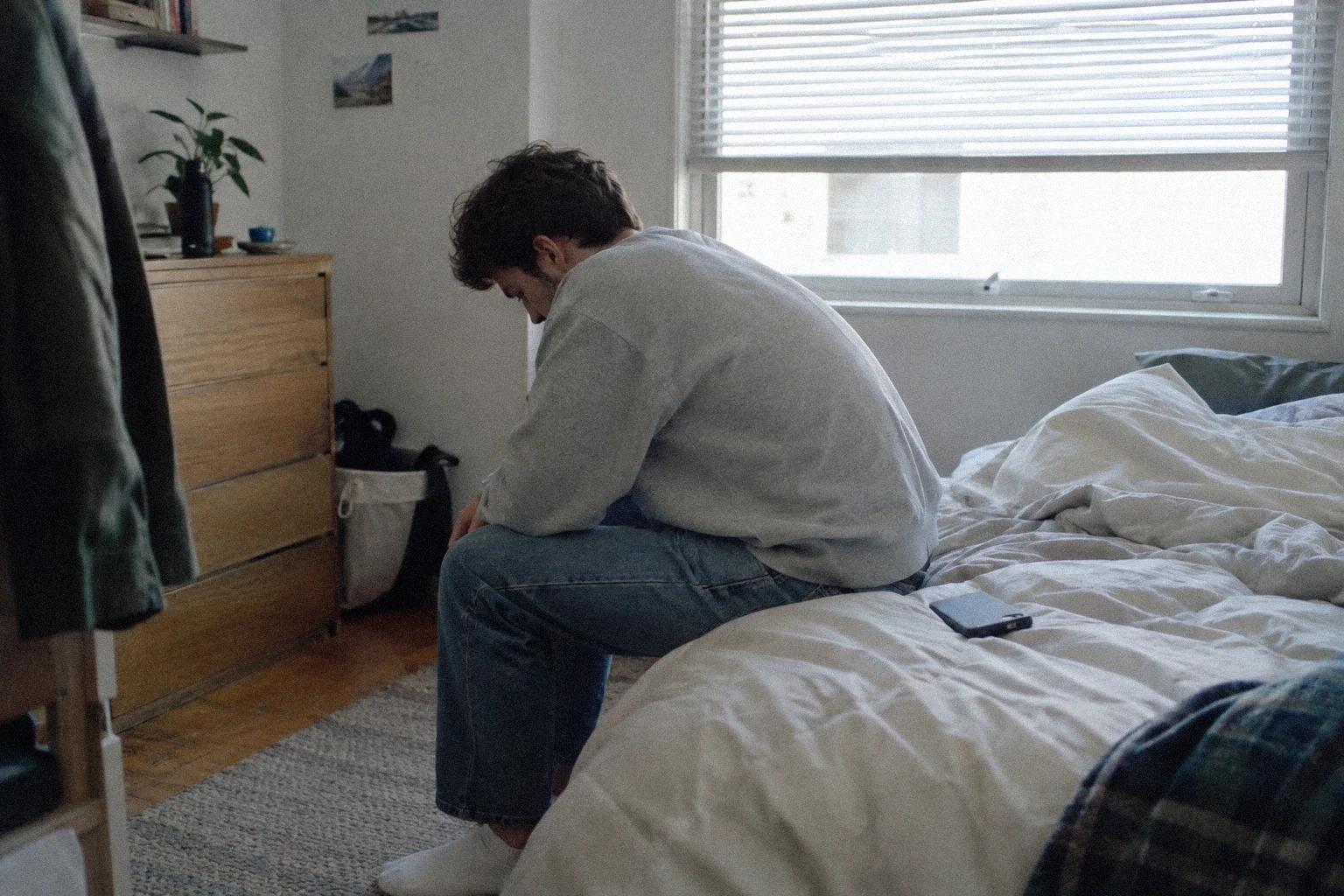
What happened is ordinary. The body stopped, attention did not: it got twenty minutes of silence in which to return to the message you never answered and Thursday’s conversation. Attention left free does not come to rest, it goes back to whatever is unresolved. That is what separates a pause that rests from a pause that chews, and it has nothing to do with the position of your body: resting without sleeping turns on where attention goes, not on posture.
Contrary to what you usually read, the culprit is not “screens”. A screen can hold detachment perfectly well: a film that genuinely grips you does the job, and nobody feels more drained after two hours at the cinema. What does not do the job is the format you can follow with half your mind. It leaves the other half free. And that half already has plans.
How do you get your energy back when you are drained?
By giving attention a job it cannot share with rumination. That is the reasoning, and it explains why the practices that work best here are not the most restful ones but the most occupying.
The simplest version is to follow a sensation of warmth moving down through the body. You start at the crown of the head, let it reach the face, the throat, the shoulders, the arms, the chest, the stomach, the legs, the feet. Ten minutes is enough. The full protocol, with its timings and landmarks, is set out in this ten-minute visualization exercise; what matters here is one of its rules.
The descent runs one way: you never go back up. If attention heads upward again, it has almost always dropped the sensation and picked the thought back up. So the rule doubles as a detector, and that is what makes it workable on an evening when you are drained: you do not have to judge whether you are “meditating properly”, you only have to notice you went back up and resume where you left off.
Two details change a lot. The first: naming the areas in order, silently, rather than sweeping through them in one block. Naming occupies the verbal channel, the very one rumination uses to tell itself its stories; while it is saying “the jaw”, it is not saying “I should have answered differently”. The second: accepting that some areas give you nothing. A shoulder that stays mute is not a failure, it is information, and pushing at it is the surest way to make the exercise exhausting.
And if the image of light strikes you as ridiculous, swap it out. Warm water, sand running down, the weight of a blanket: the function matters, not the scenery. What you want is a marker that moves slowly and in a single direction.
What the descending light does, and what it does not
The state of the evidence has to be stated plainly, because this terrain attracts promises. No study addresses the visualization of light moving through the body specifically, and nothing in the literature supports saying that it “recharges” anything in a physiological sense. What has been studied is the shape it borrows: the attentional tour of the body, area by area.
On that, data exist, and they are modest. The pilot trial by Desdentado and colleagues, published in 2025, split participants recruited online between three one-week practices: a scan turned toward internal sensations, a scan turned toward the body surface, and a meditation on an external object. A one-week pilot exists to check that a protocol holds up and to estimate tendencies. It does not settle anything, and its authors do not claim otherwise.
So the honest frame remains recovery, not energy. The practice does not manufacture a resource: it occupies attention with an instruction precise enough that work no longer fits alongside it, which is the operational definition of detachment. Kaplan described a neighbouring principle in 1995 about natural settings, which hold attention effortlessly and let the faculty you exhaust by concentrating recover. A slow sensation moving down the body works a little like a landscape: interesting enough to hold, undemanding enough not to tire.
Two practical consequences follow. First: no point aiming long. Ten minutes that hold beat thirty that drift, since what counts is the quality of the switch-off rather than its duration. Second: the practice belongs before the evening, not in place of sleep. Its job is to close the day so the hours that follow can finally be used for something else.
Saying this also means saying the limit. If your tiredness comes from a real load that is not going down, no exercise will offset it, and presenting one as a solution would be dishonest. The practice makes the evening recoverable. It does not make the week sustainable.
When it is not a recovery problem
Everything above assumes tiredness that yields, however slowly, to a genuine switch-off. When it does not, pushing harder is the wrong track.
Three signals deserve a medical appointment rather than one more practice: fatigue that settles over several weeks without variation, sleep that no longer repairs despite adequate duration, and other symptoms appearing, breathlessness, pallor, pain, weight gained or lost. Anaemia, a thyroid disorder or sleep apnoea produce exactly this drained feeling, and none of them is corrected mentally. A blood test is cheap.
There is one neighbouring case worth not confusing with this. Feeling drained is running short of fuel; feeling empty is when nothing has any relief to it any more, including what gave you pleasure yesterday. The second state is handled differently, and it is covered in this piece on feeling empty inside. If it lasts, or comes with low mood or dark thoughts, speak to a doctor or a psychologist.
Frequently asked questions
- Why do I feel so drained of energy when I sleep well?
- Because sleeping and switching off are two different operations, and the second one may not have happened. A full night clears a sleep debt; it does not reset a head that kept turning over the day all evening. That is exactly what psychological detachment measures: no longer representing the demands of work to yourself once you have left them. If the tiredness lasts several weeks despite decent sleep, raise it with a doctor, because a deficiency, a thyroid disorder or sleep apnoea produce the same picture.
- How do I get my energy back quickly?
- There is no button. What changes fastest is the quality of the switch-off rather than its length: ten minutes in which attention has a precise instruction often beat an hour on the sofa spent chewing things over. A practice that occupies perception, such as following a sensation of warmth moving down through the body, has a mechanical advantage: it needs the same resource rumination is already using, so the two run together only with difficulty.
- What is the difference between feeling drained and burnout?
- Feeling drained is an ordinary state that rises and falls from week to week. Burnout is a syndrome described by three dimensions that settle in and persist: exhaustion, cynical distance from your work, and a sense of no longer being effective. The most useful clue is not intensity but reversibility: if a weekend, a holiday or a change of pace no longer does anything at all, this is no longer a recovery question and professional advice is warranted.
- Does exercise drain you further or recharge you?
- Both, depending on what you are after. A chosen activity at moderate intensity ticks several recovery ingredients at once: it pulls attention away from work, you decided on it yourself, and it asks for a form of learning. A session that is imposed, timed, and done while thinking about your workload ticks none of them. When tiredness is heavy, aiming for a walk rather than a performance remains the safer bet.
- How long before I feel less drained?
- From a single session, expect something modest and mostly immediate: a slightly less braced body, a slightly quieter head, for an hour or two. What builds over time is the habit of marking a border between the working day and the rest of it, and that is measured in weeks rather than days. If nothing moves after three or four weeks of regular practice, the problem is probably somewhere other than the practice.
Sources
- Switching Off Mentally: Predictors and Consequences of Psychological Detachment From Work During Off-Job Time — Sonnentag & Bayer, 2005
- The Recovery Experience Questionnaire: Development and validation of a measure for assessing recuperation and unwinding from work — Sonnentag & Fritz, 2007
- Advances in recovery research: What have we learned? What should be done next? — Sonnentag, Venz & Casper, 2017
- Exploring Visceral Body Scan, Somatosensory Body Scan, and External Meditation: A Randomized Controlled Pilot Study — Desdentado et al., 2025
- The restorative benefits of nature: Toward an integrative framework — Kaplan, 1995