Non-restorative sleep: the night is not what needs lengthening
Why is my sleep not restorative
Most often, the night was not too short: it was interrupted. Micro-awakenings you never commit to memory cut it into pieces, and a chopped night does not restore the way a continuous one of the same length does. Adding an hour in bed then changes little. Duration is not the problem.
The answer you find everywhere stops one notch too early. It says quality matters more than quantity, which is true, and then never says what sets the quality. You are left with a verdict and no lever: your sleep is poor quality, good luck.
What follows names the mechanism, then the three families of causes in order of their real weight, and ends with the one breathing move that holds up during the day. But we have to start by taking off the table the symptom almost everyone relies on, because it misleads.
A broken night does not restore like a continuous one
This is the central point, and it is an old one.
A review published in Sleep in 2002 by Edward Stepanski puts it plainly: fragmented sleep is less restorative than consolidated sleep, and it leads to sleepiness-related daytime impairment. The sentence reads as banal and is formidable in practice, because it makes your sleep duration almost uninformative. You can have spent eight hours in bed, slept seven hours and forty minutes in total, and had a bad night.
What makes the difference had been tested experimentally well before. Michael Bonnet showed as early as 1986 that next-day sleepiness and performance vary with the frequency and the placement of sleep disruptions, not only with time slept. Two nights of identical length can therefore produce two very different days, depending on how the awakenings are spread out. The counter that decides your day is not the one on your watch.
It should be said straight away what this literature does not allow us to claim. Stepanski devotes a large part of his review to an unresolved problem: we do not yet know how to quantify fragmentation properly. The correlations between standard EEG arousal measures and measures of sleepiness are described as modest and erratic, and he calls for finer methods. In other words: the mechanism is solid, the measuring instrument is not yet. No app, no ring and no connected mattress gives you a fragmentation score today that is worth a laboratory recording.
That said, waking up at night is in no way abnormal. A survey by Maurice Ohayon and colleagues on a representative sample of the American population found that 35.5% of respondents woke at least three nights a week, and that 43% of those had difficulty getting back to sleep afterwards, which is 15.2% of the total sample. A third of the population wakes regularly at night. Half of that third copes without trouble. So it is not the awakening that is the problem, it is what it turns into.
Why am I tired on waking even after eight hours of sleep?
Because the heaviness of waking does not measure the night. It measures the sleep stage your alarm interrupted.
Patricia Tassi and Alain Muzet devoted an entire review in 2000 to what they call sleep inertia: a transitional state of lowered arousal immediately after waking, which temporarily degrades performance. Three of their findings change how you read your own mornings.
The first: this state shows up also after a normal eight-hour sleep period, not only after a nap. So it is not the sign of a failed night.
The second is the most useful. The most critical factor is the sleep stage preceding the awakening: an abrupt waking during slow-wave sleep produces far more inertia than waking in stage 1 or 2, with REM sleep somewhere between the two. Your alarm does not land in the same place every day, and it is the alarm that decides how you look at seven. The authors also note that prior sleep deprivation intensifies inertia, precisely because it increases the amount of slow-wave sleep.
The third concerns duration. Studies report values ranging from one minute to four hours, which is a considerable spread, but Tassi and Muzet specify that in the absence of major sleep deprivation, inertia rarely exceeds thirty minutes.
Hence a better marker than any app. Do not judge your night on waking. Judge it at the end of the morning, then around four in the afternoon. If you are sharp at eleven, your night did its job. If sleepiness catches you every day at the same moment, in a meeting, at the wheel or in front of a screen, then there is something to look for.
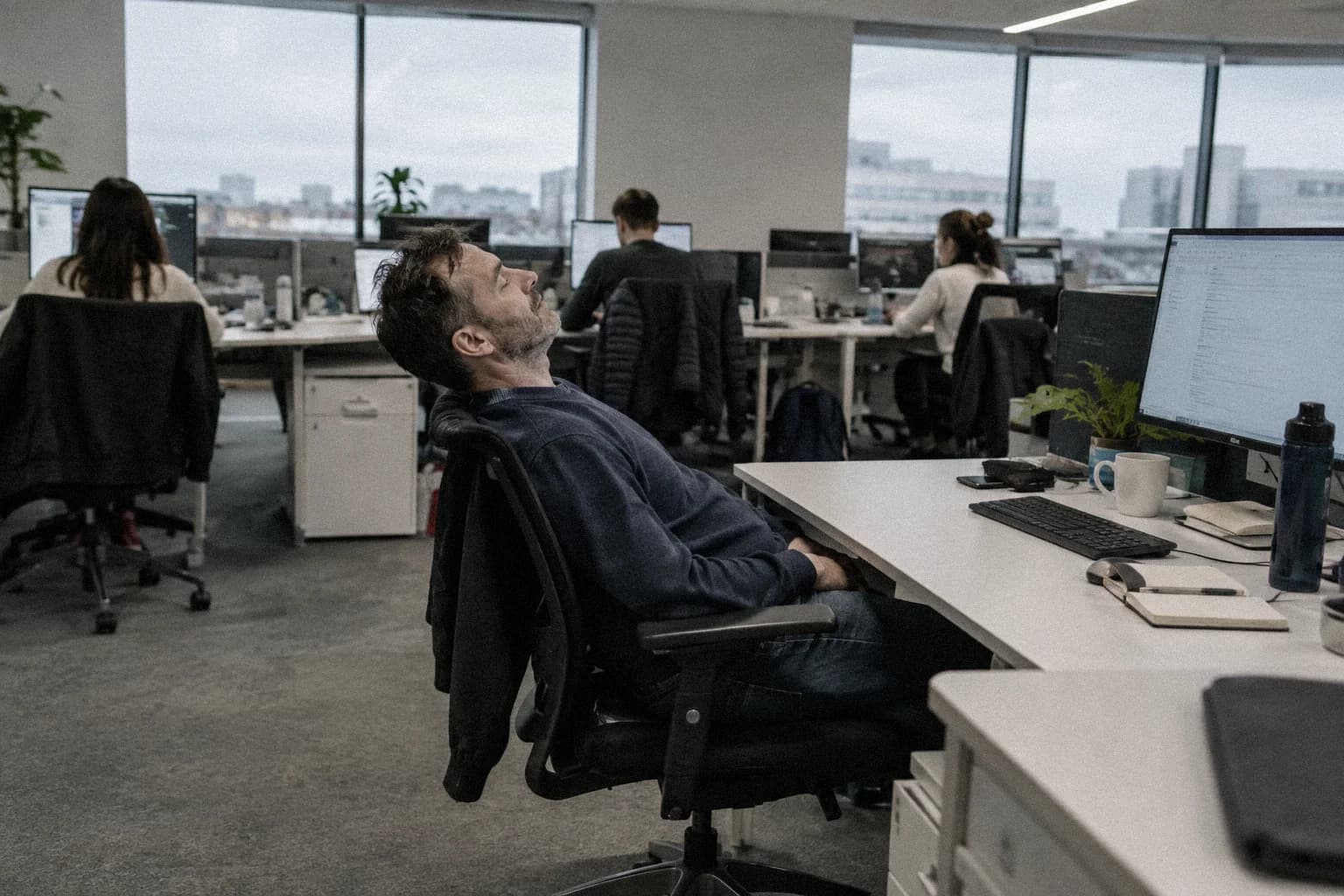
And an unpleasant corollary: many people who describe themselves as having non-restorative sleep in fact have a difficult wake-up and a perfectly decent day. That is not nothing, and it deserves fixing, but it is not fixed in the same place at all.
What breaks up your nights without ever waking you
Three families, in the order you should look at them.
Breathing during the night
This is the most common and the most silent medical cause. Obstructive sleep apnoea causes repeated breathing interruptions, each followed by a micro-arousal you retain no memory of. The night keeps its duration and loses its continuity.
An analysis published in The Lancet Respiratory Medicine in 2019 estimated that 936 million adults aged 30 to 69 had mild to severe obstructive sleep apnoea worldwide, 425 million of them a moderate to severe form, with prevalence above 50% in some countries. Take the figure for what it is: an estimate built from reliable data available for sixteen countries only, and a piece of work funded by ResMed, which manufactures apnoea treatment equipment. The order of magnitude remains useful, and the authors themselves conclude on the need for effective diagnostic strategies, which says enough about how often this cause is missed.
The signs that should send you to a doctor: snoring reported by those around you, observed breathing pauses, waking with a sense of choking or a dry mouth, morning headaches, sleepiness at the wheel. No breathing exercise treats this, and pretending otherwise would be dishonest.
Environment and substances
Less noble, often decisive, and free to test. A bedroom that is too warm generally increases the number of awakenings. Evening alcohol shortens sleep onset and then disorganises the second half of the night. Caffeine has a long half-life that varies between people, and a four o'clock coffee still weighs at midnight for some. Reflux, chronic pain or an animal moving in the bed do the same cutting work.
These factors have one advantage: they can be tested one at a time, over two weeks, without buying anything.
Activation that never comes down
This is the family that concerns us directly, and the most misunderstood. If your nervous system spends the day in high gear, it has no reason to change gear because you turned off the light. Evening is not a switch. That is why the way you close your working day counts more than the half-hour before bed, and why evening rumination (in French) is poorly treated at the moment it shows up.
Soft humming: a move that does not ask you to count
On the activation side, one breathing instruction survives scrutiny: make the exhale last longer than the inhale.
A 2021 study led by Dayoung Bae and colleagues tested exactly this setting, altering the exhalation to inhalation ratio without touching the participants' breathing rate. Twenty-eight adults, sixteen younger and twelve older, breathed at their own rate following a sound cue, either even or with an exhale twice as long. Two markers of cardiac vagal tone, RMSSD and high-frequency variability, were higher in the long-exhale condition, and the high-frequency measure stayed elevated for four minutes after the block ended. Twenty-eight people is few, and the authors keep their wording cautious. The result nonetheless points the same way as what practice has reported for a long time.
There remains a practical problem that numbered protocols ignore. Lengthening your exhale means measuring it, so counting, and counting is an attention task. In the evening, or after a broken night, that is precisely the resource in short supply. Four-count methods work very well in an armchair and very badly when you are wrung out, which explains part of the failures reported with coherent breathing protocols.
Humming solves this mechanically. You cannot hum while breathing in. Producing a continuous sound on the exhale therefore imposes the ratio without you having to count it: the breath lasts as long as the sound lasts. That is the point of the family of exercises bhramari, the bee hum (in French), belongs to, which the yoga tradition places right before rest.
How to do it, concretely
Mouth closed, jaw loose. Breathe in through the nose without trying to fill up, then let the air out while making a very low mmm, barely audible, at whatever pitch costs you least effort. The sound stops when the air stops, and you never force the end of the exhale. Three or four breaths are enough to feel the vibration in the face and upper chest.
Two details change everything. Volume first: if someone in the next room can hear you, it is too loud, and a pressed hum becomes one more effort. Timing second: do it in late afternoon or early evening rather than in bed. The goal is not to fall asleep, it is to avoid arriving in bed in high gear. If you prefer a guided format, an evening meditation or a session of waking rest play the same role on activation.
This practice is not suitable if you have acute sinusitis, an ear infection, or if the vibration triggers dizziness, which happens. In that case, a long exhale without sound does most of the work.
A two-week protocol, because one night proves nothing
Night-to-night variability is such that a one-evening test will teach you nothing. What can be read is a trend over ten to fifteen days.
Note one single thing each day, and not on waking: your energy level around eleven, out of five. Nothing else. No bedtime, no estimated duration, no app score, all of which add noise and one more reason to worry.
Then change one factor at a time, a week each. Week 1: bedroom temperature, down two or three degrees. Week 2: alcohol, cut out or moved to four hours before bed. You can follow with caffeine after two in the afternoon, then with the late-afternoon hum. Anything that moves the average by more than a point counts; the rest is noise.
This method has a flaw worth owning: it is slow, and it will never tell you why something worked. In exchange, it tells you what works for you, which no article can do, this one included.
When this is not the right track
Four situations where the above is not enough, and where persisting wastes time.
- The apnoea signs listed earlier, particularly observed breathing pauses or sleepiness at the wheel. This is diagnosed, and is not settled by lifestyle alone.
- Fatigue accompanied by unusual breathlessness, weight loss, pain or fever. Fatigue is a very unspecific symptom, and sleep is only one of its many causes.
- A loss of drive, pleasure and interest lasting more than two weeks. Depression disorganises sleep, and treating the night without looking at the rest goes nowhere.
- An ongoing medication. Several common drug families alter sleep architecture. That question belongs to your doctor or pharmacist, not to an article.
For everything else, the useful sequence comes in three steps. Stop judging your nights on your first twenty minutes awake. Test one factor at a time, over two weeks, recording your late-morning energy. And give your day a moment where the gear comes down, which is exactly the job of the hum.
Frequently asked questions
- How do I know whether my sleep is restorative or not?
- The useful marker is not the moment you wake but the end of the morning. If you are functional around eleven and the afternoon dip stays moderate, your night did its job, even if getting up was unpleasant. If sleepiness catches you every day in meetings, at the wheel or in front of a screen, that is a signal worth taking seriously. How regularly the sign appears matters more than how strong it feels on any given day.
- Why am I still tired after eight hours of sleep?
- Most often because the alarm landed during slow-wave sleep, which is much harder to come out of than light sleep. That heaviness is sleep inertia, and it is documented even after a full night. It usually clears within thirty minutes. If it lasts two hours every morning, it is no longer inertia and the question changes.
- Does alcohol in the evening cause non-restorative sleep?
- It shortens the time it takes to fall asleep and disorganises the second half of the night, where awakenings become more frequent. That is exactly the profile of a fragmented night: the duration holds, the continuity does not. For many people, a drink taken four hours before bed weighs less than one taken in bed. The most telling test is comparing two weeks, with and without.
- How long does it take to get restorative sleep back?
- It depends entirely on the cause. An environmental factor such as bedroom temperature or noise corrects itself in one night. An evening habit needs two to three weeks before the difference becomes readable. Obstructive sleep apnoea does not resolve on its own and calls for a medical diagnosis.
- Can meditation fix non-restorative sleep?
- It acts on one part of the problem only, the activation that never comes down during the day. That is useful and measurable on markers of vagal tone, but it does not compensate for apnoea, reflux or a bedroom at twenty-three degrees. Treat it as a daytime setting rather than a treatment for the night.
- Should I nap when I sleep badly at night?
- Yes if it stays short, twenty minutes at most, and placed preferably before three in the afternoon. Beyond that you enter slow-wave sleep, which is unpleasant to come out of, and you spend the sleep pressure you will need in the evening. A long nap that leaves you groggy is not a failure of willpower: it is sleep inertia, and setting the duration avoids it.
Sources
- The effect of sleep fragmentation on daytime function — Stepanski, 2002
- Performance and sleepiness as a function of frequency and placement of sleep disruption — Bonnet, 1986
- Sleep inertia — Tassi & Muzet, 2000
- Using difficulty resuming sleep to define nocturnal awakenings — Ohayon, Krystal, Roehrs, Roth & Vitiello, 2010
- Estimation of the global prevalence and burden of obstructive sleep apnoea: a literature-based analysis — Benjafield, Ayas, Eastwood, Heinzer et al., 2019
- Increased exhalation to inhalation ratio during breathing enhances high-frequency heart rate variability in healthy adults — Bae, Matthews, Chen & Mah, 2021