How to unblock your chakras: seven stops in the body
What you unblock, and what lets go
Unblocking your chakras, in practice, means moving up the body from the pelvis to the top of the skull, stopping on seven zones for one to two minutes each, with a slowed breath and attention placed exactly there. Count on eight to fifteen minutes for the full route. No equipment.
That leaves the question the method pages avoid: what actually lets go at each stop?
To our knowledge, no physiological measurement has shown an energy centre at the locations tradition describes. That finding does not make the route useless, and it is exactly what makes the rest interesting. Three mechanisms are documented, and they are enough to explain what people report.
The first is that emotions do have addresses in the body, and those addresses overlap from one person to the next. A 2014 study published in PNAS asked more than seven hundred participants to colour in, on a silhouette, the regions where they felt activation or deactivation for each emotion. The resulting maps are statistically separable from one emotion to another, and reproducible between Finland and Taiwan. Anger climbs into the chest and arms. Sadness empties the limbs. Anxiety gathers in the chest.
Compare those maps with the line of seven centres: they do not overlay, but they land on the same floors of the building. The traditional route is therefore an itinerary that passes through the places where there is something to feel.
The second mechanism is breathing. A 2018 systematic review gathered the available work on slow breathing and finds converging effects on autonomic nervous system activity and on subjective measures of calm. The third is attention itself: the ability to perceive the internal state of the body has been described since 2002 as a sense in its own right, interoception, with its own nerve pathways. It can be trained.
Put differently: energy does not circulate, but attention moves, breath slows, and the muscles attention finds eventually give. If that secular reading of the trip interests you for its own sake, we examined it in detail in the research on the five-zone vertical scan (in French).
Step 1: The pelvis: give your weight back to the floor
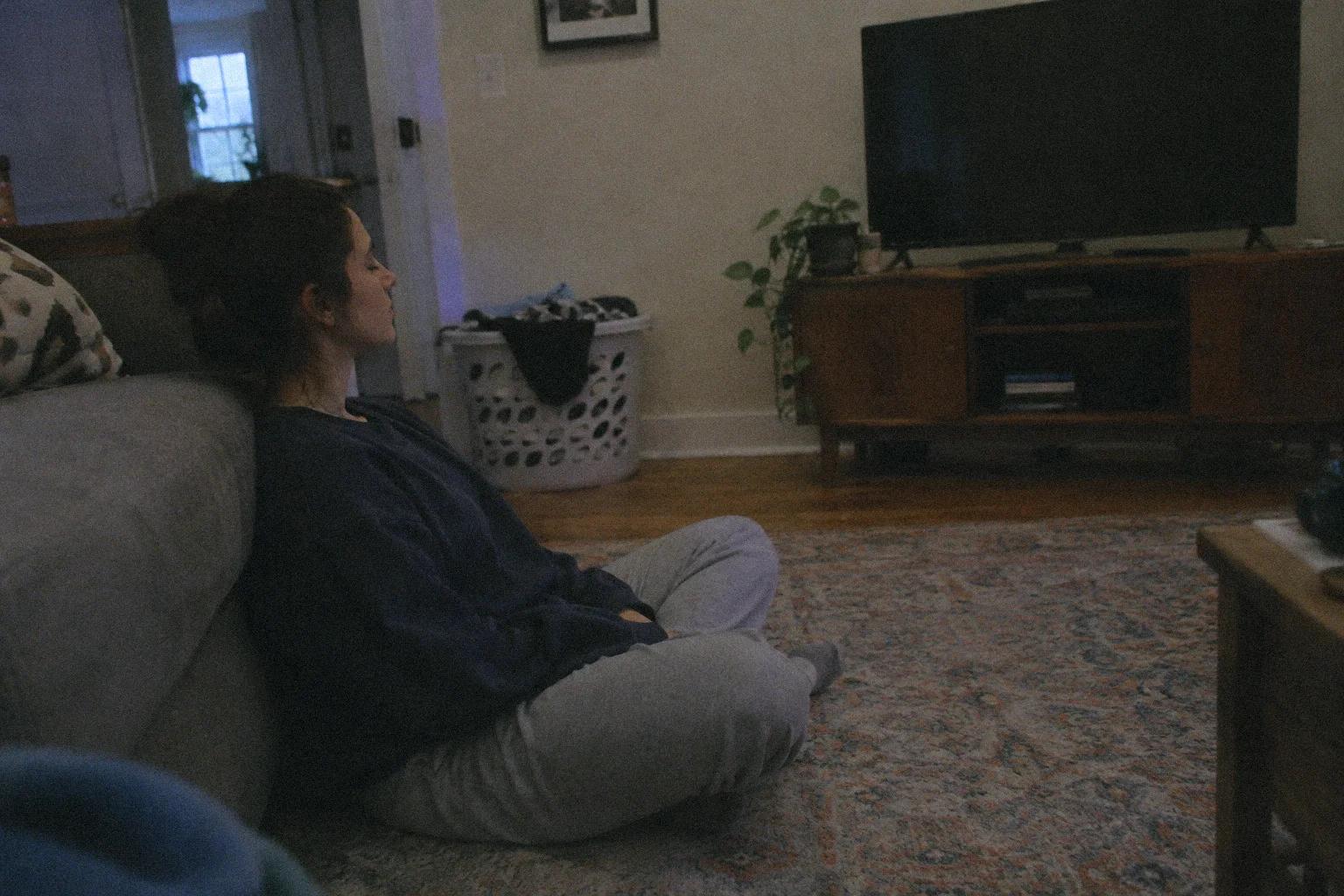
Sit on the floor, on a cushion, or on a chair with both feet flat. Bring attention to everything touching the surface: the sitting bones, the backs of the thighs, the perineum, the heels. Look for nothing except contact and weight.
Then stop holding yourself up. That is the gesture of stop number one, and it is harder than it sounds: most seated people run a constant low-level effort in the glutes and lower back that they are completely unaware of. Let the weight drop until the floor takes all of it.
Two slow breaths here, feeling the pelvis widen on the inhale. Tradition hangs stability on this zone, and the metaphor holds up: you have just given the rest of the route something to rest on. Nothing above will release well while the bottom keeps bracing.
Step 2: The lower belly: let the stomach come out
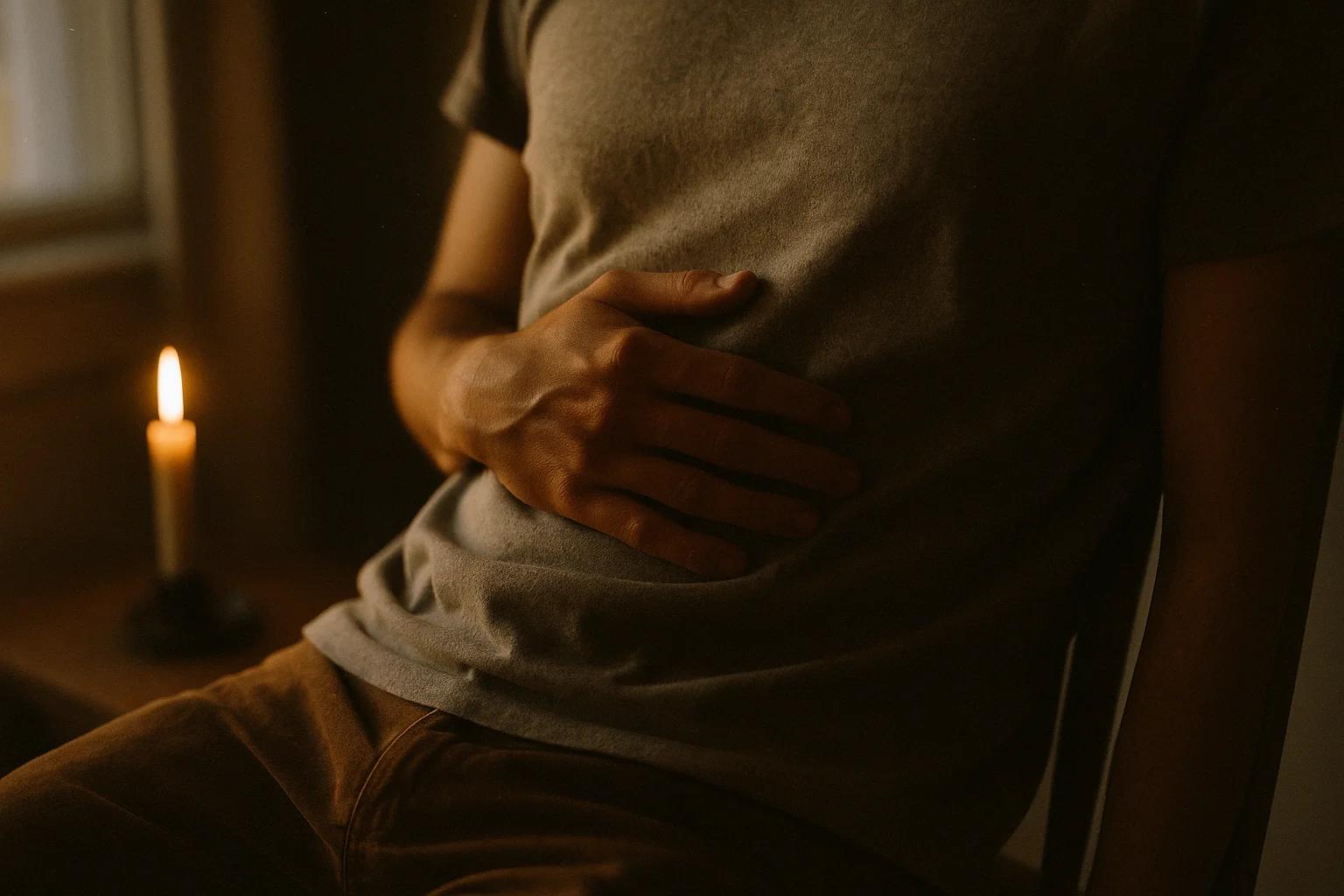
Three or four centimetres below the navel. Put a flat hand there, it is the simplest landmark.
Breathe in and let the hand rise. If it does not move, or if the chest rises instead, you have just found something: the belly is being held in, and it often stays held in all day, from postural habit as much as from tension. Let it come out properly, without elegance.
Four or five breaths here, longer on the way out than on the way in. This is the zone that shuts down in the morning for a lot of people, and we looked closely at that knot in the stomach that is waiting at the alarm. If belly breathing will not come at all, it is worth working on separately.
Step 3: The hollow under the ribs: the stop with an anatomy
Move the hand up a few centimetres, to the soft triangle just under the sternum where the ribs part. This is the most interesting stop on the route, because it is the only one where tradition and anatomy point at nearly the same object.
There is a real nerve network there, the celiac plexus, described in standard anatomical references as the largest of the abdominal autonomic plexuses: it innervates the stomach, the liver, the intestines. The diaphragm passes just above it. When someone says their stomach is in knots, they are describing a place that exists, with nerves in it.
The gesture is the same as lower down, but slower: breathe in trying to widen the ribs sideways rather than pushing the belly forward. Six breaths. The zone does not always release, and that is not a failure.
This is also the centre that wellness pages tie to self-confidence and courage, and by far the most searched of the seven. We gave it a whole article on what is actually under the ribs, including the symptom lists you find everywhere.
Step 4: The middle of the sternum: do not force it open
The centre of the chest, at heart height. The instruction that circulates most for this zone is to open: puff the chest, pull the shoulders back, breathe big. Do the opposite.
Let the shoulders fall forward if that is what they want, and breathe small. A chest that is letting go sinks slightly, it does not spread. Four breaths, without hunting for any particular emotion.
If attention alone will not settle this zone, a hand placed on it changes things surprisingly well, and the gesture is routinely underrated.
Step 5: The throat: the zone you clamp to stay quiet
The hollow between the collarbones, and everything running from there up to the jaw. Swallow once, deliberately, to feel where the work happens.
In tradition, the throat centre carries speech: saying, naming, daring to put something into words. And it happens to be, mechanically, the zone you contract to hold back a sentence or a tear. The swallowing muscles, the base of the tongue and the floor of the mouth tighten together, and the result has a name everyone knows.
The gesture: mouth closed, peel the tongue off the palate and let it drop into the floor of the mouth. Unclench the teeth by two millimetres. A good part of what feels like throat tension actually sits above it, in the jaw and the tongue.
Three breaths, feeling the air pass through a wider channel. If the sensation is a daily one, it has its own page: that lump in the throat and what holds it there. And if saying no is what triggers it, the problem is not in the neck but in what happens right after the refusal.
Step 6: Between the eyebrows: stop looking
The forehead, just above the bridge of the nose. The almost universal mistake at this stop is to stare at the spot, eyes closed, converging the gaze inward. It is tiring, and it contracts precisely what you came to release.
Do the reverse: let the eyeballs grow heavy and settle, as though they were looking downward behind the lids. The forehead releases when the eyes stop working, not when you concentrate on it.
Two breaths, feeling the skin of the forehead spread. The muscles around the eyes tire enormously in front of a screen, and a few targeted exercises do more for this zone than any visualisation.
Step 7: The top of the head: stop steering
Last stop, and the only one with nothing to do. Bring attention to the top of the skull without hunting for sensation: there is almost nothing to feel there, beyond the scalp and sometimes a tingle that comes from the attention itself.

Then drop the instruction. Stop directing anything, keep the eyes closed, and let the six previous zones exist at the same time without visiting any of them. It is the one part of the route that is not executed, and it is often where people feel the most.
One minute is enough, two if the position is comfortable. Then open the eyes slowly and move your fingers before standing up.
The route is done. If you repeat it in bed at night, the same trip exists lying down and aimed at sleep, as a body scan designed to be fallen asleep inside.
What are the symptoms of a blocked chakra?
This is the most asked question on the subject, and it deserves an answer in two parts, because the short version would be dishonest in both directions.
First part: “symptoms of a blocked chakra” is not a medical category, and no list of that kind amounts to a diagnosis. The pages that publish them tie a chakra to an organ, then the organ to a series of complaints, and present the chain as established. It is not. Chronic fatigue, digestive trouble or a lost voice have causes that can be examined, and attributing them to the sacral or the throat means skipping the examination.
Second part, and this is where the lists are not simply wrong: the signs they describe are real signs, often well observed. A belly that no longer breathes, a jaw clenched on waking, a hollow under the ribs that knots before a meeting, shoulders permanently hiked up. These things are felt, sometimes measured, and they do line up with the floors of the route.
What changes is the status you give them. Taken as the cause of a disorder, the blockage sends someone to meditate on their plexus for six months instead of seeing a doctor. Taken as an observation about the state of a zone, right now, it becomes useful: it tells you where to go first during the session.
The three markers we suggest instead of a symptom list, to be noted during the route itself: the zone the breath will not reach, the zone that stays mute when attention lands on it, and the zone that retightens as soon as you move to the next one. Note them mentally, without trying to interpret them, and start again the next day to see whether the reading moves or always comes back to the same floor. These are facts about today’s session, not about your health.
How long it takes, and how often
One to two minutes per stop, so eight to fifteen minutes in total. The long version in circulation, thirty minutes or an hour, does not add anything: past two or three minutes on the same zone, attention drifts and starts manufacturing sensations rather than observing them.
Better short and repeated. The benefit of a scan like this one appears to rest on repetition more than on the length of any one session.
One note on the word unblock, while we are here. It suggests an operation you perform once and that holds. A zone that released during the session can tighten again the very next morning, because what holds it is your posture at work, your sleep or your week. The route gets repeated, it does not conclude. That is a less gratifying promise, and it is what makes it workable.
Do you need stones, essential oils or mantras?
The first pages of results on this query nearly all sell something: a stone per centre, an oil per centre, a sound per centre. The question deserves to be taken seriously rather than waved away.
None is required. The pages that recommend them never separate what comes from the object from what comes from sitting quietly for ten minutes attending to your own body. Until that separation is made, the object has no demonstrated effect of its own.
What remains true, though, is that a support helps some people stay put. A stone in the hand gives a point of contact, a smell marks the start of the session, a sound occupies the commenting mind. Keep them for that reason, which is a good one, and not for an effect on a zone of the body.
Mantras per centre deserve a separate mention, because vocalising does do something real: holding a sustained sound lengthens the exhale and vibrates the ribcage and the throat. The effect exists, but it comes from the mechanics of the breath and not from the syllable chosen.
What this route will not fix
Three situations where you should not count on it. It can even get in the way.
Pain that keeps returning to the same spot week after week is not a blockage to work on in a session. A burning hollow under the ribs, a tight throat that interferes with swallowing, a pulling lower belly: these are ordinary reasons to see a doctor, and the route must not become a way of postponing the appointment.
During a panic attack, tightening attention onto an already gripped chest usually speeds things up rather than calming them. The useful landmarks at that moment are external or peripheral: the feet, the hands, an object in the room. The seven stops are done cold, not at the worst moment.
Finally, if the line of seven centres strikes you as mythology that keeps you out of the practice, do not force it. The same trip works perfectly well calling the zones by their names: pelvis, lower belly, hollow of the ribs, sternum, throat, forehead, top of the head. All you lose is the vocabulary, and you keep the three mechanisms that do the work.
Frequently asked questions
- What are the seven chakras and where are they?
- Bottom to top: the root at the perineum and pelvis, the sacral three or four centimetres below the navel, the solar plexus in the hollow under the ribs, the heart in the middle of the sternum, the throat at the base of the neck, the third eye between the eyebrows, the crown at the top of the head. These are surface landmarks: they tell you where to put your attention, not where an organ sits.
- Can you unblock all 7 chakras in 30 minutes?
- You can do the whole route in thirty minutes, and even in ten. What does not hold up in that promise is the word unblock taken as a one-off operation. A zone that loosens during a session can tighten again the next morning, because what holds it is your posture, your stress or your sleep. The route gets repeated, it does not get finished.
- How do you know which chakra is blocked?
- By doing the route, as it happens. The zones where attention slides off without finding anything, the ones that stay mute, and the ones the breath will not reach are the three signs worth noting. This is an observation about yourself, not a diagnosis: two people with the same throat tension can have it for completely unrelated reasons.
- Do you need stones or essential oils for this?
- No. The pages that recommend them never separate what comes from the object from what comes from sitting quietly for ten minutes. If a smell or an object in your hand helps you stay put, keep it for that reason, which is honest and sufficient. But nothing in the protocol depends on it.
- Should you work bottom to top or the other way round?
- Tradition moves up from the pelvis to the skull, and that is the order described here. Available evidence does not allow us to claim one direction works better than the other. One practical argument still favours bottom to top: starting at the pelvis sets up support before you climb into the zones where people hold the most, the throat and the forehead.
- Does this fit alongside ordinary meditation?
- Yes, and it is one form of it. The route is a guided body scan with seven named stops instead of one continuous sweep. If the traditional landmarks mean nothing to you, you can run exactly the same trip using anatomical names: pelvis, lower belly, hollow of the ribs, sternum, throat, forehead, top of the head.
Sources
- Bodily maps of emotions — Nummenmaa et al., 2014
- Anatomy, Abdomen and Pelvis: Celiac Ganglia (StatPearls) — Candal, Reddy & Samra, 2023
- How Breath-Control Can Change Your Life: A Systematic Review on Psycho-Physiological Correlates of Slow Breathing — Zaccaro et al., 2018
- How do you feel? Interoception: the sense of the physiological condition of the body — Craig AD, 2002