No, Sleep Before Midnight Does Not Count Double
Does sleep before midnight count double?
No, and the mistake is worth a close look: the belief does not get the phenomenon wrong, it gets the variable wrong. There really is a stretch of the night where you recover more, and it really sits at the start. But that start is counted from the moment you fall asleep, not from midnight.
The saying probably crossed the twentieth century attached to working hours. In a society where people got up at 5 or 6 a.m., going to bed at 10 p.m. and going to bed at 1 a.m. genuinely were not equivalent: the second option cut three hours off the night. The advice was sound. Its justification is what got lost on the way, and midnight, plainly visible on a dial, replaced the real marker, which is invisible.
The real marker is your body clock.
Myth: an hour slept at 11 p.m. is worth two slept at 1 a.m.
Taken literally, the claim is testable, and it fails. If it held, a night from 8 p.m. to midnight would amount to eight hours of sleep and should be enough for anyone. Nobody has ever reported that result, and no sleep laboratory works with arithmetic of this kind.
It also runs into an ordinary case: night work. A nurse who sleeps from 9 a.m. to 4 p.m. gets no sleep at all before midnight. Her sleep is on average shorter and more fragmented than a night sleeper’s, precisely because it falls out of phase with her body clock, but it does contain its slow-wave stages, and she does recover from it. The body does not read the clock, it reads its own position in its twenty-four-hour cycle.
What still circulates in this form is therefore a shortcut: good lifestyle advice that borrowed an explanation not its own.
What is true: your first cycles carry the slow-wave sleep
A night is not uniform. It is organised into cycles of roughly 70 to 110 minutes chaining light sleep, slow-wave sleep and REM sleep, and the make-up of those cycles shifts as the night goes on. The Institute of Medicine report on sleep notes that deep slow-wave sleep, stages 3 and 4, occurs mostly during the first third of the night, while REM sleep lengthens across the final third.
That is where the intuition comes from. The first hours of sleep really are the densest in slow waves, and they are the ones that cut most of the sleep pressure built up during the day. A kernel of truth, then.
Except that “the first third of the night” is a relative position. For someone asleep at 10.30 p.m., that third runs until about 1 a.m. For someone asleep at 1 a.m., it runs until 3.30 a.m. In both cases, the amount of slow-wave sleep in the early night does not shrink because midnight has passed: it depends on the sleep pressure built since you last woke, not on where the hands sit. That same mechanism is why a short late-afternoon nap makes falling asleep harder in the evening: it has already spent part of that pressure.
People say you have to be in bed before 11 p.m. to recover
This numbered version of the myth is more recent, and more costly, because it sets a target many people cannot reach. A care worker on shift until 10 p.m., a parent who only gets an hour to themselves once the children are down, someone who is naturally an evening type: none of them will hold 10.45 p.m. for long, and all of them will be told they sleep badly.
The problem is not that the advice is absurd. It is that it mistakes a population average for an individual instruction. The duration recommendations published by the National Sleep Foundation give seven to nine hours for an adult, with an acknowledged margin either side depending on the person. They give no bedtime at all, and for good reason: a useful bedtime is deduced from your wake time and your sleep need, it is not decreed.
Advice you cannot follow does not improve sleep. It just adds monitoring.
What your body clock looks at instead
Your body runs on a roughly twenty-four-hour rhythm, set mainly by light, which raises and lowers core temperature, cortisol and melatonin. Falling asleep happens easily within a fairly narrow window of that rhythm, when alertness drops away. Outside it, falling asleep goes badly.
And that window does not fall at the same hour for everyone. Work by Roenneberg and his team on chronotype shows that, measured on free days, the mid-point of the sleep episode spreads across several hours from person to person, from very early to very late, with a large majority of intermediate types. Two people can share the same eight-hour need and have natural windows two hours apart.
That gap has a common name, social jetlag: the distance between the schedule your body would choose and the one your week imposes. It is what weighs, and it is measured in hours of misalignment, not in distance from midnight. A late type who gets up at 6 a.m. pays for it. A late type who gets up at 9 a.m. pays nothing, even though they have never slept a single hour before midnight. It is also what can feed Sunday night anxiety among people who catch up on sleep at the weekend.
Received wisdom: midnight has passed, the night is lost
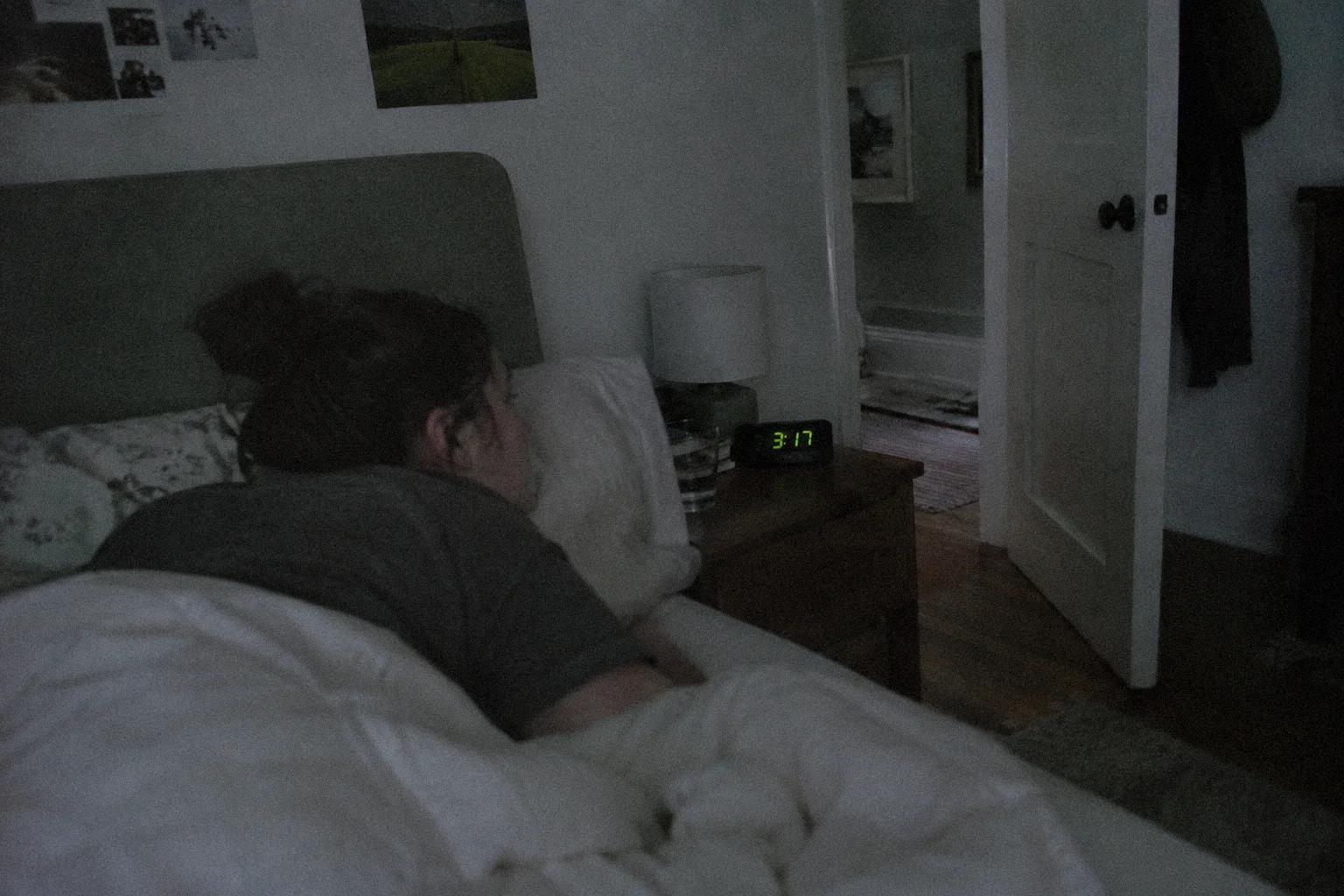
This is the most concrete consequence of the myth, and the only one that turns against the sleep of whoever believes it. It is 12.40 a.m., you cannot drop off, and you add to that the thought of having already missed the useful part of the night. The clock becomes a piece of information to monitor, and every glance at it restarts a calculation.
That calculation is precisely what delays sleep onset. Sleep clinicians call it hyperarousal: a state of physiological and mental activation incompatible with falling asleep, which anything at stake on sleep sustains very effectively. Sleep is one of the few functions that resists deliberate effort. The harder you chase it, the further it moves.
Hence one simple move, far more useful than aiming for midnight: turn the clock around, or take it out of the bedroom. You cannot calculate what you cannot read. It is a standard instruction in behavioural treatments for insomnia, and it is also what makes the rest bearable, whether that means getting back to sleep after waking in the night (in French) or simply waiting without counting. An audio guide helps for a neighbouring reason: it holds attention somewhere other than the hour, which is exactly the point of a meditation for sleep.
What is the best time to go to bed?
You work it out backwards, and the answer is yours alone. Start from the time you have to get up, subtract the sleep you need, then subtract the time it usually takes you to fall asleep. For a 6.30 a.m. wake-up and a seven-and-a-half-hour need, that puts bedtime around 10.45 p.m.
Two notes on that sum. Your real need is not the figure you aim for, it is the one after which you wake without an alarm on holiday, once the debt is paid back. And time to fall asleep counts as it is, not as you would like it: twenty minutes is common and perfectly normal.
If the window you land on falls at an hour when you are still plainly alert, that is a signal, not a failure. Bedtimes move earlier in fifteen-minute steps over several weeks, and above all through morning light, which shifts the clock far more effectively than an evening decision. And if you sleep the hours you need yet still wake up tired, the window is probably not the question: that is the territory of non-restorative sleep.
Regularity weighs more than the hour
This is the most interesting shift of the decade on the question. A cohort study published in SLEEP in 2024, run on close to 61,000 UK Biobank participants tracked with accelerometers, compared two predictors: sleep duration and its regularity from day to day. The authors report that regularity predicts all-cause mortality risk better than duration.
It is an observational study, so it does not establish causation, and irregularity may also be a sign of ill health rather than its cause. But it converges with what chronobiology has long described: a body clock steadies through the repetition of the same cues, and destabilises when those cues move.
In practice, that reorders the priorities. Holding a 12.30 a.m. bedtime every night, Saturday included, does more for your sleep than alternating 10 p.m. on weekdays and 2 a.m. at the weekend. The lever is not the hour, it is the spread between your hours. And the most effective cue is wake time, because that is what exposes your clock to morning light. The rest of the evening factors come next, including the one that pushes bedtime back without anyone deciding to, and which has nothing to do with tiredness: stop scrolling before bed.
What this reading does not fix
Dropping midnight as a marker removes needless pressure. It does not create hours of sleep, and that should be said plainly: if you sleep five hours a night, redistributing them changes nothing. The debt stays a debt.
This reading also does not apply if your hours are not yours. On shift work or night duty, regularity is out of reach by design, and what to do about it belongs to occupational and sleep medicine, not to an article. The same goes if falling asleep regularly takes more than thirty minutes and has done for over three months, or if daytime sleepiness starts to matter at the wheel: those are reasons to see a doctor, and a medical opinion will serve you better than a cycle calculation.
Still, for most ordinary nights, the question “is it too late?” has no object. Your night begins when you fall asleep, and it always begins with its most restorative cycles.
Frequently asked questions
- Do hours of sleep before midnight count double?
- No. The available evidence does not support the claim that an hour slept at 11 p.m. restores twice as much as an hour slept at 1 a.m. The belief comes from a real fact pinned to the wrong variable: the first cycles of your night carry the most slow-wave sleep, whenever that night begins.
- Is sleep before midnight better?
- Not in itself. It can be better for someone whose body clock runs early, because bedtime then falls in step with their own dip in alertness. For an evening type, aiming for 10.30 p.m. means lying down during a window when the body is still wired, and falling asleep usually takes longer.
- What is the best time to go to bed?
- The time that leaves you the sleep you need before a wake time you can hold every day. So you work backwards from the alarm, not forwards from bedtime. For a 7 a.m. wake-up and an eight-hour need, the useful window sits around 10.45 p.m., time to fall asleep included.
- Is going to bed at 2 a.m. bad for you?
- Not if that time is steady and the duration follows. The trouble is 2 a.m. followed by a 6.30 a.m. alarm, or 2 a.m. one night and 10 p.m. the next. The late hour itself matters less than the sleep debt and the irregularity that usually come with it.
- Should you get up at the same time on weekends?
- It is the highest-return habit, and the least comfortable one. Keeping your wake time within about an hour on Saturday and Sunday steadies your body clock for the whole week. Sleeping four hours later on Sunday morning shifts that clock, and Sunday evening shows it.
- Should you count 90-minute cycles to pick a bedtime?
- It is a handy approximation, not a rule. Cycle length varies between people and between cycles in the same night, roughly 70 to 110 minutes. Timing bedtime to the minute on multiples of 90 mostly adds one more reason to watch the clock in bed.
Sources
- Sleep Physiology (Sleep Disorders and Sleep Deprivation) — Institute of Medicine, Committee on Sleep Medicine and Research, 2006
- Sleep regularity is a stronger predictor of mortality risk than sleep duration: A prospective cohort study — Windred, Burns, Lane, Saxena, Rutter, Cain, Phillips, 2024
- Life between Clocks: Daily Temporal Patterns of Human Chronotypes — Roenneberg, Wirz-Justice, Merrow, 2003
- National Sleep Foundation’s sleep time duration recommendations: methodology and results summary — Hirshkowitz et al., 2015