Why can't I nap? Stop aiming for sleep
Why can't I nap
Because a nap is the one exercise in your day whose result cannot be produced by wanting it. You lie down with a clear intention, you allow yourself twenty minutes, and you wait for an onset of sleep that answers to nobody. All you can do is assemble the conditions; the rest either happens or does not.
So the thing getting in the way is usually not sleep. It is the apparatus you build around it.
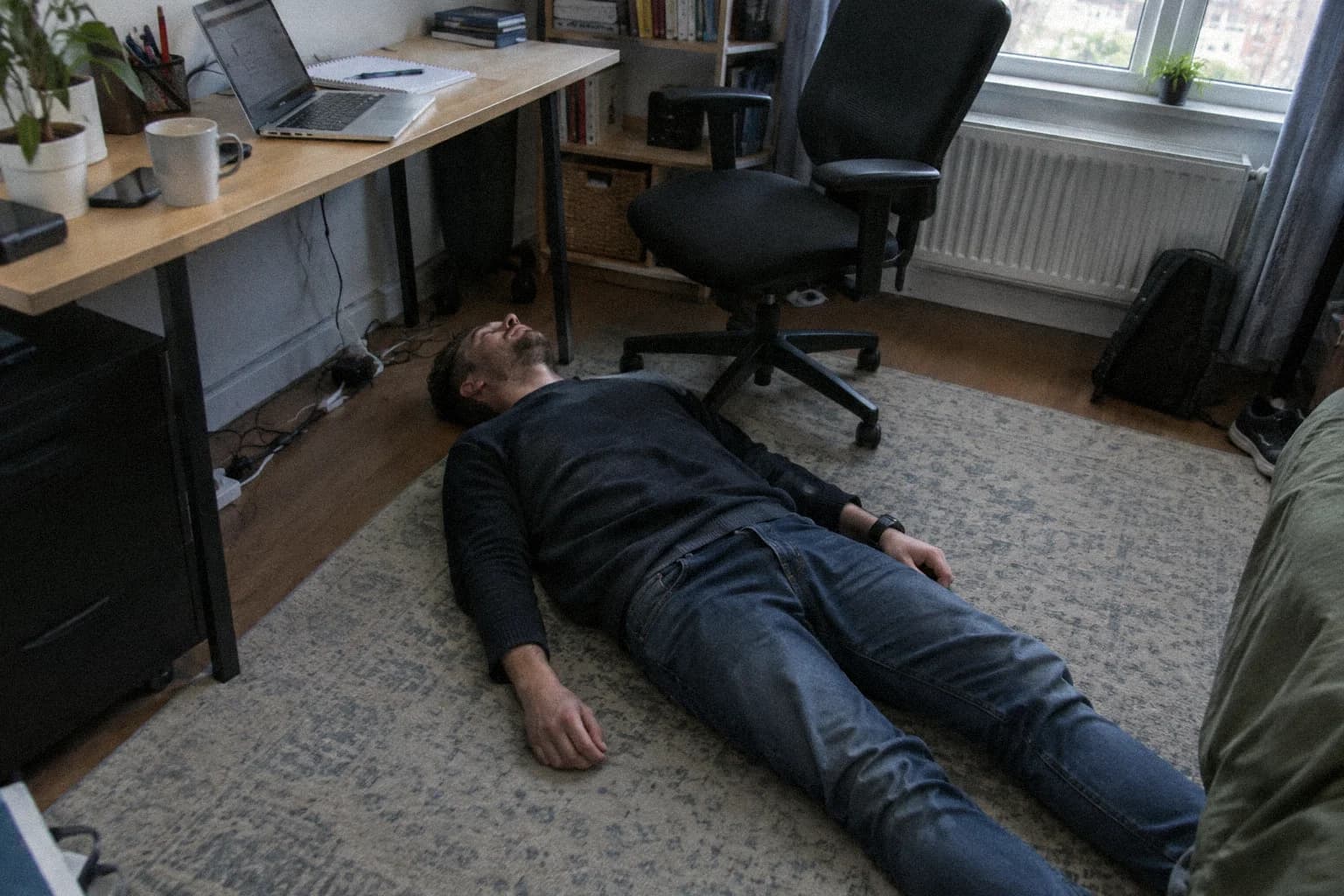
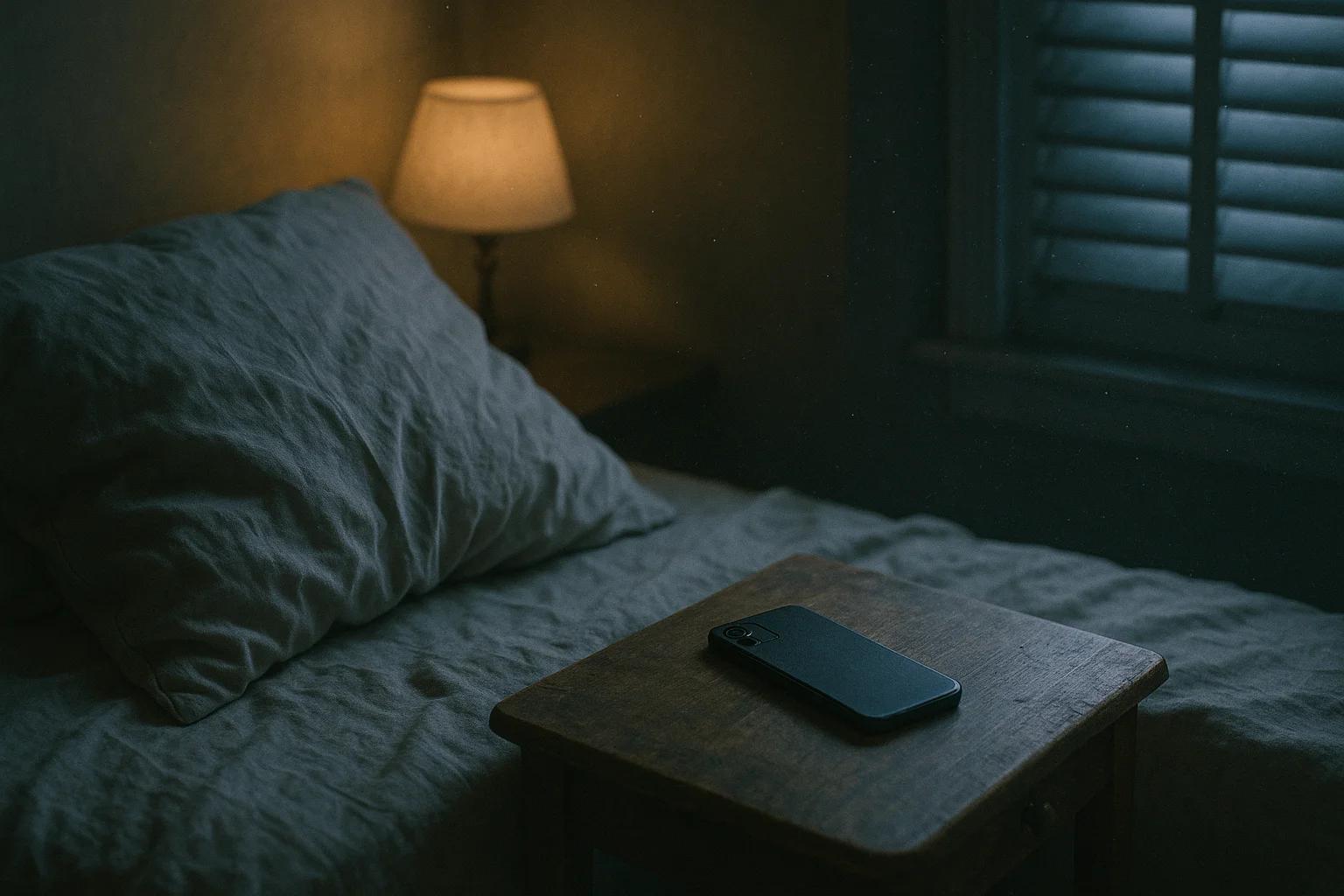
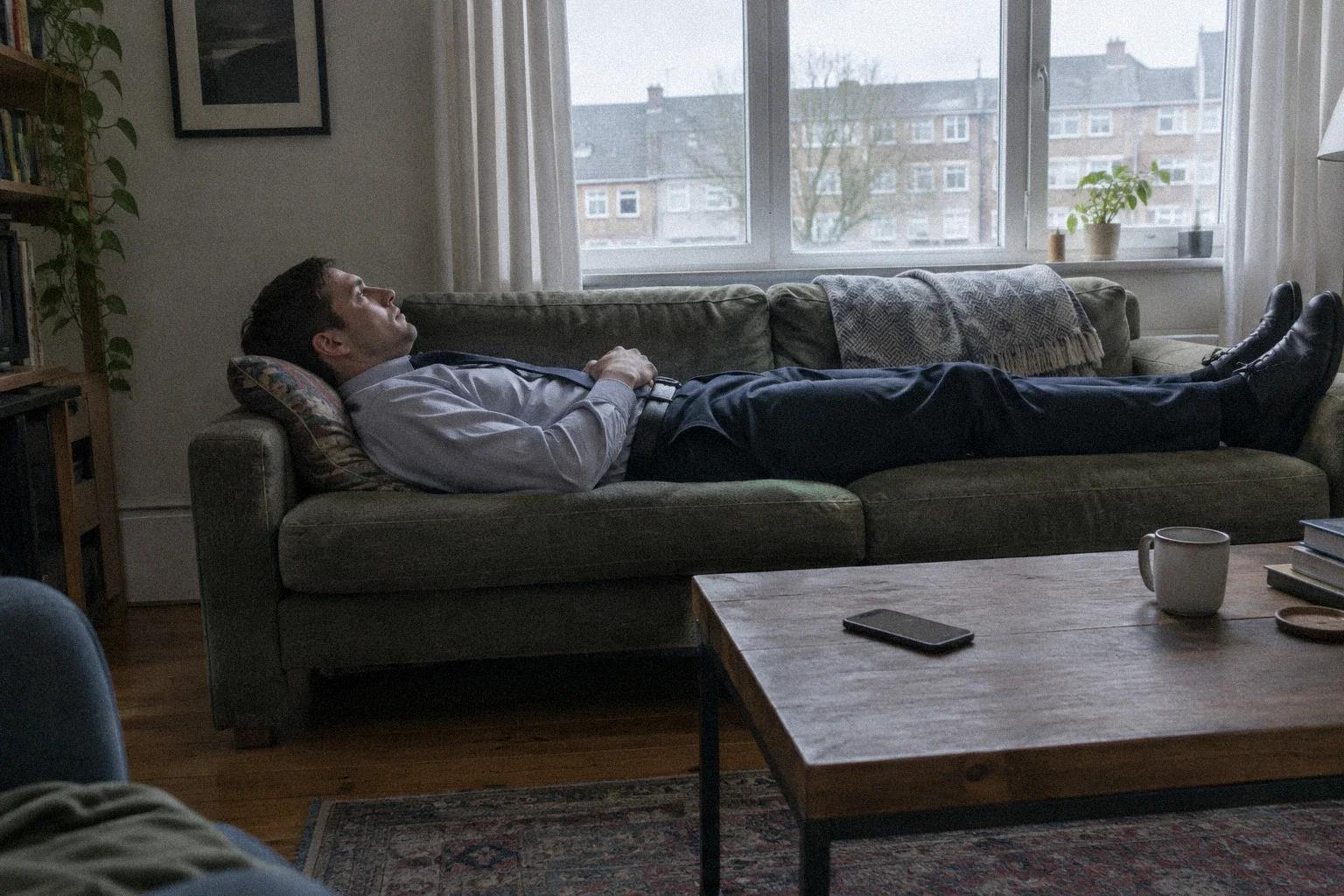
A Saturday in November, 2.10 pm, blinds half down, phone face down on the coffee table with an alarm set for 2.30. The first three minutes go fine. At minute four comes the first monitoring thought: sixteen minutes left. At minute seven: if I drop off now, this still counts. By minute twelve you have given up, and you stand up more irritated than when you lay down.
None of that is a personal failure. It is the logical consequence of setting a goal on an involuntary state inside a timed window. And it is repaired far better by changing the goal than by hunting for the right pillow, position or playlist.
One distinction is worth drawing, because the two get mixed up constantly. Not sleeping during a nap while your nights are fine is the subject of this article. Not sleeping at night either is a different mechanism: if you recognise yourself more in that exhaustion that never turns into sleep in the evening, the article devoted to it will speak to you more directly than this one.
Being tired and being sleepy are two different states
This is the most useful confusion to undo, and it is not wordplay. Sleep research has long separated fatigue from sleepiness, because the two are not measured with the same instruments and do not answer to the same causes.
Fatigue is accumulated load: heavy limbs, concentration that keeps slipping, a shorter fuse. It calls for rest, not necessarily for sleep. Sleepiness is a slope: eyelids drop, your head nods, you lose the thread of a sentence. It calls for sleep, and it alone predicts falling asleep.
A single day can produce an enormous amount of fatigue and almost no sleepiness. That is typical after a decent night, a morning of meetings, two coffees and one unresolved annoyance. The body is worn out and sleep pressure is low. Lying down will not manufacture the second out of the first.
It explains something many people report without quite believing it: you fall asleep on the sofa in front of a film at 9 pm without ever trying, and not at all at 2 pm having decided to. Sleepiness was not there in the afternoon. It was there in the evening.
The practical consequence is simple. Before lying down, it is worth asking which of the two states is actually present. If there is only fatigue, aiming for sleep guarantees disappointment, while aiming for rest cannot fail.
The harder you try to sleep, the less it comes
That sounds like a proverb. It is in fact a research object: sleep scientists built an instrument to measure precisely how much effort someone puts into falling asleep, and found that effort more pronounced in poor sleepers than in good ones.
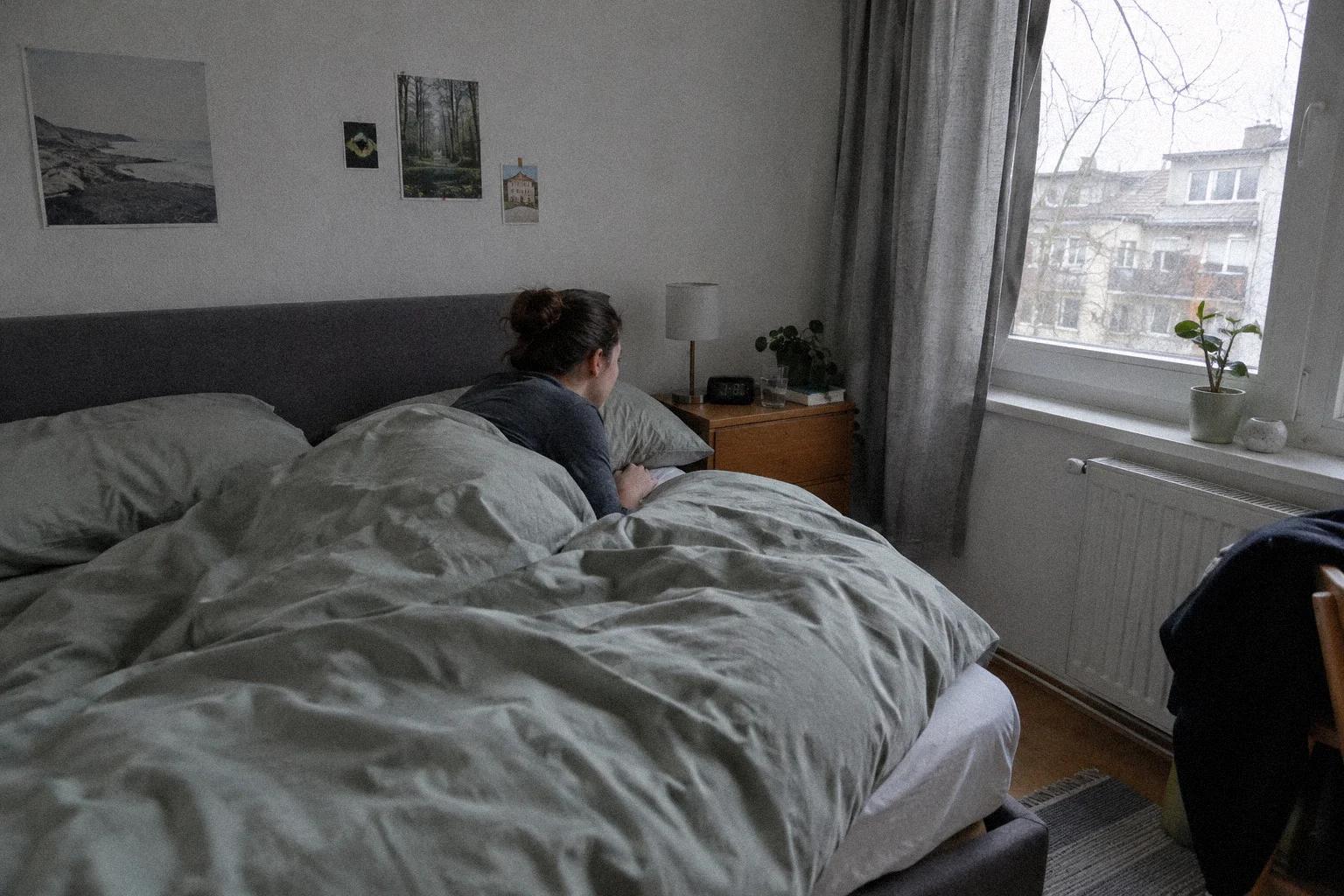
The mechanism needs no technical vocabulary. Falling asleep requires dropping your guard. Trying is guarding. The intention and the means contradict each other, and the higher the stakes climb, the tighter the guard.
A nap concentrates every ingredient of high stakes. A short window, an alarm, and an advertised reward ("twenty minutes and I'm back on form"). You could not design a better machine for preventing the very letting go it is supposed to produce.
Which leads to a correction that sounds backwards and often works: announce in advance that you are not going to sleep. Not as a trick to fool your brain, which is not fooled, but as a genuine change of contract. The instruction becomes "stay lying down for twenty minutes with my eyes closed", and that one you always keep.
Sleep sometimes slips in anyway. That is a bonus, not the measure of success.
A nap is the only part of the day where you judge yourself on an outcome you do not decide.
Does lying down without sleeping really rest you?
Enough to be worth the twenty minutes, as long as you do not expect waking rest to deliver what only a real nap delivers.
Work on napping in healthy adults mostly studies naps that actually happened, and it converges on a short window, around 10 to 20 minutes, beyond which waking up becomes unpleasant. Those findings do not transfer directly to a pause without sleep onset: the available data do not allow us to claim that waking rest produces the same alertness benefits.
What it does produce is tangible and modest. Less visual and auditory input. A breathing rate that slows without being driven. A clean interruption in a day that contains none. We looked more closely at what eyes-closed rest is worth in an article on resting without sleeping, and the short answer is: it is not a discount nap, it is a different thing.
One point deserves stating, because it often relocates the problem: if your nights are long and the fatigue persists anyway, a nap is the wrong lever. What needs looking at is the quality of the sleep itself, and that is a different conversation.
Giving your attention something else to do
Remove the goal of sleeping and you are left with twenty minutes and an attention running on empty. That is where most attempts come apart: deprived of a task, the mind goes back to watching the clock.
The practice that suits this particular moment is not a concentration practice. Too much effort, again. It is a practice of welcome, and an old one consists of addressing something kind to each part of the body, in order, expecting nothing back.
In practice: the forehead, then the eyelids, then the cheeks, the jaw, the throat, the shoulders, the arms, the belly, the legs, the feet. At each stop, one second of attention and a kind of inward nod, the way you would acknowledge someone you recognise. The intention is not to relax the area, but to recognise it as it is, tension included.
That is what separates it from a standard body scan. A scan sets out to observe, sometimes to release. This one sets out to do neither: it notes, gently. When an area stays hard, you do not camp there to win it over. You move on, and you come back next time round if there is a next time round.
Two details change a great deal. Take the route slowly: ten parts of the body can fill ten minutes, and there is no reason to rush. And if you lose your place, pick up at the next area rather than at the beginning, or the forehead becomes the only stop you ever visit.
This is the same approach that helps when relaxing refuses to happen on command, for an identical reason: it asks for no result, so it has no way of failing. Which is precisely what you need at a moment when failure was the problem.
The opposite phenomenon exists too, and it surprises the people who live it: some fall asleep the moment they meditate, including when they would rather not. If that is you, napping is probably not your difficulty.
When not to insist
This approach does not suit everyone, and there are cases where pushing on the nap works against you.
If you sleep badly at night, a late afternoon nap removes sleep pressure at the exact moment you will need it. Sleep specialists advise against it in that situation, or confine it to the early afternoon. Trying to repay a bad night with a late nap tends to maintain the cycle rather than break it.
If your body is not tired, there is nothing to recover. A share of adults never nap, and that indicates nothing in itself: habit counts for a lot, and people who nap regularly fall asleep more easily than those who attempt it once every couple of months.
Finally, some signs fall outside the scope of this article. An irresistible need to sleep during the day, fatigue that no amount of rest touches over several weeks, systematic waking in the middle of the night, snoring with breathing pauses reported by someone else: those are reasons to talk to a doctor, not to adjust a relaxation technique.
For everyone else, the shift fits in one sentence. These twenty minutes are not a test you can fail. They are time given back. What you do with them counts for more than what happens in them.
Frequently asked questions
- Why can't I nap even when I'm exhausted?
- Because fatigue and sleepiness are not the same state, and sleep research has measured them separately since the early 2000s. Fatigue is a load: it builds up and calls for rest. Sleepiness is a slope towards sleep, and it depends on the time of day and how long you have been awake. You can be flattened by fatigue at 2 pm with no sleepiness at all, especially after a decent night or a couple of coffees.
- Does lying down without sleeping actually help?
- Yes, and it is not a consolation prize. Twenty minutes with your eyes closed cuts sensory input, lets your heart rate and breathing slow without being steered, and returns some capacity for the rest of the day. The benefit is not the one a real nap gives, which acts on alertness and memory, but it is not nothing. The only thing to avoid is spending those twenty minutes checking whether it is working.
- How long should a nap be?
- Recommendations converge on 10 to 20 minutes of sleep, and work on nap length in healthy adults points the same way. Beyond that you move into heavier sleep and wake up feeling worse for about fifteen minutes. If you do not fall asleep, the same limit still works as a frame: twenty minutes lying down, then get up, without extending the attempt.
- How do you nap when you're anxious?
- By removing the stakes rather than hunting for the right technique. In people who sleep badly, the harder they work at falling asleep, the further sleep retreats: that effect has been measured, and it is exactly what a timed nap manufactures. Set an alarm so you stop tracking the clock, say quietly to yourself that you may not sleep, and give your attention a gentle task with no goal attached.
- Should you lie down flat to nap?
- Not necessarily, and sitting reclined has one advantage when sleep refuses to come: lying down as if for the night makes the gap between what you expected and what arrives more noticeable. A reclined chair, legs up, daytime clothes still on: the moment stays a daytime pause, and the thought that you did not sleep loses much of its weight.
- Is it a problem if I can never nap?
- No. Plenty of adults never nap and have no need to, and habit matters: regular nappers fall asleep faster than people trying it once in a while. Other situations do deserve medical advice: fatigue that has survived every kind of rest for several weeks, an urge to sleep you cannot resist during the day, or nights that are deteriorating at the same time.
Sources
- Distinguishing sleepiness and fatigue: focus on definition and measurement — Shen, Barbera & Shapiro, 2006
- Towards a valid, reliable measure of sleep effort — Broomfield & Espie, 2005
- Benefits of napping in healthy adults: impact of nap length, time of day, age, and experience with napping — Milner & Cote, 2009